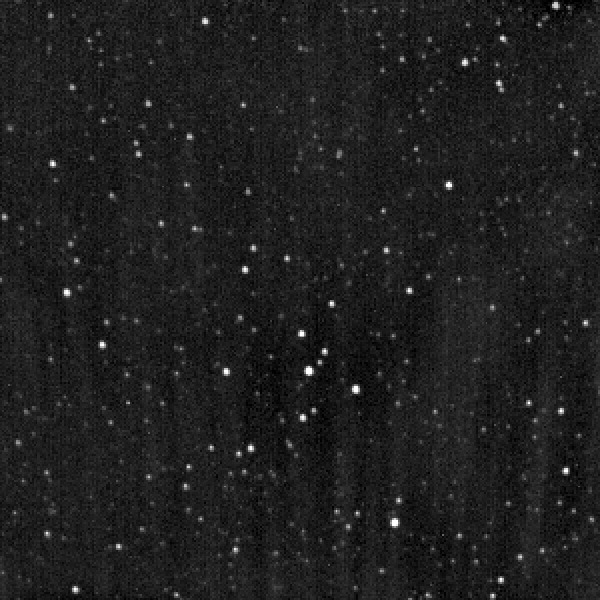
Europa Clipper Captures Uranus With Star Tracker Camera
NASA’s Europa Clipper spacecraft has recently made headlines by capturing a stunning image of Uranus using its star tracker camera on November 5, 2025. This image, taken while the spacecraft was approximately 2 billion miles (3.2 billion kilometers) away from the planet, showcases Uranus as a prominent dot against a backdrop of distant stars. The star tracker cameras, which play a crucial role in maintaining the spacecraft’s orientation, are designed to capture a narrow field of view representing just 0.1% of the sky. This remarkable achievement not only highlights the capabilities of the Europa Clipper but also serves as a fascinating glimpse into the vastness of our solar system.
Launched in October 2024, the Europa Clipper mission is on a path to the Jupiter system, where it is set to arrive in 2030. The primary objective of the mission is to conduct approximately 50 flybys of Europa, one of Jupiter’s icy moons, to investigate its potential for harboring life. Scientists aim to explore the moon’s icy shell, analyze its composition, and characterize its geological features. The insights gained from this exploration could significantly enhance our understanding of habitable worlds beyond Earth. Europa Clipper’s journey and its groundbreaking scientific goals underscore the ongoing quest to uncover the mysteries of our solar system and the potential for life beyond our planet. For more information on this mission and the intriguing world of Europa, visit NASA’s dedicated page [here](https://science.nasa.gov/mission/europa-clipper/).
2 Min Read
Europa Clipper Captures Uranus With Star Tracker Camera
PIA26544
Credits:
NASA/JPL-Caltech
Photojournal Navigation
Science
Photojournal
Europa Clipper Captures Uranus…
Photojournal Home
Photojournal Search
Latest Content
Galleries
Feedback
RSS
About
Downloads
Europa Clipper Captures Uranus With Star Tracker Camera
PNG (128.99 KB)
Description
NASA’s Europa Clipper captured this image of a starfield — and the planet Uranus — on Nov. 5, 2025, while experimenting with one of its two
stellar reference units
. These star-tracking cameras are used for maintaining spacecraft orientation. Within the camera’s field of view — representing 0.1% of the full sky around the spacecraft — Uranus is visible as a larger dot near the left side of the image.
Figure A is an annotated version of the image with Uranus and several background stars labeled.
NASA/JPL-Caltech
Figure B is an animated GIF made of a pair of images taken 10 hours apart. In this version, Uranus can be seen moving very slightly, relative to the background stars.
NASA/JPL-Caltech
At the time the images were taken, Europa Clipper was about 2 billion miles (3.2 billion kilometers) from Uranus. The spacecraft is currently en route to the Jupiter system to study the icy moon Europa.
Europa Clipper launched in October 2024 and will arrive at the Jupiter system in 2030 to conduct about 50 flybys of Europa. The mission’s main science goal is to determine whether there are places below Europa’s surface that could support life. The mission’s three main science objectives are to determine the thickness of the moon’s icy shell and its surface interactions with the ocean below, to investigate its composition, and to characterize its geology. The mission’s detailed exploration of Europa will help scientists better understand the astrobiological potential for habitable worlds beyond our planet.
For more information about Europa and Europa Clipper, go to:
Keep Exploring
Discover More Topics From Photojournal
Photojournal
Search Photojournal
Photojournal’s Latest Content
Feedback


