Renewable energy is cheaper and healthier – so why isn’t it replacing fossil fuels faster?
In recent years, there has been a significant shift in the energy landscape, with renewable sources such as solar and wind power emerging as not only environmentally friendly alternatives to fossil fuels but also more cost-effective options for electricity generation. A decade ago, the construction of coal and natural gas power plants was the norm to meet rising electricity demands. However, as technologies have matured, solar and wind energy have become cheaper than fossil fuels, with renewable energy contributing to a staggering $467 billion in avoided fuel costs globally in 2024. According to the International Renewable Energy Agency, over 90% of new electricity-generating capacity added worldwide in 2024 came from clean energy sources, resulting in renewables accounting for 46% of global installed electric power capacity. This impressive growth reflects a broader trend towards sustainable energy that not only helps combat climate change but also offers substantial health benefits by reducing air pollution associated with fossil fuel combustion.
Despite these advancements, the transition to renewable energy is not without its challenges, particularly in developing countries where energy demands are soaring. The International Energy Agency predicts that emerging economies will account for 85% of the added electricity demand from 2025 to 2027. However, the high cost of financing renewable energy projects remains a significant hurdle. In many developing nations, the upfront costs of solar and wind projects can exceed those of coal or gas due to higher interest rates stemming from perceived investment risks. This situation is compounded by regulatory inertia and political gridlock in places like the United States, where major energy projects can take years to permit. The failure of the 2024 Energy Permitting Reform Act, aimed at expediting project approvals, exemplifies the political challenges that continue to hinder progress.
To unlock the potential of renewable energy in developing countries, international cooperation is essential. Governments and international development banks can play a pivotal role by creating stable energy policies and using public funds to mitigate investment risks, thereby lowering borrowing costs for renewable projects. By fostering an environment where investors feel secure, interest rates can drop significantly, making renewables the more attractive option. Transitioning to renewable energy not only addresses climate change but also promises substantial economic and health benefits, provided that nations can navigate the political landscape and collaborate effectively to finance these vital projects. As the world moves towards a cleaner energy future, the path ahead will require commitment and cooperation to ensure that developing economies do not miss out on the renewable energy revolution.
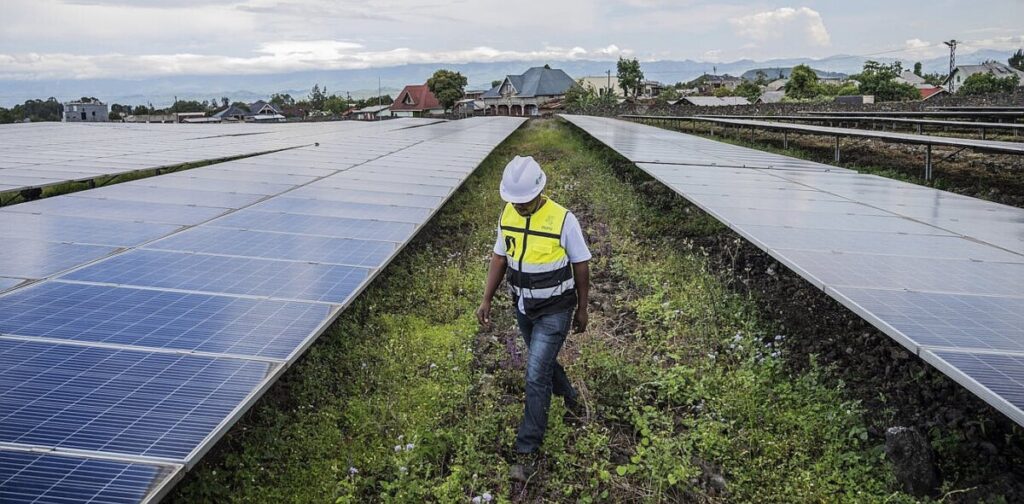
A technician walks through a solar farm in Goma, Congo, in 2025.
AP Photo/Moses Sawasawa
You might not know it from the headlines, but there is some good news about the global fight against climate change.
A decade ago, the cheapest way to meet growing demand for electricity was to build more coal or natural gas power plants. Not anymore. Solar and wind power aren’t just better for the climate; they’re also
less expensive
today than fossil fuels at utility scale, and they’re less harmful to people’s health.
Yet renewable energy projects face headwinds, including in the world’s fast-growing developing countries. I
study energy and climate solutions
and their impact on society, and I see ways to overcome those challenges and expand renewable energy – but it will require international cooperation.
Falling clean energy prices
As their technologies have matured, solar power and wind power have become
cheaper than coal and natural gas
for utility-scale electricity generation in most areas, in large part because the fuel is free. The total global power generation from renewable sources
saved US$467 billion
in avoided fuel costs in 2024 alone.
As a result of falling prices,
over 90%
of all electricity-generating capacity added worldwide in 2024 came from clean energy sources, according to data from the International Renewable Energy Agency.
At the end of 2024, renewable energy accounted for
46% of global installed electric power capacity
, with a record 585 gigawatts of renewable energy capacity added that year —
about three times the total generating capacity in Texas
.
Health benefits of leaving fossil fuels
Beyond affordability,
replacing fossil fuels with renewable energy is healthier
.
Burning coal, oil and natural gas releases tiny particles into the air along with toxic gases; these pollutants can make people sick. A recent study found air pollution from fossil fuels causes an estimated
5 million deaths worldwide
a year, based on 2019 data.
For example, using natural gas to fuel stoves and other appliances
releases benzene
, a
known carcinogen
. The health risks of this exposure in some homes has been found to be
comparable to secondhand tobacco smoke
. Natural gas combustion has also been linked to childhood asthma, with an estimated
12.7% of U.S. childhood asthma cases
attributable to gas stoves, according to one study.
Fossil fuels are also the leading sources of climate-warming greenhouse gases. When
they’re burned
to generate electricity or run factories, vehicles and appliances, they release carbon dioxide and other gases that accumulate in the atmosphere and trap heat near the Earth’s surface. That accumulation has been
raising global temperatures and causing more
heat stress, respiratory illnesses and the spread of disease.
Electrifying buildings, cars and appliances, and powering them with renewable energy, reduces these air pollutants while slowing climate change.
So what’s the problem?
In spite of the demonstrated economic and health benefits of transitioning to renewable energy, regulatory inertia, political gridlock and a lack of investment are holding back renewable energy deployment in much of the world.
In the United States, for example, major energy projects take an average of 4.5 years to permit, and approval of new transmission lines
can take a decade or longer
. A large
majority of planned new power projects in the U.S. use solar power
, and these delays are slowing them down.
The
2024 Energy Permitting Reform Act
introduced by Sens. Joe Manchin, a Democrat from West Virginia, and John Barrasso, a Republican from Wyoming, to speed approvals failed to pass.
Manchin called it
“just another example of politics getting in the way of doing what’s best for the country.”
An even bigger challenge faces developing countries
whose economies are growing fast
.
These countries need to meet soaring energy demand. The International Energy Agency expects emerging economies to account for
85% of added electricity demand
from 2025 through 2027. Yet renewable energy development lags in most of them. The main reason is the high price of financing renewable energy construction.
Most of the cost of a renewable energy project is incurred up front in construction. Savings occur over its lifetime because it has no fuel costs. As a result, the levelized cost of energy (LCOE) for those projects varies depending on the cost of financing to build them. The chart shows what happens when borrowing costs are higher in developed countries. It illustrates the share of financing in each project’s levelized cost of energy in 2024 versus the weighted average cost of capital (WACC). The yellow dots are solar projects; black and gray are offshore and onshore wind.
Adapted from IRENA, 2025
,
CC BY
In many developing countries, wind and solar projects
cost more to finance
than coal or gas. Fossil projects have a longer history, and financial and policy mechanisms have been developed over decades to lower lender risk for those projects. These include government payment guarantees, stable fuel contracts and long-term revenue deals that help guarantee the lender will be repaid.
Both lenders and governments have less experience with renewable energy projects. As a result, these projects often come with weaker government guarantees. This raises the risk to lenders, so they charge higher interest rates, making renewable projects more expensive upfront, even if the projects have
lower lifetime costs
.
To
lower borrowing costs
, governments and international development banks can take steps to make renewable projects a safer bet for investors. For example, they can keep energy policies stable and use public funds or insurance to cover part of the lenders’ investment risk.
China produces the vast majority of solar cells sold worldwide. The Chinese government has also built renewable energy projects in many Latin America countries and other developing regions.
AFP via Getty Images
When investors trust they’ll get paid,
interest rates drop dramatically
and renewable energy becomes the cheaper option.
Without international cooperation to lower finance costs, developing economies could miss out on the renewable-energy revolution and lock in decades of growing greenhouse gas emissions from fossil fuels, making climate change worse.
The path ahead
To avoid the worst
effects of climate change
, countries have agreed to
cut their greenhouse gas emissions
over the next few decades.
Achieving this goal won’t be easy, but it is significantly less difficult now that renewable energy is more affordable over the long run than fossil fuels.
Switching the world’s power supply to renewable energy and electrifying buildings and local transportation would cut about half of today’s greenhouse-gas emissions. The other half comes from sectors where it is harder to cut emissions — steel, cement and chemical production, aviation and shipping, and agriculture and land use. Solutions are being developed but
need time to mature
. Good governance, political support and accessible finance will be critical for these sectors as well.
The transition to renewable energy offers big
economic and health benefits
alongside lower climate risks — if countries can overcome political obstacles at home and cooperate to expand financing for developing economies.
Jay Gulledge is affiliated with PSE Healthy Energy


