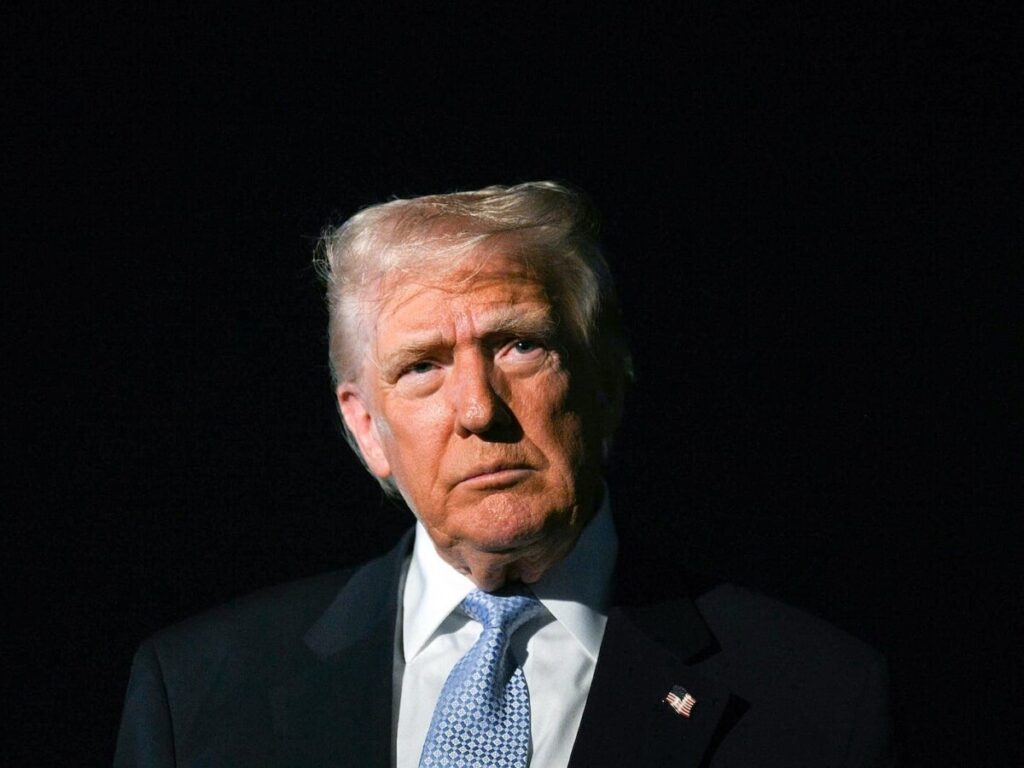
Republicans to Trump: No $2,000 tariff checks
In a bold proposal, former President Donald Trump has announced plans to send $2,000 checks to Americans funded by tariff revenues, with an anticipated rollout in mid-2026. However, this ambitious initiative faces significant skepticism from many Republican lawmakers, who express a preference for using any tariff revenue to address the national debt, which currently stands at an alarming $38 trillion. Key figures like Senator Ron Johnson and Senator Rick Scott have voiced their concerns, emphasizing the importance of fiscal responsibility over direct payments to citizens. Johnson pointed out the projected $2 trillion deficit for the current year, suggesting that any new revenue should prioritize debt reduction rather than direct financial relief.
Despite Trump’s increasing specificity and enthusiasm for the tariff checks, the reception among his GOP allies remains lukewarm. While some, like Senator Josh Hawley, have shown support for the idea as a means to provide relief to working Americans, many Republicans are cautious. House Speaker Mike Johnson, who initially dismissed the idea, has softened his stance, acknowledging that there may be merit to the proposal, but he remains focused on the implications for long-term fiscal health. The political landscape complicates matters further, as several GOP members are wary of the potential inflationary effects of distributing checks, especially after years of criticizing similar measures from the Biden administration. Economic experts have also raised concerns about the feasibility of Trump’s plan, noting that projected tariff revenues may not cover the estimated costs of the program, which could reach $600 billion.
The debate surrounding Trump’s tariff checks highlights a broader struggle within the Republican Party, balancing populist initiatives with traditional fiscal conservatism. As the 2026 elections approach, the challenge for Trump will be not only to rally support for his proposal but also to navigate the complex landscape of party priorities and economic realities. With many Republicans advocating for a focus on reducing the national debt, Trump’s proposal may need to be reimagined or rebranded to gain traction among his party’s leadership. The outcome of this discussion could significantly influence the party’s approach to economic policy in the coming years.
https://www.youtube.com/watch?v=xXopRssGYX0
Trump says $2,000 tariff checks are coming mid-2026. His GOP allies on Capitol Hill have other ideas.
Jim Watson / AFP via Getty Images
Trump has proposed sending $2,000 tariff checks to Americans in mid-2026.
He’s got a lot of work to do to convince his allies in Congress to go along with it.
Many Republicans would prefer to see any tariff revenue used to reduce the national debt.
President
Donald Trump
wants to send
$2,000 tariff checks
to Americans next year.
But to do that, he’ll have to get Congress to go along with it — and even some of his top allies are skeptical.
“We’re facing a deficit this year around $2 trillion,” Sen. Ron Johnson of Wisconsin told reporters. “I think whatever revenue we get, from whatever source, ought to go to try and bring down those deficits.”
Trump’s proposed tariff checks have received a cool response from most Republicans on Capitol Hill, with many saying they’d prefer to see the national debt addressed first.
That’s a big problem for Trump, considering it takes an act of Congress to actually send the checks.
Even those who aren’t outright rejecting the proposal — it’s always risky to oppose Trump as a Republican — are politely signaling that they’d prefer a different path.
“I mean, everybody’s got their own idea,” Rep. Andy Biggs of Arizona told BI. “I would prefer we reduce the overall tax rate, and make that permanent.”
“You know, my focus would clearly be paying down the $38 trillion of the debt,” Sen. Rick Scott of Florida told Business Insider. “But I have to see what he proposes.”
Trump’s getting more specific — but lawmakers aren’t budging
Throughout the first year of his second term, Trump has at times flirted with the
idea of sending checks
to Americans. It began in February, when Trump said that “DOGE Dividends,” checks paid for by purported DOGE savings, were “under consideration.” The
tariff rebate talk
picked up in August, when Trump embraced the idea, seemingly in response to a question from a reporter.
“We’re thinking about that, actually,” Trump said at the time.
The president in recent weeks has begun to speak more seriously about the idea, bringing it up multiple times in public remarks and Truth Social posts. On Monday, he said he was eyeing a rollout in mid-2026. And in calling for $2,000 checks, he’s gotten more specific than before.
That’s all been music to Sen. Josh Hawley’s ears, who introduced a bill to send a tariff rebate to lower-income Americans in August.
“This is my pet idea,” the Missouri Republican told reporters on Wednesday. “I just think it’s a terrific way to give relief to working people.”
And other Republicans have been forced to soften their opposition. In February, when asked about potential DOGE dividends, House Speaker Mike Johnson was relatively firm in saying he preferred to see the national debt reduced.
This month, he’s struck a slightly more conciliatory tone.
“Well, I think there’s some merit to it,” Johnson said on Fox Business earlier this month. “I mean, we’ll have to figure that out.”
“The discussion would be: If you have trillions of dollars in new revenue, what’s the best use for it?” Johnson continued. “Should you pay down the debt? Because that saves families a lot of money in the long run and puts us back on a sound fiscal trajectory.”
Still, plenty of other Republicans are holding firm. In July, when Trump was merely floating the idea, Sen. Bernie Moreno of Ohio told reporters that the proposal would “never pass” given the soaring national debt.
On Wednesday, he reiterated his opposition.
“I think we should pay down the deficit,” Moreno told Business Insider.
‘There are ways that they could maybe spin this’
Aside from the politics of it all, there are more basic problems with Trump’s proposal.
First, there’s the math: Several independent analyses of the proposal have found that there’s not nearly enough tariff revenue to fund Trump’s plan.
An analysis from the
Committee for a Responsible Federal Budget
found that the program could cost $600 billion — about double the $300 billion in projected annual tariff revenue. And that’s assuming the
Supreme Court doesn’t strike down
any of Trump’s tariffs.
There’s also the fact that stimulus checks are
likely to be inflationary
.
That’s a pill that Republicans in particular are unlikely to want to swallow, according to Scott Lincicome, vice president of general economics at the libertarian Cato Institute.
“Republicans have spent five years railing against the Biden administration for cutting people checks and sparking inflation,” Lincicome told Business Insider. “Now in power, they’re going to start cutting people checks and maybe sparking inflation?”
Still, Lincicome predicted that Republicans might try to find other ways to satisfy Trump’s demand, including by simply rebranding tax refunds that Americans are expected to receive as a result of the “Big Beautiful Bill.”
“There are ways that they could maybe spin this,” Lincicome said. “You know, have a big press conference and some really nice poster board, that makes it look like they’re actually giving people tariff rebates, when in reality, it’s just One Big Beautiful Bill tax cuts.”
Read the original article on
Business Insider


