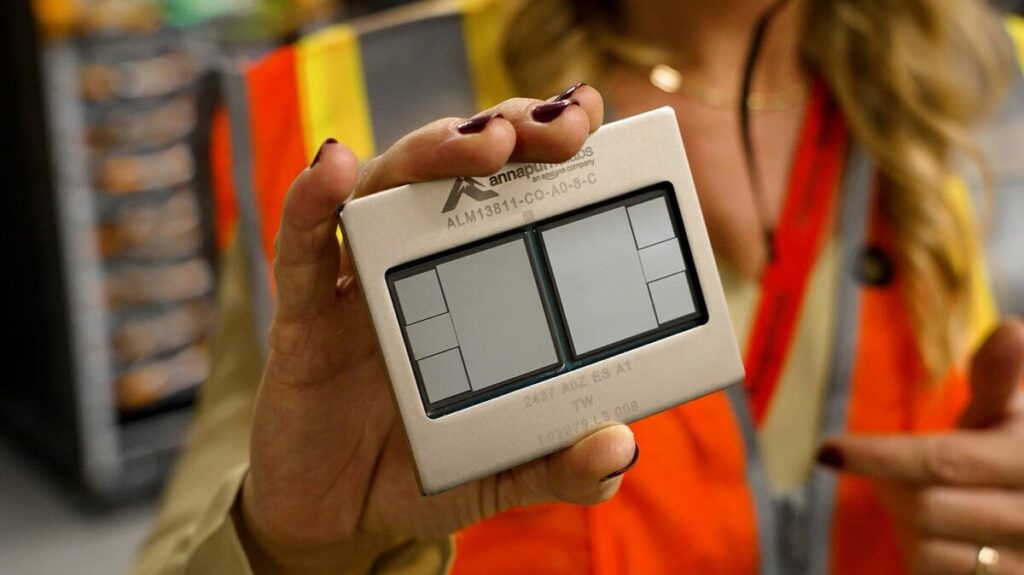
Nvidia sales are ‘off the charts,’ but Google, Amazon and others now make their own custom AI chips
Nvidia has long reigned supreme in the AI chip market, primarily due to its powerful GPUs that have become the backbone of machine learning and artificial intelligence applications. With the surging demand for AI capabilities across various industries, Nvidia’s dominance was largely unchallenged, as its chips were synonymous with high performance and efficiency. However, the landscape is shifting as tech giants like Google, Amazon, Meta, Microsoft, and OpenAI are increasingly investing in custom Application-Specific Integrated Circuits (ASICs). These specialized chips are designed to optimize performance for specific tasks, making them a formidable alternative to Nvidia’s GPUs.
The move towards custom ASICs represents a significant trend in the tech industry, driven by the need for tailored solutions that can handle the unique demands of AI workloads. For instance, Google’s Tensor Processing Units (TPUs) have been specifically designed for deep learning tasks, offering enhanced efficiency and speed for their cloud services. Similarly, Amazon has developed its own Trainium and Inferentia chips to improve the performance of its AWS cloud offerings. This shift not only allows these companies to reduce their reliance on Nvidia but also enables them to achieve cost savings and improved performance for their specific applications. Microsoft’s investment in custom silicon for AI workloads further underscores this trend, as they aim to enhance the performance of their Azure cloud services.
As these tech giants continue to innovate and develop their own ASICs, the competitive landscape for AI chips is becoming increasingly complex. While Nvidia remains a key player, the emergence of custom chips tailored to specific AI tasks could disrupt its market share. This shift highlights a broader trend in the tech industry towards specialization and customization, as companies seek to optimize their infrastructure for the rapidly evolving demands of AI. The race for supremacy in the AI chip market is on, and as more players enter the fray with custom solutions, the future of AI hardware will likely be characterized by a diverse ecosystem of chips tailored to meet the unique needs of various applications.
https://www.youtube.com/watch?v=RBmOgQi4Fr0
Nvidia is king in AI chips, but custom ASICs are gaining ground with Google, Amazon, Meta, Microsoft and OpenAI now making their own.