The Moon Was an Inside Job
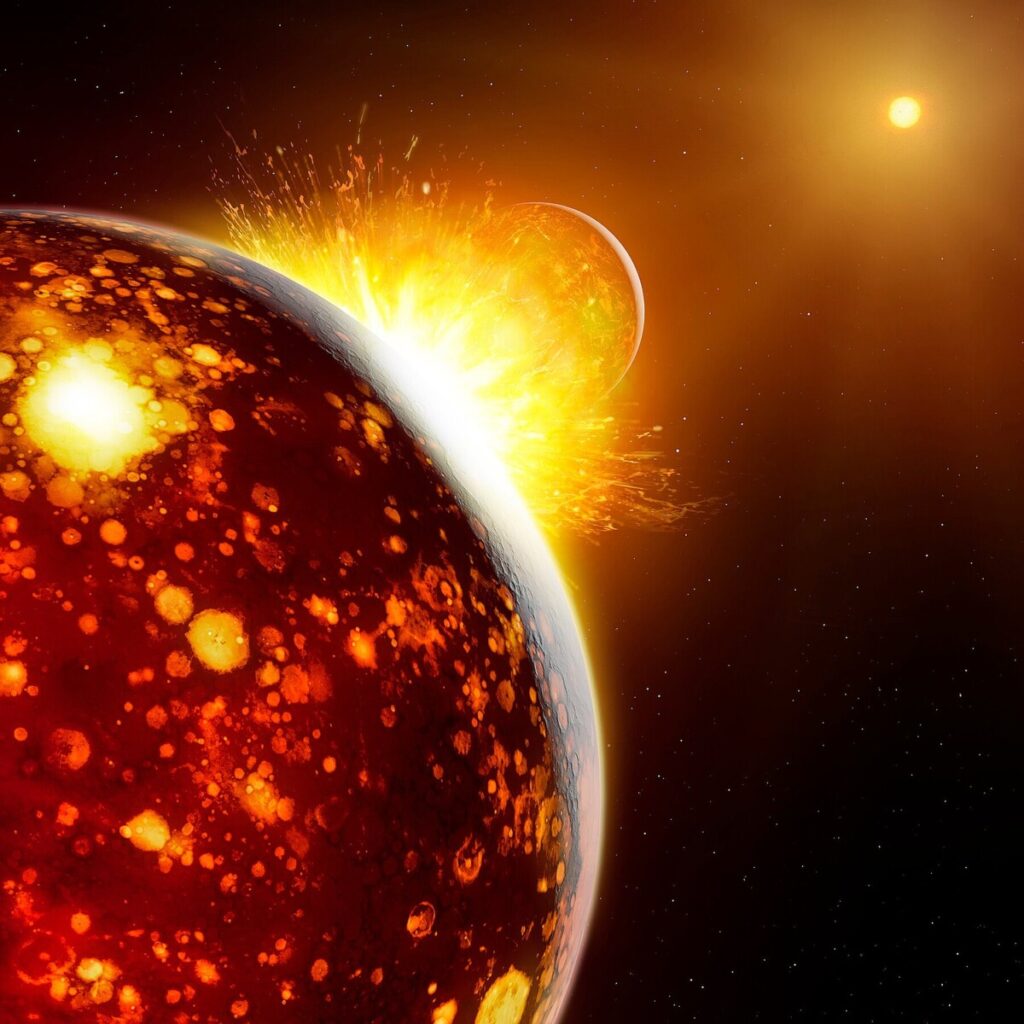
In a captivating exploration of our planet’s origins, scientists have delved into the dramatic collision between the early Earth and a Mars-sized body known as Theia, which occurred approximately 4.5 billion years ago. This cataclysmic event is believed to have been pivotal in shaping not only the Earth’s structure but also the formation of the Moon. The artist’s impression of this collision vividly illustrates a chaotic scene where molten rock and debris are hurled into space, eventually coalescing to form our lunar companion. This event took place around 100 million years after the formation of the solar system, a time when the Earth was still in its infancy, grappling with the violent conditions of a young planetary system.
The impact theory, which posits that Theia collided with the young Earth, has gained substantial support through various lines of evidence, including isotopic similarities between Earth and lunar rocks. For instance, samples brought back by the Apollo missions have revealed strikingly similar oxygen isotopes in both Earth and Moon materials, suggesting a shared origin. Furthermore, computer simulations have bolstered this theory, demonstrating how such a collision could lead to the ejection of debris that eventually formed the Moon. These findings have significant implications not only for our understanding of the Earth-Moon system but also for the processes of planetary formation throughout the universe.
As researchers continue to study the aftermath of this monumental event, they are uncovering more about the conditions that led to the development of life on Earth. The collision likely caused the planet to be enveloped in a molten state, which eventually cooled to form a solid crust. This dynamic history has laid the groundwork for Earth’s atmosphere and hydrosphere, making it a unique cradle for life. The ongoing investigations into the Earth-Theia collision not only deepen our understanding of our planet’s past but also enhance our knowledge of other planetary systems, offering clues about their potential for hosting life. As we gaze into the cosmos, the story of Earth’s formation serves as a reminder of the violent yet beautiful processes that shape celestial bodies.
Artist’s impression of the collision between the early Earth and Theia, with the sun in the far distance, roughly 100 million years after the formation of the solar system.