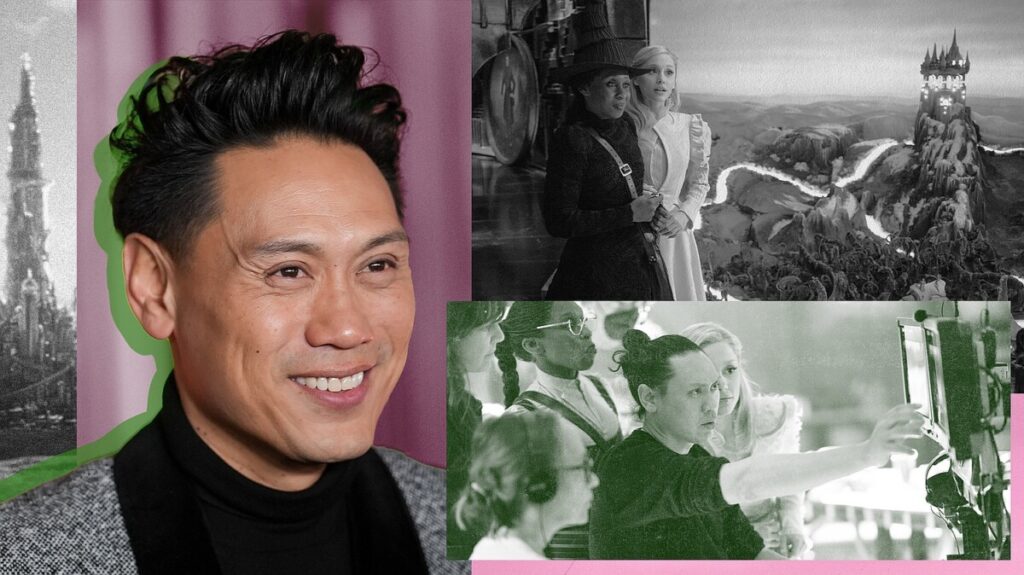
The Big Risk Wicked Is Taking
Jon M. Chu, the director of the beloved musical adaptation *Wicked*, is preparing audiences for a markedly different experience with its sequel, *Wicked: For Good*. While the first film dazzled viewers with its vibrant spectacle and catchy tunes like “Defying Gravity,” the sequel delves into deeper emotional territory, reflecting the complexities of its characters and their relationships. Chu acknowledges that the second act of *Wicked* is notoriously intricate, intertwining the narrative with L. Frank Baum’s *The Wonderful Wizard of Oz*. This transition from the light-hearted themes of the first film to the more somber tones of the sequel poses a unique challenge, as songs like “For Good” emphasize themes of farewell rather than exuberance. Chu describes *For Good* as a “minor-key riff” on its predecessor, aiming not to darken the narrative but to deepen it, exploring the self-perception struggles of Elphaba, the Wicked Witch of the West, and her friend Glinda, played by Cynthia Erivo and Ariana Grande, respectively.
The decision to split the *Wicked* story into two films was driven by the desire to do justice to its rich narrative. Chu felt that a two-part film would allow for a more immersive storytelling experience, enabling audiences to absorb the fairy tale elements before they are deconstructed. He faced the daunting task of filming both movies simultaneously during the pandemic, a time when the future of cinema was uncertain. Despite the challenges, Chu remained focused on the essence of the story, guided by a mantra from the producers: “It’s about the girls, stupid.” This principle ensured that every scene reflected the characters’ journeys, allowing for a more profound exploration of their development and the emotional stakes involved.
As *Wicked: For Good* approaches its release, Chu expresses confidence in the film’s authenticity and emotional depth, emphasizing that the real success lies in the connection audiences will feel with the characters. He believes that the journey of making these films has not only transformed the narrative but also his own understanding of storytelling. The quote from Baum inscribed on the Tin Man’s outfit—“If we walk far enough, we shall sometime come to some place”—resonates with Chu, encapsulating the idea that the journey itself is what matters most. This philosophy underpins both films, ultimately inviting audiences to reflect on their own paths while engaging with the timeless themes of friendship, courage, and self-discovery woven throughout the *Wicked* saga.
Jon M. Chu always knew that the second
Wicked
film wouldn’t fully resemble the first. The director’s
adaptation of the blockbuster musical
brought theatergoers back to Oz last year, capturing the fizzy glamour found in the stage show’s first act. The movie was a smash hit, winning two Oscars and entering the words
holding space
into the cultural lexicon. Yet its sequel,
Wicked: For Good
, has to translate the musical’s notoriously knotty second act, which weaves the story of L. Frank Baum’s
The Wonderful Wizard of Oz
, often messily, into the premise. Plus, there’s no “Popular” or “Defying Gravity”—no sparkly or soaring numbers to make the audience feel elated. Even the song that lends the sequel its title, “For Good,” is a tearjerker, a ballad about saying goodbye.
Wicked
was a frothy coming-of-age tale;
For Good
is a more challenging story. As Dorothy and Toto make their way toward the Emerald City, Elphaba (played by Cynthia Erivo), now known as the Wicked Witch of the West, and her best friend, Oz’s It Girl, Glinda (Ariana Grande), must wrestle with their self-perception, a conflict that’s not easily translated into splendiferous spectacle.
For Good
is, as a result, a minor-key riff on its predecessor. “It’s not about going darker,” Chu told me over Zoom earlier this week. “It’s going deeper.”
Chu anticipated pushback from Universal Pictures on his approach. Thus, before the release of
Wicked
, he delivered a rough cut of its sequel to executives. “I needed the studio to understand the tone difference so that they weren’t expecting the first movie, a year later,” he explained. Only after
Wicked
debuted did the director revisit the cut. Chu and I recently spoke about the half decade he spent on the production of the two films, wrestling with the story’s second act, and the one quote from
The Wonderful Wizard of Oz
that guided him throughout the process.
This conversation has been edited for length and clarity.
Shirley Li:
Let’s start with the decision to split the story into two films. There were two scripts available—a one-movie version, and a two-movie version. Why were you so certain that
Wicked
needed to be two films, shot simultaneously no less?
Jon M. Chu:
You usually have a few weeks right when you jump on a project when you’re king, so you better make the big decisions. [
Laughs
.] That’s what I’ve learned. I just told everyone, “We
have
to do the two-movie version. We cannot keep going back and forth.” Like, this debate is going to kill this project again until someone comes in and says, “This is what we are doing.”
Now, deep down, I was always like, “You never know.” We’re betting huge. This thing is either going to tank our careers or let them soar. There was no in between. But to me, it was like, the movie needs the room.
Wicked
took
The Wizard of Oz
and deconstructed our ideas about fairy tales. I always envisioned it as a one-year, two-movie experience, and that the time between them was actually critical to the storytelling of this—that you were going to absorb the fairy tale so it could shatter in front of us.
Li:
Once everyone was on board, how did you feel? You started production in the middle of the pandemic, shortly after your last movie-musical,
In the Heights
, hadn’t done well at the box office; people weren’t going to the cinemas then, and musicals can be a tough sell in general. To embark on a project of this scale, even while working alongside
Wicked
’s original writers, Stephen Schwartz and Winnie Holzman, as well as the producer Marc Platt, must have been daunting.
Chu:
Honestly, it’s weird to say, but I didn’t fear a lot at that moment. We didn’t have much to lose. I think the biggest fear was:
Are the
Wicked
fans going to want this to be as deep and as truthful as
I
see the material? And am I going to get along with Stephen Schwartz?
[
Laughs
.] That actually
is
the biggest thing. Like, it was a complicated production.
Are these people going to be tied so preciously to their original material that I cannot do the things that I know need to be done?
I didn’t know Schwartz or Winnie or Marc Platt well enough, and I thought,
If they want to strangle this, they could
. Luckily, they let go.
In COVID lockdown, nobody even knew what the future of movies was, so part of me thinks I got this job only because they were like, “No one’s ever going to make movies again.” But I knew exactly what this movie was. It’s part superhero movie, part drama, part romantic comedy, part romance, part friendship saga. The musical element was the language in which we were telling it, but it was not the
genre
in which we were doing it.
[
Read: The fairy tale we’ve been retelling for 125 years
]
Li:
How did you keep all of that straight while filming two movies?
Chu:
I saw it as one giant story. I had the plotting of Movie 1 and Movie 2 on my office wall, and every scene was labeled with the emotion I wanted the audience to feel. And so all of the departments could walk in there, and I would say, “Today is
yearning
. Today is
courage
. Today is
resentment
.” That was my map, and each of the girls had their maps. I think Cynthia used perfumes. Ari’s notes were like a madman’s notes. And then our crew had a war room. For both movies, you could walk from one side of the room to the other, and there’s models, pictures, fabrics. There’s designs for everything, so you could see the color story. You could feel the design story. You could walk the movie.
There were things we were insecure about in the first movie.
Can we make people buy into a musical? Is Elphaba and Glinda’s relationship going to be the thing that people buy into? Can we get the audience to care about these girls?
They did, and they were in deeper than I ever thought they could be. What they fell in love with in the first movie was not the musical numbers and the bubbliness. They were seduced by these, but they’re not why people came back multiple times; it’s not why they dressed up as the characters for Halloween. These characters are fighting for their optimism, their idea of what they want. The more we throw at them, the more they have to figure out how to live in the reality of the mess but know that the dream can still exist.
That gave me room to go deeper in these characters. We would have no debate with the studio about darkness in this movie, because we already had the hearts of people. They were rooting for these characters, so you should throw as much shit at them as possible, because that’s great storytelling.
(Giles Keyte / Universal Pictures)
Li:
There’s a lot of shit they have to go through. The second act of
Wicked
is famously messy: You have to incorporate the plot of
The Wizard of Oz
, ensure that a significant time jump makes sense, and wrap up every character’s story in a satisfying way. How did you know the audience would follow you into this more complicated realm?
Chu:
The biggest advantage we ever got from the 20-year production of
Wicked
onstage was the mantra that the producers handed to me, which was: “It’s about the girls, stupid.” They said that at my first meeting. “Whatever you do, wherever you go, the biggest lesson to learn is ‘It’s about the girls.’” Every scene had to be: If one of them was in it, then it had to be about why the other one wasn’t in it. If none of them was in it, then it had to be about one of those girls not being present.
Li:
How did that affect the way you approached “For Good,” the finale number? You shot it in a way that goes somewhat against what one would think a musical’s big finish should be like: It’s restrained, just a camera swooping around Cynthia and Ariana confessing how much they mean to each other.
Chu:
The thing that trapped me for “For Good” early was the fact that it’s the
last
song of the two-movie, year-long saga. You’re like,
Okay, we gotta give them the big ending
. So did I have my cranes out there? Did I think,
Should I have it snow?
Of course I had all of that stuff ready, but when we rehearsed it, it just became very clear:
I don’t want to leave their faces when they’re singing these words
. Their faces were the only things I wanted to look at.
Li:
Your take on “For Good” captures how these two films work, in a way. It’s like the first
Wicked
is a Trojan horse, delivering big, bubbly musical elements before revealing, in the second film, the trickier messages inherent to the show’s second act. Is that how you feel too, or am I way off?
Chu:
No, I think you’re right on. I don’t know if I’d say a Trojan horse, but I think all great musicals are about something that’s very relevant, and I think musicals have a great cover.
Music
is a great cover.
In a weird way,
Wicked
was always the second movie. That’s why we wanted to make this. The second movie is about: How much bravery and courage does it take to pop your bubble? And does courage have an expiration date?
Li:
Wicked
is a story of transformation for both Glinda and Elphaba. But what about you—how has making these films changed you?
Chu:
Crazy Rich Asians
came from a place of desperation for me as a filmmaker, to know who I am.
In the Heights
was my heart—I put
all
my creativity into that.
Wicked
is the only job that I never had to pitch for, that was given to me. I had to find within
Wicked
why
I
had to be the one to make it.
(Giles Keyte / Universal Pictures)
I think about my parents, and I think about the American dream. And I think,
If I can be as great as I can be, then I can show that the American dream
is
real and that fairy tales do happen. I can hire a diverse cast at the highest form of entertainment, and no one can question why. I can just set the precedent
.
That’s kind of what I feel like my role is: Do it, prove it, and show it.
Li:
We are talking just a few days before this film hits theaters, and the reviews are here too. Does this conjure a sense of pressure? Fear?
Chu:
I’m not fearful at all. How the audience takes it, how the reviewers take it, that’s not my problem. I think we were in it for so long, we had to validate it for ourselves and be like,
Did we do everything we could? Did we turn every stone? Did we do our best?
Yeah, we did.
Li:
I’m starting to understand why Ariana and Cynthia were crying so much on the press tour last year. They’d finished
For Good
, unlike the rest of us.
Chu:
[
Laughs
.] We really believe in it! It’s in our DNA; it’s not bullshit!
There’s a quote that I love from the L. Frank Baum book that we inscribed on the Tin Man’s outfit. We never got a close-up of it, so no one’s ever going to see it, but it was something that stayed with me throughout
Wicked
. It’s this: “If we walk far enough, we shall sometime come to some place.” It is not a romantic quote, it is not a flashy quote, but I feel like that’s life. That’s actually what our job is. It’s not about getting to a destination. Just keep walking, and you’ll end up at the place you need to be.


