Why MAGA is so concerned with Epstein − and why the files are unlikely to dent loyalty to Trump
In a significant political development, President Donald Trump has recently shifted his stance on the release of the Epstein files held by the U.S. Department of Justice. On November 18, 2025, the House of Representatives voted overwhelmingly to push for the release of these documents, with only one Republican opposing the measure. The Senate followed suit, unanimously agreeing to send the request to Trump, who signed it the next day. This change comes amidst a growing interest among Trump’s MAGA base in the Epstein case, particularly as it intertwines with long-standing conspiracy theories and sentiments within the movement. Alex Hinton, a scholar who has extensively studied the MAGA phenomenon, elaborates on how this interest reflects deeper cultural and political dynamics at play.
Hinton describes the MAGA movement as a nativist and populist force, characterized by an “America First” ideology that often manifests in xenophobia and a distrust of elites. He notes that the Epstein case resonates with many conspiracy theories that are foundational to MAGA beliefs, such as the “Stop the Steal” narrative and the idea of a “deep state” working against the interests of the American people. Epstein’s ties to powerful elites and allegations of sex trafficking have made him a focal point for conspiracy theorists, especially given the historical context of theories like Pizzagate, which implicated Democratic elites in heinous crimes. This convergence of narratives fuels a sense of urgency among MAGA supporters, who are eager to uncover what they perceive as a cover-up by the establishment.
Moreover, Hinton highlights the complex relationship between Trump and his MAGA supporters, noting that while there may be tensions—evidenced by Trump’s recent split with prominent supporter Marjorie Taylor Greene—there is a strong loyalty to Trump among his base. This loyalty is underscored by a cultural imperative within MAGA circles to “not cross the boss,” reflecting an intense devotion to Trump that discourages dissent. As Trump maneuvers to reclaim the narrative surrounding the Epstein files, he demonstrates a keen understanding of his supporters’ concerns, particularly regarding issues like sex trafficking that resonate deeply, especially among conservative Christians. Ultimately, Hinton suggests that Trump’s strategic pivot to support the release of the Epstein documents is a calculated move to maintain his grip on the MAGA base while deflecting criticism and reinforcing his position as a champion against perceived elite corruption.
https://www.youtube.com/watch?v=qMIP4RIoCHc
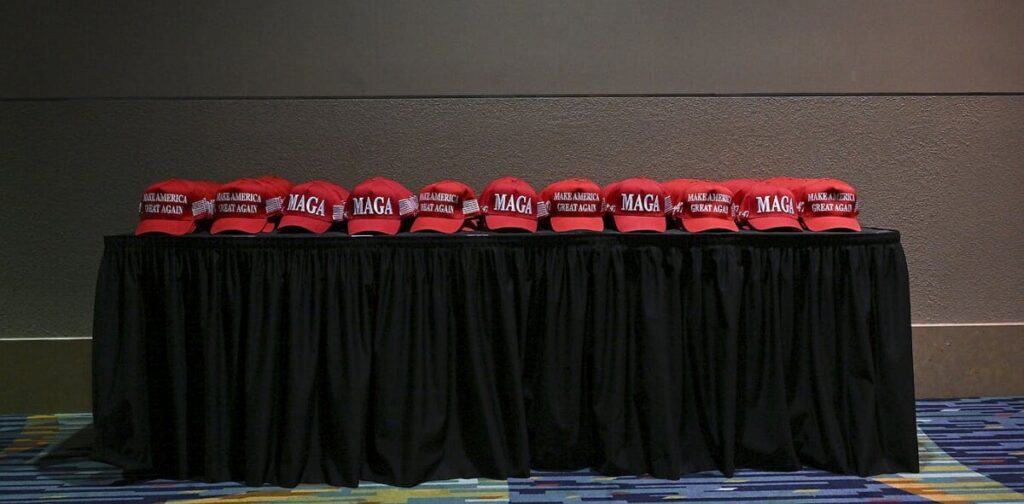
MAGA hats are placed on a table at an election night party in West Palm Beach, Fla., on Nov. 5, 2024.
Ricky Carioti/The Washington Post via Getty Images
With the
latest shift by President Donald Trump
on releasing the Epstein files held by the U.S. Department of Justice –
he’s was for it after being against it after being for it
– the MAGA base may finally get to view the documents it’s long wanted to see. On the afternoon of Nov. 18, 2025, the House voted overwhelmingly to seek release of the files, with
only one Republican voting against the measure
.
The Senate later in the day agreed unanimously
to pass the measure and send it on to the president for his signature; Trump signed it on Nov. 19. The Conversation’s politics editor, Naomi Schalit, talked with scholar Alex Hinton,
who has studied MAGA for years
, about Make America Great Again Republicans’ sustained interest in the case of accused child sex trafficker Jeffrey Epstein. Hinton explains how MAGA’s interest in the case fits into what he knows about the group of die-hard Trump supporters.
You are an expert on MAGA. How do you learn what you know about MAGA?
I’m
a cultural anthropologist
, and what we do is field work. We go where the people we’re studying live, act, talk. We observe and sort of hang out and see what happens. We listen and then we unpack themes. We try and understand the meaning systems that undergird whatever group we’re studying. And then, of course, there’s interviewing.
U.S. Rep. Thomas Massie, a Kentucky Republican, speaks at a press conference alongside alleged victims of Jeffrey Epstein at the U.S. Capitol on Sept. 3, 2025.
Bryan Dozier/Middle East Images via AFP, Getty Images
It appears that MAGA, Trump’s core supporters,
are very concerned
about various aspects of
the Epstein story
, including the release of documents that are in the possession of the U.S. government. Are they, in fact, concerned about this?
The answer is yes, but there’s also a sort of “no” implicit, too. We need to back up and think, first of all, what is MAGA.
I think of it as what we call in anthropology a nativist movement, a foregrounding of the people in the land. And this is where you get
America First discourse
. It’s also xenophobic, meaning that there’s a fear of outsiders, invaders coming in. It’s populist, so it’s something that’s sort of for the people.
Tucker Carlson interviewed Marjorie Taylor Greene
, and he said, “I’m going to go over the five pillars of MAGA.” Those were America First, this is absolutely central. Borders was the second. You’ve got to secure the borders. The third was globalist antipathy, or a recognition that globalization has failed. Another one was free speech, and another one he mentioned was no more foreign wars. And I would add into that an emphasis on “we the people” versus elites.
Each of those is interwoven with a
key dynamic to MAGA, which is conspiracy theory
. And those conspiracy theories are usually anti-elite, going back to we the people.
If you look at Epstein, he’s where
many of the conspiracy theories converge
:
Stop the Steal
,
The Big Lie
,
lawfare
,
deep state
,
replacement theory
. Epstein kind of hits all of these, that there’s this elite cabal that’s orchestrating things that ultimately are against the interests of we the people, with a sort of antisemitic strain to this. And in particular,
if we go back to Pizzagate in 2016
, this conspiracy theory that there were these Democratic elitists who were, you know, demonic forces who were sex trafficking, and lo and behold, here’s Epstein doing precisely that.
There’s kind of a bucket of these things, and Epstein is more in it than not in it?
He’s all over it. He’s been there, you know, from the beginning, because he’s elite and they believe he’s doing sex trafficking. And then there’s a suspicion of the deep state, of the government, and this means cover-ups. What was MAGA promised?
Trump said, we’re going to give you the goods
, right?
Kash Patel, Pam Bondi, everyone said
we’re going to tell you this stuff. And it sure smacks of a cover-up, if you just look at it.
But the bottom line is there’s a realization among many people in MAGA that you’ve got to stay with Trump. It’s too much to say there is no MAGA without Trump. There’s certainly no Trumpism without Trump, but MAGA without Trump would be like the tea party. It’ll just sort of fade away without Trump.
People in MAGA are supporting Trump
more than more mainstream Republicans on this. So I don’t think there’s going to be a break over this, but it certainly adds strain. And you can see in the current moment that Trump is under some strain.
President Donald Trump and U.S. Rep. Marjorie Taylor Greene, a longtime supporter, have split over the Epstein files release.
Elijah Nouvelage/AFP Getty Images
The break that we are seeing is Trump breaking with one of his leading MAGA supporters, Marjorie Taylor Greene, not the MAGA supporter breaking with Trump.
With Greene, sometimes it’s like a yo-yo in a relationship with Trump. You fall apart, you have tension, and then you sort of get back.
Elon Musk was a little bit like that
. You have this breakup, and now she’s sort of backtracking like Elon Musk did. I don’t think what is happening is indicative of a larger fracturing that’s going to take place with MAGA.
It seems that Trump did his about-face on releasing the documents so that MAGA doesn’t have to break with him.
It’s absolutely true. He’s incredible at taking any story and turning it in his direction. He’s sort of like a chess player, unless he blurts something out. He’s a couple of moves ahead of wherever, whatever’s running, and so in a way we’re always behind, and he knows where we are. It’s incredible that he’s able to do this.
There’s one other thing about MAGA. I think of it as “don’t cross the boss.” It’s this sort of overzealous love of Trump that has to be expressed, and literally no one ever crosses the boss in these contexts. You toe the line, and if you go against the line, you know what happened to Marjorie Taylor Greene, there’s the threat Trump is going to disown you.
You’re going to get primaried
.
Trump has probably made a brilliant strategic move, which is suddenly to say, “I’m all for releasing it. It’s actually the Democrats who are these evil elites, and now we’re going to investigate Bill Clinton and all these other Democrats.” He takes over the narrative, he knows how to do it, and it’s intentional. Whoever says Trump is not charismatic, he doesn’t make sense – Trump is highly charismatic. He can move a crowd. He knows what he’s doing. Never underestimate him.
Does MAGA care about girls who were sexually abused?
There is concern, you know, especially among the devout Christians in MAGA, for whom sex trafficking is a huge issue.
I think if you look at sort of notions of Christian morality, it also goes to notions of sort of innocence, being afflicted by demonic forces. And it’s an attack on we the people by those elites; it’s a violation of rights. I mean, who isn’t horrified by the idea of sex trafficking? But again, especially in the Christian circles, this is a huge issue.
Alex Hinton receives funding from the Rutgers-Newark Sheila Y. Oliver Center for Politics and Race in America, Rutgers Research Council, and Henry Frank Guggenheim Foundation.


