What’s Up: November 2025 Skywatching Tips from NASA
**Celestial Wonders Await: November Skywatching Highlights**
As November unfolds, skywatchers are in for a treat with a series of astronomical events that promise to dazzle stargazers. This month, the night sky will feature a stunning conjunction of Mars and Mercury, the sparkling Leonid meteor shower, and an intriguing phenomenon where Saturn’s iconic rings will temporarily disappear from view. These events offer a unique opportunity to connect with the cosmos and witness the beauty of our solar system.
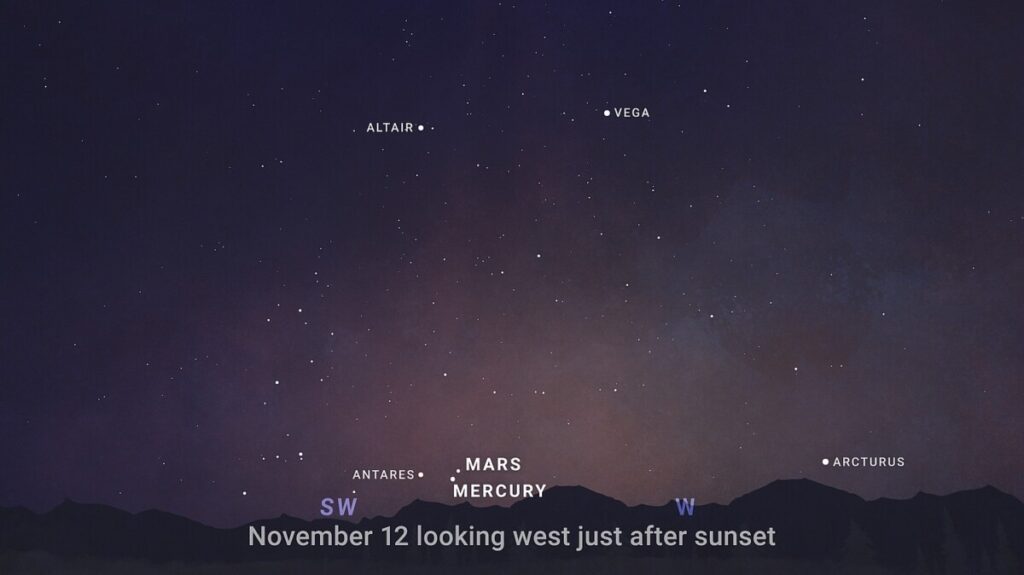
On November 12, Mars and Mercury will align in a conjunction, appearing close together in the southwestern sky just after sunset. Although these planets are actually separated by over 100 million miles, their visual proximity will create a breathtaking sight for observers. Mars, easily identifiable by its distinctive reddish-orange hue, will be positioned just above Mercury, providing a perfect opportunity for photography and casual observation. This conjunction is a reminder of the vastness of space and the intricate dance of celestial bodies that can be witnessed from our own backyard.
Following the conjunction, the Leonid meteor shower will peak between November 16 and 18, offering a spectacular display of shooting stars. This annual meteor shower, which occurs as Earth passes through debris left by the comet 55P/Tempel-Tuttle, can produce 10-15 meteors per hour under optimal dark sky conditions. The best viewing times will be late on November 16 into the early morning hours of November 17, with the radiant point of the shower located in the constellation Leo in the eastern sky. Stargazers are encouraged to find a dark spot away from city lights to fully enjoy this celestial spectacle.
Lastly, on November 23, Saturn’s rings will temporarily vanish from sight due to the planet’s axial tilt. Saturn’s rings, which are incredibly thin, will align in such a way that they face Earth directly, making them nearly invisible. However, this is a temporary phenomenon; as Saturn continues its orbit, the rings will gradually become visible again. This cyclical nature of visibility serves as a reminder of the dynamic and ever-changing characteristics of our solar system.
As we immerse ourselves in these celestial events, it’s a perfect time to reflect on the wonders of the universe and the joy of skywatching. Whether you’re a seasoned astronomer or a casual observer, November offers a rich tapestry of sights that invite us to look up and marvel at the cosmos. Don’t miss out on these incredible opportunities to connect with the night sky!
Mars and Mercury cozy up, the Leonids sparkle, and Saturn’s rings are…disappearing?
Mars and Mercury get close for a conjunction, the Leonid meteor shower delights, and Saturn’s rings are…disappearing?
Skywatching Highlights
Nov. 12: A conjunction between Mars and Mercury
Nov. 16-18: Leonid meteor shower peak viewing
Nov. 23: Saturn’s rings disappear
Transcript
Mars and Mercury have a cozy conjunction, the Leonid meteor shower delights, and Saturn’s rings are…disappearing?
That’s What’s Up for November.
Conjunction:
Mars and Mercury will cozy up together in the night sky just after sunset on November 12th.
The planets will experience what is known as a conjunction, meaning they appear close together in the sky from our view (even though in real life, Mars and Mercury are well over 100 million miles apart).
But you can see these two long distance pals close together if you look slightly southwest just after sunset in the early evening sky on November 12th.
NASA/JPL-Caltech
Mars will be just to the right above Mercury, and you’ll know it’s Mars by its distinctive reddish-orange color.
Leonid Meteor Shower:
The Leonid meteor shower will sparkle across the skies this month, peaking on November 17th.
NASA/JPL-Caltech
While the meteor shower stretches from November 3rd through December 2nd, it will be at its most visible late on the night of November 16th into the dawn of November 17th, even into the early morning of November 18th.
Look for meteors coming from the shower’s radiant point within the constellation Leo in the eastern sky.
With dark skies, you might see 10-15 meteors per hour with this shower which happens when we travel through the debris trailing the comet 55P/Tempel-Tuttle.
Saturn’s rings disappear
Saturn’s rings will disappear from view this November!
Saturn orbits the sun leaning at an angle of 26.7 degrees. This means that from our view, its rings shift up and down over time.
On November 23, Saturn will be angled in such a way that its rings face us, and since they are so thin they’ll just disappear from view.
Alan Friedman/avertedimagination.com
But don’t worry, the rings aren’t gone from view forever. As the planet continues to orbit, its rings will gradually become more visible again.
Conclusion + Moon Phases
Here are the phases of the Moon for November.
NASA/JPL-Caltech
You can stay up to date on all of NASA’s missions exploring the solar system and beyond at science.nasa.gov.
I’m Chelsea Gohd from NASA’s Jet Propulsion Laboratory, and that’s What’s Up for this month.
Keep Exploring
Discover More Topics From NASA
What’s Up
Skywatching
Galaxies
Stars


