Europa Clipper Captures Uranus With Star Tracker Camera
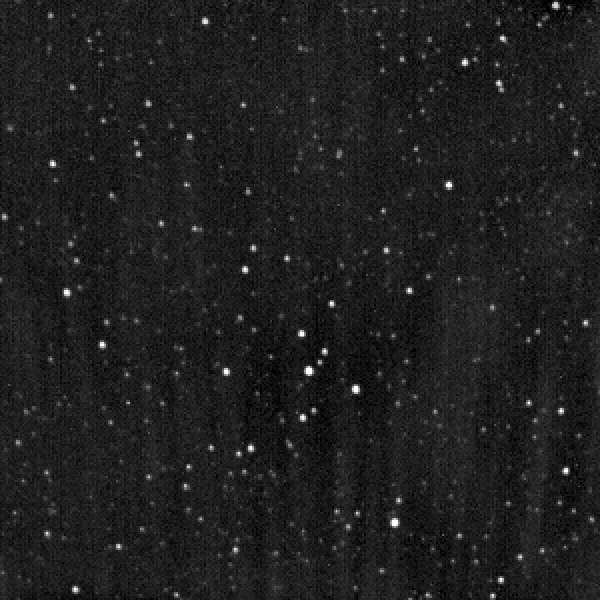
NASA’s Europa Clipper spacecraft recently achieved a remarkable milestone by capturing an image of Uranus using its star tracker camera on November 5, 2025. This image, taken from a distance of approximately 2 billion miles (3.2 billion kilometers) from the planet, showcases Uranus as a prominent dot amidst a field of stars, highlighting the spacecraft’s capability to maintain orientation in deep space through its stellar reference units. The image not only serves as a stunning visual representation of the distant planet but also demonstrates the functionality of the star tracker, which is crucial for the spacecraft’s navigation as it journeys toward its primary destination—the icy moon Europa.
Launched in October 2024, the Europa Clipper mission is designed to arrive in the Jupiter system by 2030, where it will conduct around 50 flybys of Europa. The mission’s primary objective is to investigate whether the subsurface ocean beneath Europa’s icy shell could harbor conditions suitable for life. To achieve this, the spacecraft will focus on three key scientific goals: determining the thickness of the icy shell, analyzing the moon’s surface interactions with the ocean below, and characterizing its geological features. The insights gained from these explorations will significantly enhance our understanding of astrobiological potential in environments beyond Earth, making the Europa Clipper mission a pivotal step in the quest to find life elsewhere in the universe.
In addition to the impressive image of Uranus, the Europa Clipper team also created an animated GIF that shows the planet’s slight movement relative to the background stars over a span of ten hours. This visual aids in illustrating the vast distances and the dynamics of celestial bodies as observed from the spacecraft. As the mission progresses, the data collected will not only inform us about Europa but also contribute to broader discussions about the potential for life on other celestial bodies within our solar system and beyond. For more information on the Europa Clipper mission and its objectives, visit NASA’s dedicated page.
2 Min Read
Europa Clipper Captures Uranus With Star Tracker Camera
PIA26544
Credits:
NASA/JPL-Caltech
Photojournal Navigation
Science
Photojournal
Europa Clipper Captures Uranus…
Photojournal Home
Photojournal Search
Latest Content
Galleries
Feedback
RSS
About
Downloads
Europa Clipper Captures Uranus With Star Tracker Camera
PNG (128.99 KB)
Description
NASA’s Europa Clipper captured this image of a starfield — and the planet Uranus — on Nov. 5, 2025, while experimenting with one of its two
stellar reference units
. These star-tracking cameras are used for maintaining spacecraft orientation. Within the camera’s field of view — representing 0.1% of the full sky around the spacecraft — Uranus is visible as a larger dot near the left side of the image.
Figure A is an annotated version of the image with Uranus and several background stars labeled.
NASA/JPL-Caltech
Figure B is an animated GIF made of a pair of images taken 10 hours apart. In this version, Uranus can be seen moving very slightly, relative to the background stars.
NASA/JPL-Caltech
At the time the images were taken, Europa Clipper was about 2 billion miles (3.2 billion kilometers) from Uranus. The spacecraft is currently en route to the Jupiter system to study the icy moon Europa.
Europa Clipper launched in October 2024 and will arrive at the Jupiter system in 2030 to conduct about 50 flybys of Europa. The mission’s main science goal is to determine whether there are places below Europa’s surface that could support life. The mission’s three main science objectives are to determine the thickness of the moon’s icy shell and its surface interactions with the ocean below, to investigate its composition, and to characterize its geology. The mission’s detailed exploration of Europa will help scientists better understand the astrobiological potential for habitable worlds beyond our planet.
For more information about Europa and Europa Clipper, go to:
Keep Exploring
Discover More Topics From Photojournal
Photojournal
Search Photojournal
Photojournal’s Latest Content
Feedback


