Webb telescope discovers a new surprise about a rare pair of extreme stars
NASA’s James Webb Space Telescope has made a groundbreaking discovery in the Milky Way by revealing that the rare star system Apep, named after the Egyptian god of chaos, contains a third companion star—an enormous supergiant. Apep consists of two Wolf-Rayet stars, which are known for their intense blue-white light and powerful stellar winds as they approach the end of their life cycles. These massive stars are among the most fascinating objects in the universe, with only about 1,000 known to exist in our galaxy, which is home to hundreds of billions of stars. The uniqueness of Apep lies in the fact that both of its primary stars are Wolf-Rayets, making it a standout in the small group of binary systems featuring these rare stellar types.
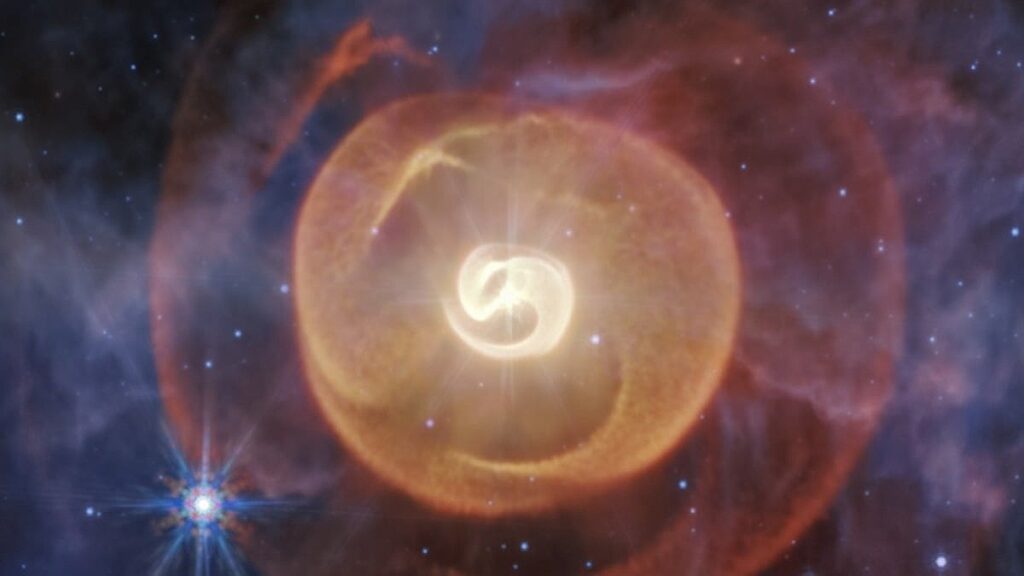
The recent findings, detailed in two papers published in *The Astrophysical Journal*, confirm that Apep’s third companion star is a supergiant, estimated to be 40 to 50 times more massive than our Sun. The two Wolf-Rayet stars, originally heavier, have lost mass over time, now weighing in at 10 and 20 times the mass of the Sun. Ryan White, a lead author from Macquarie University, described the observations from Webb as a “smoking gun” that proved the gravitational connection of the third star to the Apep system. The telescope’s advanced capabilities allowed astronomers to visualize the two Wolf-Rayet stars generating powerful winds that collide and create intricate carbon dust shells. These shells, which have formed over the last 700 years, resemble concentric ripples in a pond and are shaped by the gravitational dance of the stars, with their non-circular forms likely influenced by the stars’ orbits and varying wind strengths.
The discoveries not only shed light on the dynamic interactions within the Apep system but also provide insights into the broader processes of star formation and evolution in the universe. The dust shells are expanding outward at speeds between 1,200 and 2,000 miles per second, indicating a complex interplay of forces at work. As the outer supergiant star moves through these expanding dust shells, it creates distinct gaps, further confirming its presence in the system. While the distance to Apep has been updated to approximately 15,000 light-years away, researchers acknowledge that further observations are needed to precisely determine its distance from Earth. As Yinuo Han, another lead author, aptly put it, “Looking at Webb’s new observations was like walking into a dark room and switching on the light,” highlighting the telescope’s pivotal role in illuminating the mysteries of our universe.
NASA
‘s
James Webb Space Telescope
has revealed that an exceptionally rare star duo in the Milky Way has a third companion — and it’s a monster.
The star system, named Apep after the Egyptian god of chaos, includes two
Wolf-Rayet stars
, a type that burns blue-white and hot, generating powerful gas winds as it nears death. These stars are old, huge, and on the verge of
supernova
explosions.
The Apep pair has intrigued astronomers because of how scarce Wolf-Rayet stars are in
space
. Only about 1,000 exist in the galaxy, which contains hundreds of billions of stars. Of the few
binary star systems involving Wolf-Rayets
, Apep is the only one wherein both fall in this category.
Now new telescope studies confirm that Apep has a third star — a supergiant roughly 40 or 50 times more massive than the
sun
. The two Wolf-Rayet stars were likely even heavier than that when they were younger, but have since shriveled down to 10 and 20 times the mass of our host star.
“Webb gave us the ‘smoking gun’ to prove the third star is gravitationally bound to this system,'” said Ryan White, a lead author from Macquarie University in Australia, in
a statement
.
SEE ALSO:
NASA has a broken giant antenna that could upend its 2026 plans
With Webb, astronomers were able to see the two Wolf–Rayet stars blasting out fierce winds that smash together and make carbon dust. Instead of one big cloud, Apep has a stack of four nested dust shells that look like the ripples surrounding a stone plopped into a pond. Each shell repeats the same pattern, indicating the dust-making process fires on a steady rhythm.
The shells hold their shape even as they drift nearly two
light-years
outward. But despite their predictability, the shells aren’t perfectly round. Slight warps probably come from the stars’ long, stretched orbit, according to the research, or from winds that blow harder in some directions than others.
The James Webb Space Telescope revealed neat, layered dust shells shaped by two powerful stars.
Credit: NASA GSFC / CIL / Adriana Manrique Gutierrez illustration
The
findings
are described in two new
papers
published in
The Astrophysical Journal
.
“Looking at Webb’s new observations was like walking into a dark room and switching on the light,” said Yinuo Han, lead author of one of the papers, in a statement. “Everything came into view.”
The shells formed over the last 700 years as the two stars repeatedly approached each other. Their gas collisions shoot out thick clumps of carbon dust at 1,200 to 2,000 miles per second. By measuring how fast the shells move and how far apart they sit, researchers estimate that the two orbit each other about once every 193 years.
As for the third star, it circles around the other two from a wider distance. As the dust shells expand, this outer star plows through them, leaving a neat, pie-shaped gap in every shell. Because the gap appears in the same place each time, researchers know it’s part of the system.
The dust temperatures, shell spacing, and the system’s overall brightness point to Apep being farther away than earlier studies suggested — perhaps 15,000 light-years off in the distance.
“We solved several mysteries with Webb,” Han said. “The remaining mystery is the precise distance to the stars from Earth, which will require future observations.”