We watched NATO’s new drone-killer with nearly 2,000 combat victories go to work. Here’s what it can and can’t do.
In a significant move to bolster air defense capabilities in Eastern Europe, NATO forces are training with the Merops system, a cost-effective counter-drone technology already proven in the conflict in Ukraine. The Merops system, which includes the Surveyor interceptor drone, has successfully intercepted nearly 2,000 Russian drones, making it an attractive option for countries like Poland and Romania, which have recently faced drone incursions from Russia. The urgency for such systems intensified following incidents in September where Russian drones violated Polish airspace, prompting NATO allies to seek efficient and affordable air defense solutions. Business Insider reported on the training exercises in Nowa Dęba, Poland, where US, Polish, and Romanian troops are learning to operate this innovative system.
The Merops system, developed under the American initiative Project Eagle, consists of a ground control station, the Surveyor interceptor, and mobile launch platforms, enabling flexible deployment in various scenarios. With a crew of four, including a commander, pilot, and two technicians, the system is designed for user-friendliness, allowing soldiers to quickly adapt to its operation. The Surveyor drone, which can reach speeds of over 175 miles per hour, is capable of autonomously tracking and engaging enemy drones using advanced sensors. During training demonstrations, soldiers launched the Surveyor from a pickup truck, showcasing its potential to intercept larger, one-way attack drones like the Iranian-designed Shahed, which have been a significant threat on the battlefield.
While the Merops system boasts a high success rate of around 95% against Shahed-type drones, it does have limitations. It is specifically tailored for larger reconnaissance and attack drones and may struggle against smaller, low-flying first-person-view (FPV) drones that are prevalent in modern warfare. The Surveyor interceptor, priced at $15,000 each, offers a more economical solution compared to the high costs associated with deploying fighter jets and advanced missiles, which can run into hundreds of thousands of dollars. As NATO seeks to strengthen its Eastern Flank Deterrence Line, the Merops system represents a strategic shift towards integrating low-cost, effective drone defense capabilities to counter the growing aerial threats posed by Russia.
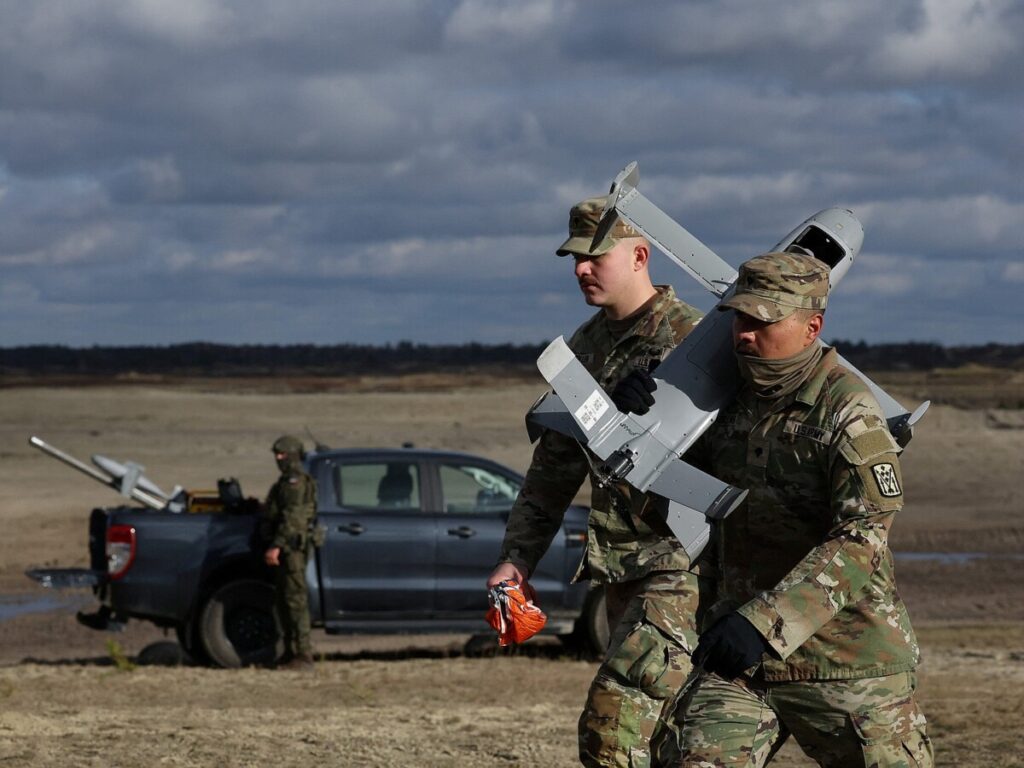
A US soldier carries the Surveyor interceptor drone at a demonstration in Poland this week.
Kacper Pempel/REUTERS
NATO forces are training to use a cheap intercepter drone that has already proven itself in Ukraine.
Poland and Romania are deploying the Merops system in response to recent Russian drone incursions.
Business Insider watched soldiers train on Merops this week and learned what it can and can’t do.
NOWA DĘBA, Poland — Proven in the skies above Ukraine, a cheap drone-killer that has logged nearly 2,000 Russian intercepts is now in the hands of Western troops.
Poland and Romania have purchased and are deploying the
Merops system
to better protect Eastern European airspace after a series of
Russian drone incursions
a couple of months ago, wake-up calls that left NATO allies scrambling to field low-cost air defenses.
This week, Business Insider observed US, Polish, and Romanian forces training on the American-made counter-drone system, which launches an
interceptor drone
called the “Surveyor” to take down enemy threats by slamming into them or exploding nearby.
At a training range in southeastern Poland, US military officials said that Merops is designed to intercept both reconnaissance and strike drones, including the newer and faster variants powered by
jet engines
.
“This system right here is very reliable,” American Army
Sgt. Riley Hiner, an interceptor pilot who has helped train the NATO soldiers, told Business Insider.
However, while the Merops system has a record of success in combat, it’s not without its limitations.
A Polish soldier prepares to launch the Surveryor interceptor drone from the bed of a pickup truck.
Jake Epstein/Business Insider
What is Merops?
Interceptor drones have emerged as one of Ukraine’s
top air defense tools
in recent months, allowing it to hunt and destroy large numbers of cheap Russian
Shahed-style drones
at a relatively low cost per engagement.
Merops, developed by the American initiative Project Eagle, is one of many counter-drone systems that Ukraine has been using.
Ukraine’s defense industry
is producing hundreds of interceptor drones each month, and Western military leaders seeking to procure cheaper air defense systems to match the growing threat that drones pose to Europe are taking note of their success.
Interest turned to urgency in September after Russian drones violated Polish airspace.
NATO fighter jets
fired expensive air-to-air missiles to shoot down weapons worth a fraction of their cost.
Poland and Romania, the latter of which faced its own
Russian drone incursion
just a few days later, decided to procure and deploy Merops as part of a new NATO initiative to defend the alliance’s Eastern edge against potential future attacks.
A US soldier holding the Surveyor interceptor.
Jake Epstein/Business Insider
US Army Brig. Gen. Curtis King, the head of the
10th Army Air and Missile Defense Command
, described the counter-drone system as “very lethal,” “very effective,” and also “cost-effective.”
Merops consists of a ground control station, the Surveyor interceptor, and launch platforms. Operated by a four-person crew consisting of a commander, a pilot, and two technicians, it can be deployed at a fixed location or on the move, making it a flexible asset.
Business Insider watched Polish, Romanian, and American troops work with the Merops system on Tuesday as the soldiers were nearing the end of their two-week training course. King, speaking to reporters, said the system is user-friendly, so soldiers can quickly learn how to operate it.
US Army Europe and Africa said the Merops training reflects efforts by Poland and Romania to quickly field proven battlefield systems and strengthen NATO’s new Eastern Flank Deterrence Line, which aims to protect the alliance with a mix of low-cost drones and
layered defenses
.
What threats can it hit?
During a demonstration, Polish soldiers launched the Surveyor from the bed of a pickup truck. The interceptor drone attempted to score a direct hit on its target — a drone mimicking a Shahed — but after several attempts and near misses, it deployed a parachute and floated down to the ground.
The Surveyor interceptor drone costs $15,000 apiece.
Jake Epstein/Business Insider
The parachute feature allows troops to reuse the Surveyor, ultimately saving money in the training cycle.
US military officials said that the Surveyor drone was unarmed during Tuesday’s demonstrations, but under real combat conditions, it would carry a small warhead that could destroy a hostile drone by exploding next to it rather than needing to score a direct hit.
The propeller-powered Surveyor interceptor drone can be piloted remotely or operate autonomously, using radio frequencies, thermal signatures, or radar sensors to track its target. It is capable of reaching speeds over 175 miles per hour and is resistant to
electronic warfare
, which has become an ever-present threat to drone operations in Ukraine.
Military officials said the Surveyor is designed to defeat high-flying one-way attack drones, such as the notorious
Iranian-designed
Shahed, as well as reconnaissance drones. Ukraine has already used it to record more than 1,900 successful intercepts in combat.
They emphasized that the Surveyor interceptor can also take down
jet-powered drones
, which travel faster than those powered by propellers. Russia began fielding these advanced variants in combat earlier this year.
Hiner, the American pilot, said that Merops has about a 95% success rate, especially when intercepting Shahed-type drones. “I think as mobile as it is, and as versatile as it is, it’s very easy to use,” he added.
The Surveyor can be launched from trucks or ground stations, making it a flexible option.
Jake Epstein/Business Insider
What are the limitations?
Merops isn’t the end-all counter-drone defense. It’s built for a specific threat, not all drone threats. For instance, it would likely struggle against low-flying
first-person-view
(FPV) drones given their size and profile, Hiner said.
Most FPV drones are small quadcopters connected to pilots via radio frequency signal or fiber-optic cables. These drones often carry small explosive payloads and can
deliver precision strikes
for just a few hundred dollars. They dominate the battlefield in Ukraine.
Merops is built for bigger one-way attack and reconnaissance drones. With its $15,000 Surveyor interceptor, it’s designed to be much less expensive than the threat it’s hunting. Older Shahed variants, for example, are estimated to be worth $35,000 apiece. Its deployment in NATO gives the alliance a new capability that it previously lacked.
Military officials hope that Merops will also provide NATO with a cheaper alternative to having to use fighter jets and advanced
air-to-air missiles
, which can cost hundreds of thousands of dollars, for drone defense in Eastern Europe.
“That’s our major objective,” King said. “We have got to find lower costs — both sensors and effectors.”
Read the original article on
Business Insider


