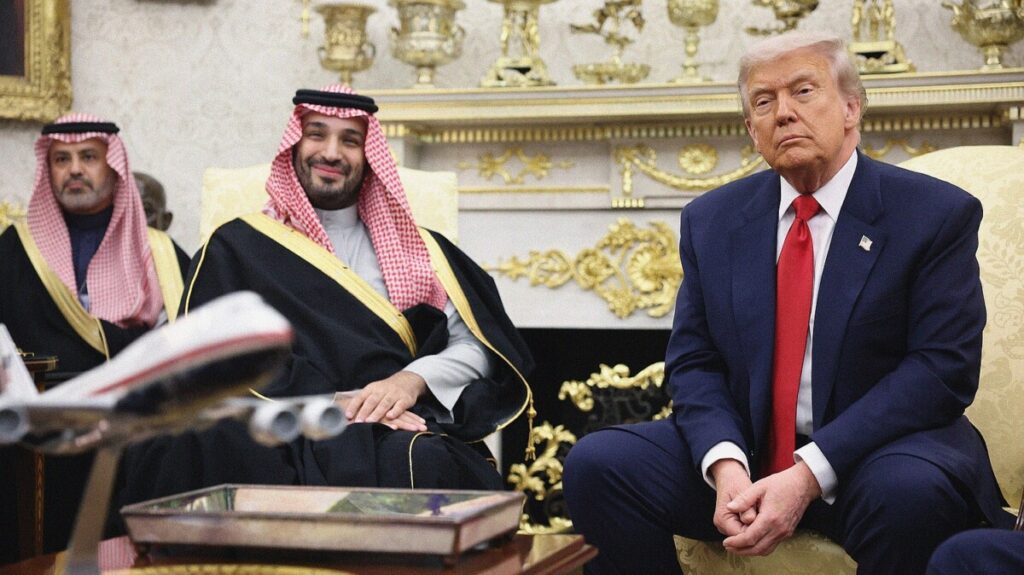
Trump’s Self-Damning Response to a Legitimate Question
In a tense Oval Office meeting, President Donald Trump faced tough questions from ABC News correspondent Mary Bruce regarding Saudi Arabia’s controversial actions and the Trump family’s business ties to the kingdom. Bruce’s inquiries included the potential conflicts of interest involving Trump’s businesses in Saudi Arabia and the country’s involvement in the 9/11 attacks, as well as Crown Prince Mohammed bin Salman’s (MBS) alleged role in the brutal murder of journalist Jamal Khashoggi in 2018. Trump’s responses were notably defensive, labeling Bruce’s questions as “horrible” and “insubordinate,” even suggesting that ABC should lose its broadcasting license for what he termed “fake news.” This exchange highlights the growing tensions between American journalistic integrity and the political maneuverings of the Trump administration, especially in relation to a key ally like Saudi Arabia.
The meeting underscored a significant shift in U.S.-Saudi relations, with MBS being welcomed back to Washington despite his controversial past. The Trump administration has justified overlooking MBS’s alleged crimes, including the Khashoggi murder, by emphasizing Saudi Arabia’s strategic importance to U.S. interests, such as investments and potential normalization of relations with Israel through the Abraham Accords. While MBS acknowledged Khashoggi’s death as regrettable, he deflected responsibility, asserting it was not his fault and that Khashoggi was not significant enough to warrant a personal death order. This response contrasted sharply with Trump’s reaction, which exhibited a sense of entitlement and a disdain for critical questioning, suggesting that even mild dissent could lead to severe consequences.
The broader implications of this meeting reveal a troubling convergence of American and Saudi values, as the U.S. appears to be adopting a more authoritarian tone under Trump, mirroring the oppressive political climate in Saudi Arabia. The initial hopes for Saudi Arabia to modernize and embrace democratic values seem increasingly ironic, as the kingdom has become more aligned with American cultural trends while both nations drift towards a mutual acceptance of power over principles. The meeting serves as a stark reminder of how foreign policy can shape domestic values, warning that partnerships with autocratic regimes may lead to a degradation of democratic ideals in the United States itself. As both countries navigate this complex relationship, the risk remains that their political trajectories may converge in troubling ways, compromising the very values that once defined American democracy.
At an Oval Office meeting yesterday between the American president and the ruler of Saudi Arabia, Mary Bruce of ABC News asked a series of questions that Donald Trump
deemed
“horrible,” “terrible,” and “insubordinate.” Bruce’s first question concerned possible conflicts of interest involving the Trump family’s business in Saudi Arabia. “I think the broadcasting license should be taken away from ABC because your news is so fake,” he replied. The other questions (not even questions, really—Trump interrupted Bruce before she could finish her sentence) related to Saudi Arabia’s involvement in the 9/11 attacks and Crown Prince Mohammed bin Salman’s alleged role in the 2018 dismemberment of the Saudi political operative and
Washington Post
columnist Jamal Khashoggi. Khashoggi, Trump said, “was extremely controversial,” and “a lot of people didn’t like” him. Trump scolded Bruce for “embarrassing” MBS, as he is universally known, with the question.
For decades, one of the forlorn liberal desires was for Saudi Arabia to modernize, secularize, and become more American. MBS has made transformational progress in this regard. He granted women the right to work, drive, and live lives independent of men; curtailed persecution of all people by religious fanatics; and brought in Western entertainers such as Louis C.K., famous for violating the ancient Wahhabi prohibition against masturbating in front of unrelated women in hotel rooms. These transformations have been unaccompanied by the expansion of political rights. Such rights as exist are those granted, always provisionally, by the crown prince, and they do not include the right not to be dismembered for opposing the crown prince’s policies.
Yesterday’s meeting was a grim update on the political changes in the two leaders’ respective countries. First there was the general implication that MBS is now welcome back in Washington. Trump’s circle has made the case that Saudi Arabia’s value to the United States is so great that certain crimes by its leader must be overlooked, just as the United States sometimes relies on its friends to overlook its own. MBS came to America bearing gifts: a much vaunted financial investment; a refreshed relationship; the prospect, uttered publicly, of Saudi Arabia joining the Abraham Accords and recognizing Israel. For Trump, and for many other like-minded people in government, the logic is that if these relationships are valuable, they are more valuable than the life of any one person.
[
Helen Lewis: I watched stand-up in Saudi Arabia
]
The more interesting aspect of the meeting, however, was the shift in tone. MBS replied to Bruce’s question about Khashoggi politely, if inadequately. His reply was an abbreviated version of
what he told me
when I asked him a similar question about Khashoggi in 2021. (That was the last time he granted an extended interview to an American journalist.) He said that Khashoggi’s death was painful—for him, the crown prince—and that it was regrettable but not his fault. He said that such an event would not happen again and added, when I followed up, that he would not have killed Khashoggi, because Khashoggi was not important enough to merit a death order. If he were to kill his enemies, he said, there were “a thousand” whom he would have killed before he got around to Khashoggi. Even after this “embarrassing question,” as Trump put it yesterday, MBS let me pester him for another hour, sometimes answering tartly when the questions were impertinent but never threatening to cut the conversation short, or throw my tape recorder or me into a wood chipper. In the Oval Office, one could fault MBS for answering insufficiently about Khashoggi, but one could not fault him for failing to answer at all, or for acting as if an impertinent question constituted lèse-majesté.
Trump saw things differently, and in that sense his response was the more loathsome of the two. Even though he was not the one in the room in line for a throne, Trump replied with regal offense. The threat to take away ABC’s broadcasting license for “embarrassing” MBS is of course outrageous. But the tone was in some ways the most self-damning aspect of his response, because, unlike MBS’s, it was brittle and aggrieved, and conveyed a sense that asking a hard question could get a commoner put in the stocks.
The progress that American liberals once craved—for Saudi Arabia to become more American in its values—in the end now seems like one of those ironic wishes in tales of yore, that boomerang back and wound the wisher. Saudi Arabia is more American now. Its people go to rap concerts, and its leader watches Netflix. Even so, no one could seriously compare the politics of America (where elections still happen, and courts sometimes tell the government that it cannot do what it wants) to those of Saudi Arabia, where there are no politics, just power.
But America has closed the gap by becoming a little more Saudi. It has a leader who gilds his palace and hisses to his courtiers that they should do something about anyone guilty of even the mildest insolence. (Incidentally, I take a similar dynamic to be MBS’s implied alibi for Khashoggi’s death: His courtiers murdered Khashoggi not on his direct orders, but in overzealous fulfillment of a general order to keep critics in line.) Moralists in foreign policy have long warned that if you partner with countries that do not share your values, your own values will degrade to match theirs faster than theirs will improve to catch up with yours. As of yesterday, I would say that America and Saudi Arabia—which for so long have styled themselves as unlikely siblings, more alike than they appear—are on course to match each other’s speeds, and meet almost perfectly in the middle.


