The godfather of AI doesn’t think CEOs have thought about one big thing that could happen if AI kills most jobs
Geoffrey Hinton, often referred to as the “godfather of AI,” recently shared his concerns about the potential consequences of artificial intelligence on job markets during a discussion with Senator Bernie Sanders at Georgetown University. Hinton, a British-Canadian computer scientist renowned for his groundbreaking work in machine learning, emphasized that many CEOs, including high-profile figures like Elon Musk and Larry Ellison, may not fully grasp the economic ramifications of their investments in AI and robotics. He pointed out that if workers lose their jobs and income, there will be fewer consumers able to purchase products, leading to significant social disruption. Hinton’s comments echo the sentiments of other tech leaders, such as Bill Gates and Dario Amodei, who have warned that AI could displace a substantial number of white-collar jobs, with predictions suggesting that half of all entry-level positions could be at risk.
During the event, Hinton asserted that while AI has the potential to create new job categories, such as “prompt engineers” who optimize interactions with AI systems, the net effect will likely be a loss of jobs rather than a gain. He stated, “I don’t believe it’s going to create as many new jobs as it replaces,” highlighting his belief that we are still in the early stages of AI development, which is advancing rapidly. This sentiment is echoed by other industry leaders; for instance, Musk has suggested that AI will accelerate the replacement of desk jobs, potentially leading to a future where work is optional due to the capabilities of robots and AI. He envisions a scenario where universal high income could replace traditional employment, though he acknowledges the accompanying trauma and disruption.
The concerns raised by Hinton and Sanders resonated deeply with the Georgetown student audience, many of whom expressed apprehension about AI’s impact on their job prospects and economic security. When asked whether they believed AI would benefit or harm their future, a significant majority indicated that they felt it would be detrimental. This reflects a growing awareness among younger generations about the challenges posed by rapid technological advancements and the need for thoughtful discussions on how society can adapt to these changes, including potential solutions like universal basic income, which has gained traction among some tech leaders as a way to address the economic fallout from AI-driven job displacement. As the conversation around AI continues to evolve, the insights shared by Hinton serve as a critical reminder of the need for a balanced approach that considers both innovation and its societal implications.
https://www.youtube.com/watch?v=qrvK_KuIeJk
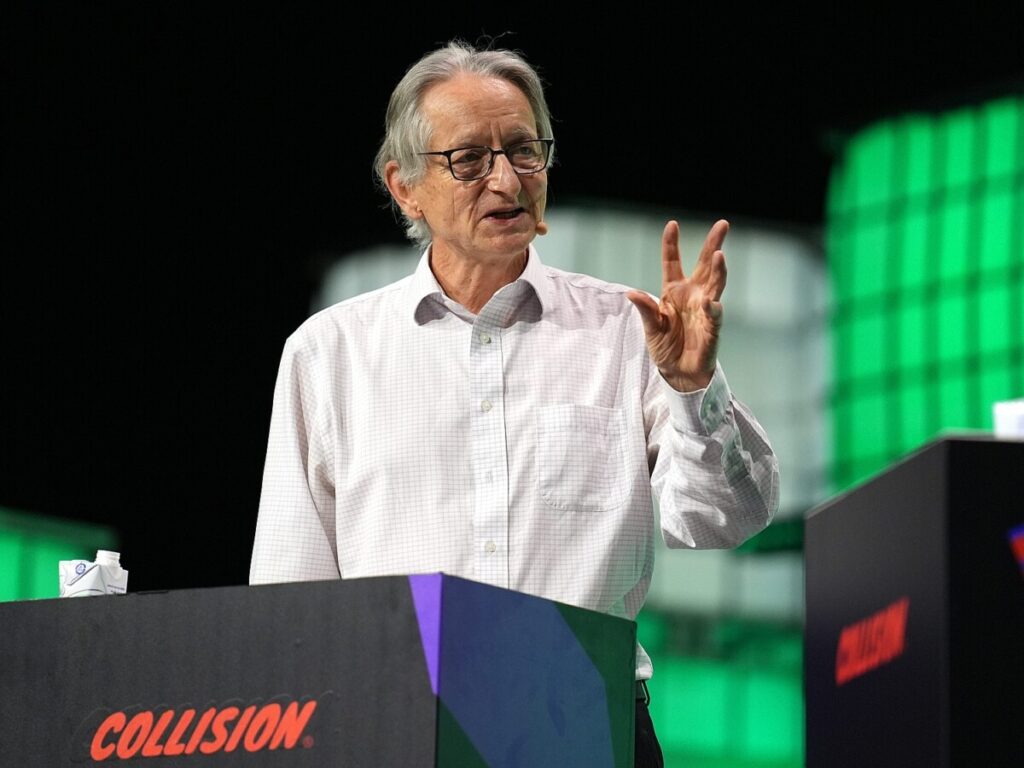
Geoffrey Hinton, the “godfather of AI.”
Mert Alper Dervis/Anadolu via Getty Images
Geoffrey Hinton doesn’t think CEOs have thought about how mass unemployment impacts buying.
Hinton argued AI will likely destroy more jobs than it creates, impacting white-collar roles.
Students express concern that AI could harm their future job prospects and economic security.
The “godfather of AI” has a reality check for CEOs.
Geoffrey Hinton, the British-Canadian Nobel Prize winner for his contributions to machine learning, joined Sen. Bernie Sanders for a discussion at Georgetown University on Tuesday about “the promise and the peril” of AI.
Sanders, an independent who caucuses with the Democrats, kicked off the discussion by asking whether multibillionaires like Elon Musk, the CEO of Tesla, and Larry Ellison, a cofounder of Oracle, have considered the impact on working-class people when making
enormous investments in AI
and robotics.
“They should be, but I don’t think they are,” Hinton said in response, “And I think many of them haven’t really absorbed canes, that if the workers don’t get paid, there’s nobody to buy their products, and they haven’t really thought through the massive social disruption we’ll get if we get very high unemployment.”
Sanders followed up with the examples of Bill Gates, the founder of Microsoft, who once predicted that humans won’t be needed for most things, and Dario Amodei, the CEO of Anthropic, who more recently said that AI could lead to the loss of half of all
entry-level white collar jobs
.
Hinton thinks that these predictions “are probably right.”
“So you often see articles saying, ‘oh, AI’s not going to
replace jobs
, AI fails in lots of things,'” Hinton said. “AI currently does fail in some things. What you have to remember is we’re in the very early stages. This is a new technology. It’s getting better very fast.”
“I don’t believe it’s going to create as many new jobs as it replaces,” Hinton added of AI later in the conversation. “It’ll create jobs like prompt engineer — how do you prompt this chatbot to get the best out of it — but I don’t believe there’ll be nearly as many new jobs created as it destroys, as it replaces.”
Musk, last month,
said that AI will replace desk jobs “at an accelerated rate.”
“Ultimately, working will be optional because you’ll have robots plus AI,” he said on Joe Rogan’s podcast. “And we’ll have, in a benign scenario, universal high income, not just universal basic income. Universal high income, meaning anyone can have any products or services that they want, but there will be a lot of trauma and disruption along the way.”
Musk is not alone in suggesting that some form of
universal basic income
be distributed with the wealth created by AI; OpenAI CEO Sam Altman is also a proponent.
Amazon CEO Andy Jassy said back in June that AI’s capabilities would allow
Amazon to shrink its white-collar workforce
in the future. The company laid off
14,000 corporate employees
in October, although Jassy attributed the firings to “culture” rather than AI. Earlier in 2025, Shopify and Duolingo both informed their teams that they would need to demonstrate that AI couldn’t perform the roles for which they were hiring before they could request additional head count.
Georgetown students who attended the event seemed acutely aware of the downsides of AI. At the end of the discussion, Sanders asked the audience whether they think AI would benefit their future or harm their prospects. The latter option saw significantly more raised hands.
Read the original article on
Business Insider


