Philly’s ‘transit vigilante’ created a real-time bus tracker for his neighbors
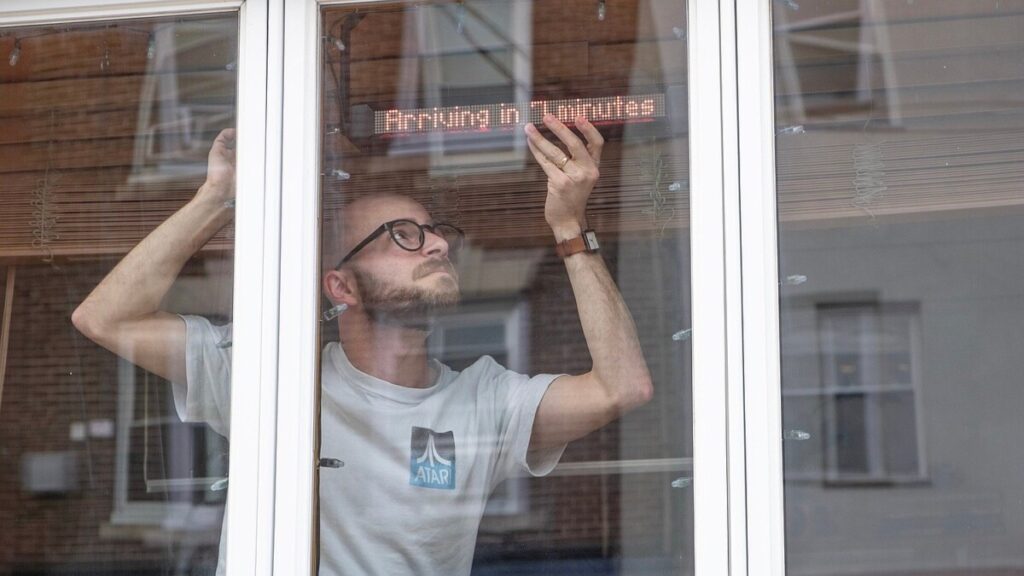
In Philadelphia, the local mass transit system, SEPTA, has faced significant challenges recently, including severe service cuts and the elimination of numerous bus routes. Amidst these difficulties, South Philly resident Max Goldberg has taken it upon himself to improve the experience for fellow commuters. Calling himself a “transit vigilante,” Goldberg created a DIY digital transit sign that provides real-time information on bus arrivals, making it easier for riders to know when their bus is coming. His journey began in late 2024 when he looked out his home office window and noticed the people waiting at a nearby bus stop. Inspired by the idea of a large clock that could display real-time bus information, he set out to build a solution that would help his community.
Goldberg’s project started with an old electronic sports timer he had repurposed over the years. Despite being a novice coder, he was motivated to enhance the timer by replacing its internal microcontroller with one that could be programmed to display real-time bus arrival information. After navigating the complexities of SEPTA’s website and its API—a set of tools that allow different software applications to communicate—he successfully extracted the necessary data to inform commuters of bus arrival times. His first iteration was a simple clock, but after weeks of tinkering, he upgraded to a more sophisticated pixel grid LED display capable of showing full sentences about bus schedules. The positive feedback from commuters, including thank-you notes and gifts, reinforced his commitment to helping his neighbors.
Goldberg’s innovative approach not only addresses a pressing need in his community but also exemplifies the spirit of grassroots problem-solving. His real-time bus tracker, which has evolved into a more user-friendly version, showcases the potential of DIY technology to enhance public services in times of crisis. Although SEPTA has yet to acknowledge his efforts, Goldberg remains unfazed, focusing on the joy of seeing his neighbors benefit from his creation. His project serves as a reminder of how individuals can make a difference, especially when public systems are struggling, and highlights the importance of community engagement and innovation in urban environments.
Philadelphia’s mass transit system has had a rough go of it lately. The Pennsylvania city’s main public transit provider, SEPTA, has been dealing with
massive service cuts
, including the elimination of entire bus routes. But South Philly resident Max Goldberg is undeterred.
“I feel a bit like a transit vigilante,” says Goldberg, a creative director and
DIY
hobbyist who often uses SEPTA. In late 2024, Goldberg created a tool to make both his own life and those of his fellow bus riders a little easier: a digital transit sign providing real-time information for buses en route.
How the idea began
“There’s a window behind the computer monitor in my home office that overlooks a bus stop, where there are always people waiting,” explains Goldberg. “I realized how fun it could be to have a big clock in the window—like the clocks you sometimes see outside of banks—so that everyone could know the time.”
He then took it a step further, turning the clock into a digital transit tracker that lets those waiting know how far away the next bus is.
How he built it
To create his DIY masterpiece, Goldberg started off with a large electronic sports timer, similar to the kinds of running clocks you’d see at a soccer match. He picked up the device during his years of working in video production, and had been using the four-digit, seven-segment display as wall decor since 2013.
Goldberg’s first iteration of his real-time, community bus tracker was made from an old sports clock.
Image: Max Goldberg
Once he set his sights on using the clock, he had to figure out a way to program it. When it came to coding, Goldberg considered himself a novice. “I’ve played around with Arduinos,” which are open-source microcontrollers that you can use for creative projects like automated blinds and
motorized Iron Man helmets
, says Goldeberg. So he knew that the clock had a microcontroller—a small, single-chip computer (basically a miniature PC) that controls a single function within a device, like a digital countdown for keeping score—which acted as its “brain.”
“I thought, what if I rip the brain out of this clock and replace it with something different? Then I could program the system to update with different numbers.”
The surprisingly difficult task of getting bus times
Next, he had to figure out how to get and interpret the real-time bus information from SEPTA. While the transport authority tracks buses directly on their website, “the website is kind of annoying to use,” says Goldberg. “It takes a lot of steps to get the information you need when all you really want to know is, ‘How many minutes until the next bus comes?’”
Since Goldberg has a background in web design, he knew to look for the website’s Application Programming Interface (API), a connection between computer programs that allows them to essentially “talk with” one another, sharing data between apps, systems, and devices. For example, when a mobile weather app needs the forecast for a specific city, it uses an API key—which is the app’s unique code, similar to a password—to request that info from a weather service specializing in real-time data for that particular city. The weather service receives the request, verifies that the code is authentic, and then responds with relevant data, such as temperature, humidity, wind speed, and a multi-day forecast.
Philadelphia’s public SEPTA buses can be surprisingly difficult to track using their official website.
Image:
DepositPhotos
/ Marek SLUSARCZYK
Anyone is able to get SEPTA’s transit information, says Goldberg, but it can be overwhelming. You really have to know what you’re looking for. So he used the website’s API to filter the information down into what exactly he and commuters wanted to know: when the buses on this particular route would arrive.
Getting the clock to display the right information
After he gathered that info, Goldberg focused on putting everything together. This included figuring out how the clock worked, basic wiring, and coding.
“I think I was one of the earliest vibe coders,” says Goldberg, referring to a term for programmers who use AI tools like with ChatGPT for help. “Basically, you describe what you’re trying to do, it gives you a code and you try that code and see if it works or if it doesn’t. Maybe the numbers are showing up but they’re all upside down. So then you have to figure out how to fix that.”
Related Hobbyist Stories
Giant pumpkin growers face off for world gourd domination
Teen turns his suburban home into elaborate haunted house every October
A dedicated son brings Fenway Park to his dad’s backyard
In Vermont, one man is bringing pay phones back to life
Illinois man has spent 40 years rebuilding a WWII-era B-17 bomber
A life-long car lover recreated the Griswold’s famous station wagon
Amateur paleontologist opens fossil museum in rural Minnesota
How people reacted to Goldberg bus clock
After a few weeks of tinkering around in the evenings and troubleshooting issues like getting the clock to show actual bus ETAs, Goldberg placed the tracker in his office window, and waited to see what happened.
“At first it wasn’t super obvious what it was, because there’s not a lot of room to display words like ‘next bus coming in…,’” he says. “But the people who got it were really into it.” Since it was the holiday season, some commuters left Goldberg thank you cards outside his place. A person who works for the app Transit even gifted him with a pair of company-branded socks. But more importantly, commuters were catching their buses on time. “I just like seeing people use it,” says Goldberg.
Goldberg’s new and improved bus timer
In the year since, the DIY creator has made a 2.0 version of his SEPTA tracker. Rather than using a digital clock, it’s more of a pixel grid LED display that can actually write full sentences telling commuters when to expect the next bus.
Goldberg’s new bus tracker is able to display full sentences to help commuters keep track of transit updates.
Image: Max Goldberg
The one downside, says Goldberg, is that the letters are kind of small. The custom-built project consists of about $15 worth of parts from AliExpress (an online marketplace), all put together in a 3D-printed enclosure. Version 2.0 also uses the same “brain” as the original: an ESP32 microcontroller with a pin board, built-in wifi, and Bluetooth connectivity.
“Think of the ESP32 as a tiny, very inexpensive computer with built-in wifi,” he says. “Just like how computers have ports to plug in things like monitors, keyboards, etc, the ESP32 has pins that you connect wires to so you can ‘plug in’ things like sensors, lights, and motors.” Goldberg programmed the ESP32 to access SEPTA’s system directly, sending real-time info, as well as letters and numbers, through the specific wires that he connected.
Goldberg put the coding for his original SEPTA project
up on Reddit
, so if you want to build one yourself you can. “The only issue is that you need the exact clock,” he says, “which is kind of hard to find.” He’s also working on making the software for his 2.0 model publicly available.
While SEPTA does have countdown trackers at some of its stops, they’re more within Philadelphia’s high-traffic areas. Goldberg’s creation, meanwhile, displays information for a neighborhood bus stop. There’s no shelter or bench at the stop, just a metal sign displaying the number of the transit vehicle that stops there.
“[Goldberg’s bus tracker] does have a dimmer on it, so it’s more muted at night.” And it’s also just a little less annoying to use than constantly updating a transit app.
As to whether or not SEPTA has responded to Goldberg’s project, the answer is “no.” But for this transit vigilante, that’s OK. “Honestly, they’ve got a
lot
of other stuff going on right now,” he says. “It feels nice to help out where I can.”
In
The Workshop
, Popular Science highlights the ingenious, delightful, and often surprising projects people build in their spare time. If you or someone you know is working on a hobbyist project that fits the bill, we’d love to hear about it—
fill out this form
to tell us more.
Goldberg’s real-time bus tracker announces “Now arriving” as a SEPTA bus pulls up, right on time.
Image: Max Goldberg
The post
Philly’s ‘transit vigilante’ created a real-time bus tracker for his neighbors
appeared first on
Popular Science
.


