80 years ago, a WWII B-17 bomber crashed in the Baltic. Scientists are finally learning who was onboard.
A dedicated team of marine archaeologists is making significant strides in identifying the crew of a B-17 bomber that tragically crashed into the Baltic Sea during World War II. For 82 years, the remains of the aircraft and its crew have lain undiscovered beneath the icy waters, a somber testament to the sacrifices made during one of history’s most tumultuous periods. The Boeing B-17, affectionately dubbed the “Flying Fortress,” played a crucial role in various military campaigns, including the notorious bombing of Dresden in February 1945. Designed for long-range missions at high altitudes, the B-17 required its ten-member crew to wear specialized suits to combat the frigid temperatures and low oxygen levels at cruising altitudes of up to 35,600 feet. Despite its formidable firepower, the aircraft had a grim survival rate, with crews facing only a 25 to 33 percent chance of completing the required 25 missions.
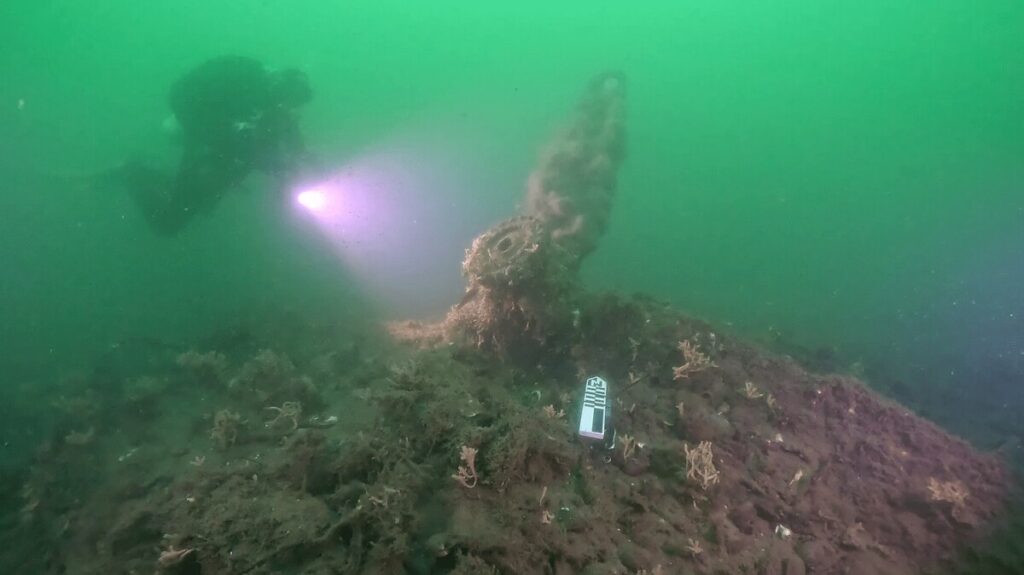
The mystery of this particular B-17 began in 1943 when it went down over the Baltic Sea, leaving its crew among the estimated 81,000 U.S. service members still missing from past conflicts. The wreck remained elusive until 2001, when a local diver alerted the U.S. Defense POW/MIA Accounting Agency (DPAA) to its location. In July 2023, marine archaeologists from Texas A&M University joined forces with the DPAA to locate the wreckage using advanced sonar imaging and metal detection techniques. Their efforts led to the discovery of a half-buried section of the aircraft, prompting a dive to investigate the site. Underwater visibility was poor, but the team was able to piece together the remnants of the B-17, gaining insights into the crash and its aftermath.
Among their remarkable findings were two .50-caliber machine guns, which had been ejected during the crash but remained surprisingly well-preserved after decades underwater. These guns, crucially marked with serial numbers, could provide the key to identifying the specific bomber and its crew. Anthropologist Katie Custer Bojakowski emphasized the importance of these machine guns, noting that their serial numbers and placement on the aircraft were meticulously controlled during the war. With further archival research, the team hopes to connect the aircraft to its crew and ultimately bring closure to the families of those who served. As Piotr Bojakowski stated, the goal extends beyond mere archaeological discovery; it aims to honor the memories of the lost airmen and provide answers to their descendants, closing a long chapter of history that has remained open for far too long.
A team of marine archaeologists is one step closer to identifying an
Air Force
crew who lost their lives aboard a
B-17 bomber
amid the height of
World War II
. For 82 years, their unidentified remains and aircraft have rested at the bottom of the icy Baltic Sea. While more work is needed to match the downed plane to its unknown pilots, a key clue may reside on a pair of surprisingly well preserved .50-caliber machine guns.
What was the B-17 bomber?
Eight decades after its debut, the
Boeing B-17 bomber
remains one of military history’s most recognizable aircraft. Commonly known as the Flying Fortress, the B-17 is famous for its role in multiple campaigns across Germany, including the tragic
Dresden bombing
in February 1945. The US military specifically commissioned the four-engined plane to avoid radar detection, by flying long-range at altitudes as high as 35,600 feet. Since the B-17’s cabin remained unpressurized throughout a flight, the aircraft’s 10-member crew were required to wear specialized suits to withstand the thin air and freezing temperatures.
The Flying Fortress cumulatively dropped more bombs than any other plane during World War II, but those numbers came at a steep cost to its crews. Over Germany, B-17’s only had a
25 to 33 percent chance
of surviving the 25 flights required to complete a single tour.
A mystery crash
An estimated 81,000 United States service members remain missing in action from
past wars
, including the crew of a B-17 bomber that went down while flying above the Baltic Sea near Germany in 1943. This particular plane was lost to history until 2001, when a local diver reported their discovery of the wreckage to the US Defence POW/MIA Accounting Agency (DPAA). In July, marine archaeologists from Texas A&M University began collaborating with the DPAA to pinpoint the bomber’s underwater location, with a goal to finally identify the plane and its crew. The team surveyed a 0.38-square-mile section of sea using techniques such as side-scan sonar imaging and magnetometry metal detection to locate the B-17’s exact position. Next, they guided a remotely operated vehicle (ROV) to any anomalies flagged during the scans to separate geological formations from actual wreckage.
ROV footage revealing a half-buried section of airfoil ultimately convinced Texas A&M marine archaeologist Piotr Bojakowski and volunteers from the Nordic Maritime Group to dive down and investigate themselves. However, Bojakowski and his team had to swim extremely close to the plane to obtain visual confirmation as the Baltic Sea’s murky, blue-green waters only allowed for less than 10 feet of visibility.
“It’s an exciting process to see a crash site underwater,” Bojakowski said in a recent
university profile
. “Even though it’s in ruins, you begin to visualize the entire aircraft with the engine and wings and fuel tanks. You slowly start piecing everything together in a way that makes sense and understand what happened.”
Serial numbers and salvage efforts
During their dives, Bojakowski’s team made a particularly remarkable find amid the B-17 wreckage–one that could finally identify its MIA crew. It appears that the Flying Fortress’ twin .50-caliber machine guns were ripped from the plane during the crash. Despite the damage, the guns have remained in decent condition even after more than 80 years underwater. They were subsequently raised to the surface for closer inspections, and careful cleaning eventually allowed Bojakowski and colleagues to clearly read the machine guns’ serial numbers.
“On the aircraft wreckage, it’s really important to find the machine guns,” explained anthropologist Katie Custer Bojakowski. “They are a controlled item in the military and so are not only stamped with a serial number, but their location on any given aircraft was also tightly controlled throughout the war.”
With more archival research, both Bojakowskis are confident that they’ll be able to ID the specific B-17 bomber, as well as its crew. From there, they can contact any of their surviving descendants and complete a long incomplete chapter of history.
“We want to investigate the case not just as an archaeological site; we want to understand what happened and bring closure to the families,” said Piotr Bojakowski. “It is a unique experience that requires a lot of archaeological work and careful investigation of all individual pieces to provide the best answers.”
The post
80 years ago, a WWII B-17 bomber crashed in the Baltic. Scientists are finally learning who was onboard.
appeared first on
Popular Science
.


