4,000-year-old silver goblet tells a tale of chaos and order
An intriguing reinterpretation of the ancient ˁAin Samiya cup has emerged, suggesting that its engravings may not illustrate the violent creation myth of the Babylonian Enuma Elish, as previously believed. An international team of archaeologists, including researchers from Switzerland’s University of Zurich and the University of Toronto, has put forth a new theory that posits the goblet instead depicts a narrative of cosmic order emerging from chaos. Dating back to the Intermediate Bronze Age (circa 2650–1950 BCE), this small silver goblet was discovered in 1970 at a burial site in the Judean Hills, and its artwork is now believed to represent one of the earliest known cosmological depictions.
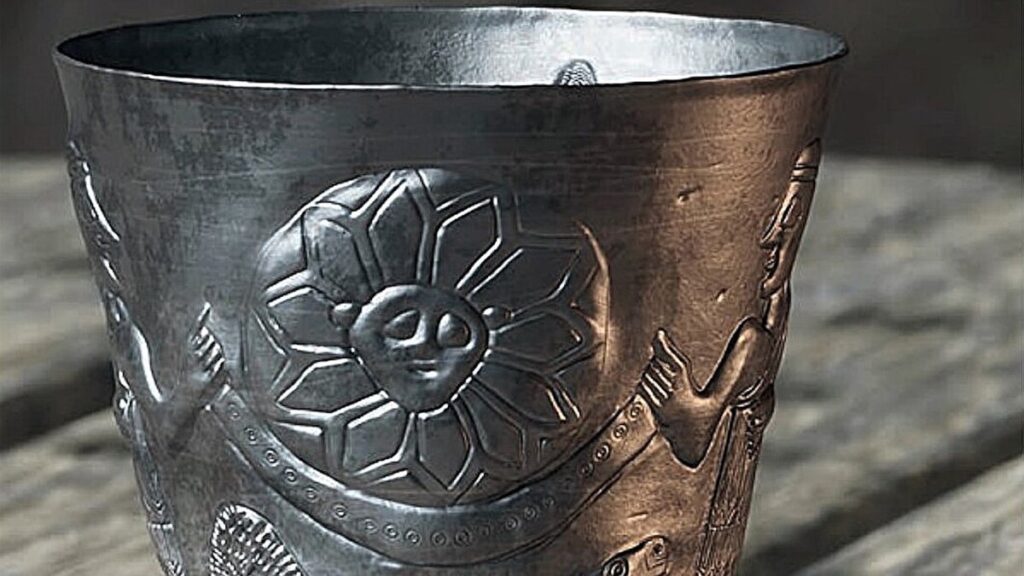
Previously thought to reflect the chaos and conflict central to the Enuma Elish, the cup’s imagery has been reexamined to suggest a more peaceful origin story. The first scene shows a half-human, half-animal figure alongside a celestial emblem, while a subsequent illustration depicts two humans with a crescent moon cradling a face inside the sun, indicating a transition from chaos to order. The researchers argue that rather than showcasing a battle, the cup symbolizes the birth of a sun deity and the successful establishment of cosmic order. They highlight stylistic choices in the artwork that suggest the passage of time, such as the evolving appearance of the deities from youthful to more aged figures, symbolizing growth and stability.
Despite the compelling arguments presented, some scholars remain skeptical, suggesting that the goblet’s engravings could reference other mythological themes beyond Babylonian narratives. The study authors acknowledge that their interpretation is one of several potential readings of the goblet’s story. Regardless of the ongoing debate, the ˁAin Samiya cup stands out as a significant archaeological find, reflecting the complex cultural and cosmological beliefs of its time. Its burial context suggests it was intended to connect the deceased with the sun’s journey, reinforcing its importance in the ancient world. As researchers continue to explore the meanings behind this artifact, it remains a captivating insight into early human understanding of the cosmos.
The message engraved in an ancient goblet’s intricate artwork may have a different meaning than experts first believed. After reexamining the renowned
ˁAin Samiya cup
, an international team of
archeologists
argue the small, silver drinkware doesn’t depict an early iteration of the
Babylonian
Enuma Elish creation myth. Instead, they now theorize that the engravings illustrate a much more peaceful origin story for the universe. If true, the vessel features one of the earliest known cosmological depictions ever recorded.
What is the ˁAin Samiya goblet?
The
ˁAin Samiya cup
was first discovered in 1970 at a gravesite in the Judean Hills, and is named after a nearby Palestinian village. Subsequent analysis dates the roughly 3.1 inch tall artifact back to the
Intermediate Bronze Age
(about 2650–1950 BCE), an era that likely featured numerous nomadic communities across the region. Given the itinerant lifestyles of these groups, archaeologists investigating the era mostly rely on relics like the ˁAin Samiya goblet that are recovered from burial sites. As for its origins, the researchers think the cup was possibly designed by someone in southern
Mesopotamia
, but produced in northern Mesopotamia or even present-day Syria due to the region’s vast silver resources.
Although considerably damaged, researchers previously managed to reconstruct the majority of the cup’s decorative art. The first scene appears to show a half-human, half-animal figure gripping plants with a celestial emblem or rosette between its legs. Based on similar artwork from the time period, experts believe that the figure’s legs each belong to a separate bull splitting off from the main body. A large, fearsome snake also stands beside the individual. A second illustration appears to showcase a later event, and includes two humans holding ends of a crescent containing a face inside the sun. Here, the snake appears subdued and lays underneath the crescent.
Two sides of the original goblet discovered in 1950. Credit:
A recreation of the artwork featured on the cup. Credit: Journal of the Ancient Near Eastern Society “Ex Oriente Lux” (2025)
A different creation story
For decades, many scholars contended that the cup shows an early variant on the
Enuma Elish
myth. Central to the ancient Babylonian religion, the tale recounts the god Marduk’s battle with the sea goddess of chaos, Tiamat. After defeating her, Marduk then uses her body to build the cosmos, Earth, and humans.
However, critics cite multiple issues with this explanation for the ˁAin Samiya cup’s artwork. First, the scenes fail to show any violence or fighting, which is central to the Enuma Elish legend. The timeline also doesn’t quite make sense–the first true evidence of Enuma Elish’s cultural adoption didn’t begin for around another 1,000 years after the goblet was crafted.A team from Switzerland’s University of Zurich and the University of Toronto in Canada think this longstanding, Babylonian-tied reasoning requires some revision. Their take is laid out in a study published in the
Journal of the Ancient Near Eastern Society “Ex Oriente Lux
.
”
Instead of a cosmological birth through bloody combat, they argue the ˁAin Samiya goblet tale begins with an era of chaos and ends with order. The first scene doesn’t show a proto-Marduk readying for battle, but the birth of an unknown sun deity. Meanwhile, the cup’s final section celebrates the god’s successful ordering of the universe.
“The artist has effectively depicted the passage of time through a series of simple stylistic choices,” the study’s authors wrote. “For example, on the left, the sun appears quite small, demonstrating its recent birth, while on the right it appears to have grown and radiates strength and happiness.”
The team adds the two deity illustrations are about the same size, likely indicating their immortality. That said, the passage of time is still noted in the artwork.
“Instead of bare skin, they later wear an elegant tunic, their headgear is more modern, and their ears are adorned with earrings,” they explained before adding that a, “few wrinkles on their necks may indicate that even the gods are aging.”
The serpent also shows signs of visible aging. During the chaotic era, it “stood tall and looked assertive” but finally “appears bent over” thanks to the “efforts of the great gods who actively maintain cosmic order.”
A recreation of the artwork featured on the cup. Credit: Credit: Journal of the Ancient Near Eastern Society “Ex Oriente Lux” (2025)
Remaining ancient mysteries
To bolster their interpretation, the authors noted striking similarities between other Near East cosmological creation art, including parallels across Egypt, Anatolia, and Mesopotamia. Multiple cultures include a crescent-shaped boat ferrying celestial objects across the sky, while bull-human entities can be found in other places.
However, not everyone is fully convinced yet, and even the study authors conceded this is simply another potential read of the goblet’s story. Speaking with
Smithsonian
magazine
, Princeton Theological Seminary biblical scholar Mark Smith suggested it could reference other myths like the Baal cycle.
“I think the objection to assuming that it’s a Babylonian creation story is correct, but it’s not clear that this is a creation myth at all,” Smith said.
Still, most experts can agree that cup remains one of the most remarkable finds from an era notorious for its comparative lack of archaeological evidence. Its ultimate resting place also speaks to its symbolic significance.
“The purpose of the burial object was to connect the soul of the deceased with the journey of the sun, ultimately to heaven,” the study’s authors concluded.
The post
4,000-year-old silver goblet tells a tale of chaos and order
appeared first on
Popular Science
.


