Guiding Artemis: Brian Alpert Turns Lessons Learned Into Lunar Progress
Brian Alpert’s journey into the aerospace industry took a pivotal turn during his sophomore year of college, when a seminar by Tricia Mack from NASA’s Johnson Space Center ignited his passion for space exploration. Mack’s insights into the intricacies of planning spacewalks and supporting operations from Mission Control inspired Alpert to pursue a career at NASA. After earning a co-op position at Johnson, he made a beeline to Mack’s office, marking the beginning of an impressive 18-year career at the agency. Today, Alpert serves as the cross-program integration deputy for NASA’s Human Landing System (HLS), a critical component of the Artemis program that aims to return astronauts to the lunar surface. His role involves coordinating with various Artemis initiatives, ensuring seamless communication and integration among different teams, and addressing challenges that arise during the mission planning process.
Alpert’s extensive experience at NASA has equipped him with a unique perspective on the importance of teamwork and adaptability in the face of challenges. He has held multiple roles, including spacewalk crew instructor and flight controller, and has directly contributed to high-stakes missions, such as addressing spacesuit failures during a spacewalk on the International Space Station. His commitment to collaboration and problem-solving is evident in his belief that the talented individuals at NASA are what truly make the work fulfilling. Alpert emphasizes the value of the skills and lessons learned early in one’s career, which can be invaluable in future endeavors. He also enjoys the lighter side of NASA culture, participating in events like the annual Chili Cookoff and engaging in friendly trivia competitions, showcasing the camaraderie that thrives within the agency.
As Alpert reflects on his career, he acknowledges the significant changes NASA has undergone since he became a full-time employee in 2009. His approach to navigating these changes involves setting clear goals for himself and his team, which helps maintain focus on their mission amid the inevitable challenges. Alpert’s journey from a college student inspired by a NASA seminar to a key player in the Artemis program exemplifies the opportunities available within the aerospace industry and serves as an inspiring reminder of the impact of mentorship and passion in pursuing one’s dreams.
Brian Alpert’s path was always destined for the aerospace industry, but his journey turned toward NASA’s Johnson Space Center during his sophomore year in college. That was when Tricia Mack, who works in NASA’s Transportation Integration Office within the International Space Station Program, spoke to his aerospace seminar about planning spacewalks, training crews, and supporting operations from the Mission Control Center in Houston.
Alpert was inspired to join the agency and later earned a spot as an engineering co-op student at Johnson. “My first stop after new employee orientation was Tricia’s office,” he said.
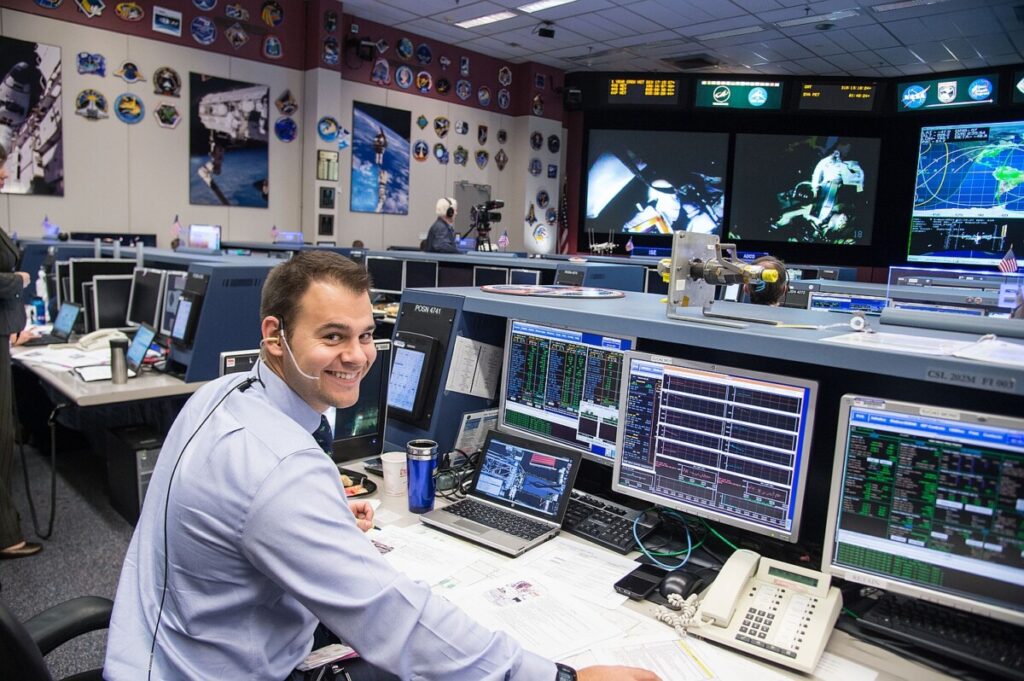
Brian Alpert supports a spacewalk outside of the International Space Station from the Mission Control Center at Johnson Space Center in 2015.
NASA/Bill Stafford
Eighteen years later, Alpert is the cross-program integration deputy for NASA’s human landing system (HLS) – the mode of transportation that will take astronauts to the lunar surface as part of the Artemis campaign. In his role, Alpert is responsible for coordinating with other Artemis programs, like the Orion Program, on issue resolution, joint agreements, data exchanges, hardware integration, and reviews. He also co-leads the Exploration Atmospheres Issue Resolution Team, assessing risks to and impacts on space vehicle atmosphere, spacesuit pressure, and operational timelines for Artemis missions.
Alpert has enjoyed the opportunity to participate in several proposal reviews for Artemis program contracts as well. “NASA’s model of embracing public-private partnerships to achieve its strategic goals and objectives is exciting and will continue to expand opportunities in space,” he said.
He applies lessons learned and skills gained from his previous roles as a spacewalk crew instructor, flight controller, and systems engineer to his current work on HLS. “I hope to pass on to the next generation that skills and lessons you learn as a student or a young employee can and will help you in your future work,” he said.
Brian Alpert routes cables in the Johnson Space Center’s Neutral Buoyancy Laboratory in preparation for a crew training run in 2011.
Image courtesy of Brian Alpert
Alpert’s prior NASA roles involved memorable experiences like working to address spacesuit and vehicle failures that occurred during a spacewalk on International Space Station Expedition 32. He was serving as the lead spacewalk systems flight controller in the Mission Control Center at the time and played a key role in getting NASA astronaut Suni Williams and JAXA (Japan Aerospace Exploration Agency) astronaut Aki Hoshide safely back aboard the space station. Since Williams and Hoshide did not complete the spacewalk’s primary objective – replacing a Main Bus Switching Unit – a backup spacewalk was scheduled several days later. Alpert was on console for that spacewalk, too.
“One important lesson that I have learned through my career to date is how exceptionally talented, passionate, and hard-working everyone is here at NASA,” he said. “Whenever work gets stressful or problems get hard, there are teams of people that have your back, are willing to problem-solve with you, and can bring another perspective to finding a solution that you may not have considered.” He added that his colleagues are the best part of his job. “As much as I love what we do at NASA, what really gets me excited to come to work is all the outstanding people I get to work with every day.”
Brian Alpert completes a dive in NASA Johnson Space Center’s Neutral Buoyancy Laboratory for a spacesuit familiarization exercise in 2009.
Image courtesy of Brian Alpert
Learning how to navigate change has been an important lesson for Alpert, as well. “NASA has been through a lot of change since I became a full-time employee in 2009,” he said. “Making sure that I have clear goals for myself, my work, and my team helps us all stay focused on the mission and the work at hand and helps us prioritize projects and tasks as questions or challenges inevitably arise.”
One challenge Alpert especially enjoys? Johnson’s annual Chili Cookoff. He has participated in many cookoffs as part of the Cosmic Chili team, noting that he often dons a Wolverine costume as part of the festive fun. He also welcomes a space trivia challenge – and a chance to add to his collection of trivia trophies.
Explore More
3 min read
NASA signs US-Australia Agreement on Aeronautics, Space Cooperation
Article
2 months ago
7 min read
International Space Station: Launching NASA and Humanity into Deep Space
Article
2 months ago
4 min read
Astronaut Candidates Get to Work at Johnson Space Center
Article
2 months ago


