Taiwan is sending everyone a handbook to prepare them for war. Here’s what’s inside.
Taiwan is taking significant steps to bolster its national security amid rising tensions with China, which has long considered the self-governing island a part of its territory. In a proactive move, Taiwan’s Ministry of National Defense announced the distribution of 11 million national security handbooks to every household on the island, which has a population of approximately 23.3 million people. This comprehensive guide, first introduced in 2022 and expanded in 2023, is designed to prepare civilians for potential crises, including military conflict. While the handbook does not directly name China as a threat, the scenarios and maps included in the guide strongly indicate that Beijing’s aggression is a central concern. This initiative aligns with similar efforts by countries like Finland and Sweden, which have also released civil defense handbooks in light of geopolitical tensions, particularly regarding the war in Ukraine.
The handbook offers practical advice on various aspects of crisis preparedness, emphasizing the importance of household logistics and emergency supplies. It encourages families to maintain a rolling stockpile of essentials that can last at least a week, including dry foods, water, hygiene products, and emergency items like portable gas stoves and flashlights. Additionally, it outlines the importance of having a go-bag ready for quick evacuation, which should contain necessities such as water, ready-to-eat food, medical supplies, and identification documents. The guide also addresses military threats, detailing potential scenarios such as sabotage of critical infrastructure and air raids, while advising civilians on how to respond to these situations. For instance, in the event of an air raid, individuals are instructed to stay away from walls and windows to minimize injury from shockwaves.
Moreover, the handbook underscores the psychological aspect of preparing for a crisis, encouraging families to discuss their anxieties and practice stress-relief strategies. It emphasizes the need for parents to engage their children in conversations about the potential realities of war, fostering an environment where children can express their fears and learn to differentiate between credible information and disinformation. This comprehensive approach not only aims to equip Taiwanese citizens with the necessary skills and knowledge to navigate potential crises but also seeks to build a resilient community capable of responding effectively to threats. As Taiwan continues to enhance its defense readiness, these handbooks serve as a crucial resource for promoting national security awareness and preparedness among its citizens.
https://www.youtube.com/watch?v=QQQ8282bQUU
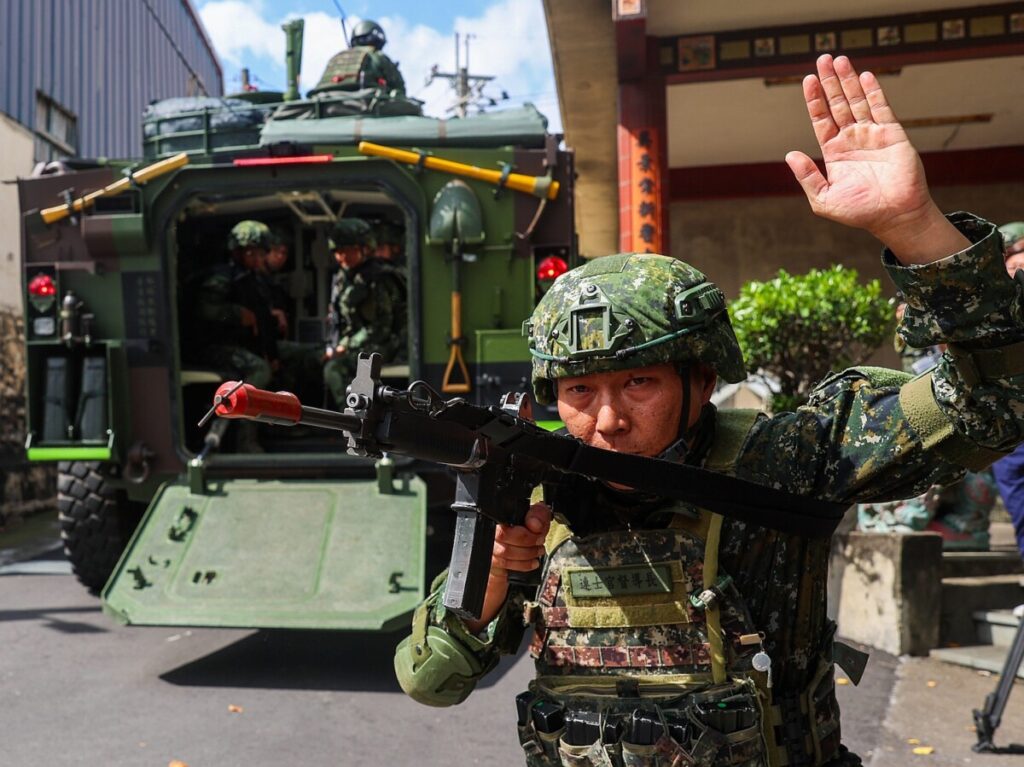
Taiwan has been training its soldiers how to prevent Chinese forces from pushing further into cities on the island.
Daniel Ceng/Anadolu via Getty Images
Taiwan is rolling out 11 million national security handbooks to all households on the island.
The guides contain concrete tips on what civilians should do now to prepare for a war or crisis.
They include detailed steps on how to pack go-bags, stock up on supplies, and form contingency plans.
Taiwan has a new manual for times of
crisis and war
, and it’s making sure that everyone receives one.
The local national defense ministry said on Tuesday that it was sending 11 million copies of the new handbook, which was revealed in September, to all households across the island.
The self-governed island is home to roughly 23.3 million people.
Taipei first published a civil defense handbook in 2022, then expanded it in 2023. Countries such as Finland, Sweden, and Lithuania have also released similar guides amid concerns about a potential war with Russia.
But
Taiwan’s new edition
features a revamped style with graphics and simple tips catering toward the wider public. It’s also the first year that Taiwan is launching a massive mailing campaign to distribute the handbooks.
While the 2025 National Public Safety Guide did not specifically name mainland China, Taiwan’s de facto military concern, as a threat, maps and posited scenarios in the book strongly suggest aggression from Beijing as a key concern.
Such guides also cover disasters such as nuclear accidents or earthquakes, but offer specific insight into how militaries around the world expect civilian populations to prepare for urban conflict.
Here’s what Taiwan’s new handbook teaches its people about war at home.
Take stock of your household
Participants take part in a mass casualty evacuation event during annual exercises.
I-HWA CHENG/AFP via Getty Images
The handbook begins by asking readers to consider key logistics in the event that
Taiwan comes under threat.
These include:
The number of people in the household.
Older adults, pets, or children who may need special attention.
Food supplies for short periods.
Medicine stocks for chronic conditions.
A radio and cash at home.
Any landlines in case phone or internet communications are severed.
Portable batteries that are charged.
Keeping more supplies than needed at home
Taiwan has been running drills at warehouses with supermarket workers to simulate wartime conditions.
Daniel Ceng/Anadolu via Getty Images
The handbook advises maintaining a rolling stockpile of supplies that can last for at least one week. This means that households would consume food and necessities from their stockpile while regularly replenishing it, rather than buying only what they need at present.
The items that Taiwan recommends include:
Dry foods such as nuts, instant noodles, canned goods, and chocolate.
At least 3 liters, or about 3.17 quarts, of water per day per person.
Household items such as gloves and plastic bags.
Hygiene items, including contact lenses, sanitizing wipes, and feminine hygiene products.
Baby supplies or items for older adults, such as baby formula or hearing aids.
Emergency items such as a portable gas stove, LED lamps, dry cell batteries, and water purifiers.
Prepare a go-bag
I-Hwa Cheng / AFP via Getty Images
A go-bag is a pack of easily transportable necessities that households have on standby in case they need to flee quickly.
Taiwan’s suggestions for a standard go-bag include:
Two 600ml, or 20-ounce, bottles of water.
Some ready-to-eat foods.
Medicine, sanitary items, simple cleaning materials, and pain relief medication.
IDs, health insurance information, and financial documents.
Clothes for colder or wet weather.
Durable walking shoes.
A whistle.
Charging accessories.
A Swiss army knife.
Paper, pen, and maps.
A portable radio with batteries.
Military threat scenarios
Taiwan has been ramping up national defense preparedness as tensions with Beijing continue to sour.
Daniel Ceng/Anadolu via Getty Images
This year’s edition listed several specific hostile or sabotage scenarios, going into more detail than previous versions. While these do not mention China, they were accompanied by a map of China’s southeastern seaboard and the Taiwan Strait.
The listed threats are:
Sabotage of undersea cables or critical infrastructure.
Enemy naval patrols that may insist on boarding Taiwanese vessels.
Live-fire drills near Taiwan.
A no-fly zone being created around Taiwan under the guise of
military exercises.
Hostile drones flying in Taiwan’s airspace.
Blocking of traffic and commercial activity across the
Taiwan Strait.
Direct attacks or acts of armed aggression.
Infiltration or sabotage.
What to do in a ground invasion
Beijing has long stated that its goal is to reunify with Taiwan, which would likely require it to conduct a cross-strait invasion should war break out.
Daniel Ceng/Anadolu via Getty Images
Taiwan’s previous handbook came with identifiers for military uniforms from mainland
China’s People’s Liberation Army
and the island’s Republic of China Armed Forces.
But these were missing from this year’s edition, which suggested that enemy forces could disguise themselves anyway.
“Civilians may have trouble telling the difference between friendly and non-friendly forces, since distance, surroundings, and other factors can create confusion,” the handbook said.
The handbook told civilians to leave the area as soon as possible if they see any military activity, and not to share footage of Taiwanese military movements online.
How to survive air raids in Taiwan
People take shelter during an air raid drill.
I-HWA CHENG/AFP via Getty Images
While the best way to survive an air raid is typically to seek an underground shelter, Taiwan’s handbook said that if time is short, civilians should stay away from walls, doors, and windows to lower the chances of injury from shockwaves of debris.
The guide encouraged those stuck outside to lie flat on the ground, cover their heads, slightly open their mouths, and turn away from the explosion.
Dealing with stress and anxiety
Taiwan suggested that civilians prepare go-bags with their children.
I-HWA CHENG/AFP via Getty Images
The handbook encourages people to talk about their
stress or anxiety
, while limiting exposure to non-essential news or online information to avoid feeling overwhelmed.
“Maintain a good diet, sleep, and exercise regimen to stay healthy and relieve stress,” it added.
Discussing war with kids
Children practice how to survive in war during an exercise held by a civil defense organization.
I-HWA CHENG/AFP via Getty Images
The handbook specifically suggests that parents prepare go-bags with their children, and encourage kids to talk openly about their anxieties about war.
They should also intentionally teach kids how to distinguish legitimate news from disinformation, the handbook said.
Set emergency meeting points with family
Taiwan suggests that households set at least three meeting points that all members remember.
Daniel Ceng/Anadolu via Getty Images
The guide specifically recommends that families start designating three emergency points that all members know how to reach, and have everyone memorize the contact information of three key family members or friends.
They should also familiarize themselves with evacuation routes in their neighborhood, while noting the nearby air raid shelters or aid points.
Basic medical aid skills
Members of a Civil Defence volunteer group take part on a drill while practicing rescue and medical care operation of wounded soldiers.
Alberto Buzzola/LightRocket via Getty Images
The guide also contains simple first aid instructions, specifically for what to do when dealing with toxic chemicals,
nuclear scenarios
, burns, bleeding, and resuscitation needs.
Warnings about apps and phones from mainland China
US lawmakers have also raised concerns about Chinese applications being a potential national security threat.
Nikolas Kokovlis/NurPhoto via Getty Images
The handbook specifically warns of data collection risks from popular phone apps developed in China, including the AI platform DeepSeek, the
social media apps RedNote
and TikTok, and the messaging platform WeChat.
“Additionally, some Chinese-brand devices with camera functions, such as surveillance cameras and image sensors, could also lead to privacy leaks,” the guide said.
The US has raised its own concerns about Chinese-made apps as potential national security threats, most notably when Congress passed a law in 2024 that compels ByteDance, the Beijing-headquartered
owner of TikTok
, to divest from its app or face a ban from the US.
Read the original article on
Business Insider


