Why Trump Gets Away With It
In a reflective piece on the state of American democracy, the author draws parallels between the tumultuous events surrounding Richard Nixon’s resignation in 1974 and the current political climate under Donald Trump. On a poignant August day over 51 years ago, Nixon, facing the fallout from the Watergate scandal, made his exit from the White House, leaving behind a nation grappling with the implications of political corruption and a compromised presidency. Gerald Ford, who succeeded Nixon, emphasized the need for healing and reconciliation in his inaugural address, reminding Americans that their government is based on laws rather than the whims of individuals. However, the author argues that the foundational norms and guardrails that once guided the country through crises have eroded in recent years, leading to a concerning landscape where the rule of law and constitutional checks on presidential power seem increasingly fragile.
The article delves into the specifics of the Watergate scandal, highlighting the bipartisan efforts to uncover the truth, including the critical role played by journalists Bob Woodward and Carl Bernstein. It contrasts this historical accountability with the present-day scenario, where Trump’s administration has faced numerous legal challenges and accusations of defying court orders. The author notes a significant decline in public trust in the media, which once served as a pillar of democracy, with only 28% of Americans expressing confidence in mass media as of last month. This decline, coupled with a perceived partisanship in the Supreme Court and a Congress that appears to capitulate to presidential demands, paints a grim picture of the current checks and balances. The author warns that the absence of a robust media landscape and the erosion of local news sources exacerbate political polarization and disengagement among citizens, undermining the accountability that is vital for a healthy democracy.
Ultimately, the piece calls for a concerted effort to rebuild trust in the news system and reestablish the norms that have historically underpinned American democracy. The author emphasizes the importance of local journalism in fostering community engagement and informed citizenry, suggesting that restoring a shared understanding of facts is essential for meaningful political discourse. As the nation reflects on its past, the hope is that a renewed commitment to the principles of governance articulated by Ford—where the rule of law prevails and the people truly govern—can guide the way forward in overcoming the challenges posed by contemporary political dynamics.
https://www.youtube.com/watch?v=5e2oQISK7Fw
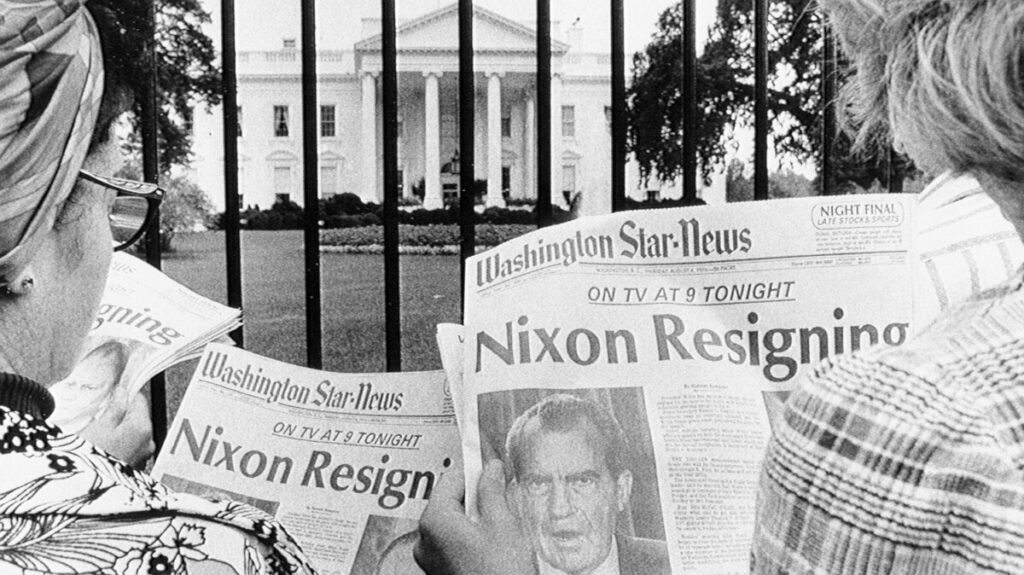
On a hot, drizzly Friday in August more than 51 years ago, I stood with other reporters on a temporary riser outside the East Wing of the White House. There, we watched as a disgraced Richard Nixon climbed the stairs to a presidential helicopter, turned at the doorway, extended his arms in a bizarre victory salute, and flew off into history.
A short time later, we were ushered into the East Room, where Nixon had earlier given an emotional farewell speech to his staff. There we witnessed the swearing-in of Gerald Ford as the 38th president of the United States. In a brief, eloquent address to an overflow crowd of more than 300, Ford called for healing and reconciliation. “Let brotherly love purge our hearts of suspicion and of hate,” he urged.
At the end of the ceremony, Chief Justice Warren Burger, who had administered the oath of office to Ford, put his hand on the shoulder of Senate Minority Leader Hugh Scott, a Republican from Pennsylvania, and
said with tears in his eyes
, “Thank God, it works.” Burger clearly meant the Constitution, the rule of law, the system of checks and balances, and a peaceful transfer of power under the unprecedented circumstances of the Watergate scandal.
It hasn’t been working lately.
Taking my brother-in-law on a Washington sightseeing tour not long ago, I walked with him past the White House, where a crane was at work demolishing the last of the East Wing to make way for President Donald Trump’s grandiose gilded ballroom. A uniformed Secret Service agent wearing body armor, a pistol holstered across his chest, stood guard at a closed gate that had admitted thousands of visitors a year to the “people’s house.” I couldn’t help thinking that, just as the historic structure of the East Wing is gone, so too are the norms and guardrails that got the country through a crisis half a century ago.
[
Read: White House architecture was an honor system. Trump noticed.
]
Recall how Watergate unfolded. Burglars paid by the Nixon reelection campaign bugged telephones at the Democratic National Committee headquarters in Washington’s Watergate complex. They were caught in the act after a night watchman discovered tape over a door latch and called the police. The scandal broadened and climbed, revelation by revelation—much of it through the reporting of journalists,
The Washington Post
’s Bob Woodward and Carl Bernstein. A bipartisan Senate Watergate Committee was formed and held hearings, trying to find the truth. It was a Republican senator, Howard Baker of Tennessee, who kept asking two key questions: “What did the president know, and when did he know it?” A witness revealed that there was an Oval Office taping system that recorded the conversations there. A unanimous Supreme Court ordered Nixon to turn over the tapes to a special prosecutor appointed by his own Justice Department. The president, having previously refused, then complied. A “smoking gun” tape revealed that Nixon had plotted to block investigators as he campaigned for reelection. The leaders of his own party in Congress went to the White House to tell him that he was almost certainly going to be impeached and convicted. And Nixon was soon on that helicopter leaving office.
It’s hard to imagine any of this happening today. The checks on the presidency have all grown weaker.
The Constitution? The current president of the United States has issued an executive order ending birthright citizenship, despite the fact that it is clearly set forth in the Constitution. He toys with the idea of running for a
third term
, even though the Constitution bans this. Earlier this year, when a reporter on Air Force One asked Trump if he would leave office in January 2029, he responded, “Next question.” More recently, Trump acknowledged that he can’t run again, as much as he’d like to. But can we trust that as his final word—like his promise, before the wrecking crews went to work, that his new White House ballroom wouldn’t “interfere with the current building”?
The rule of law? According to a
New York Times
tracker
, the current Trump administration has been sued hundreds of times in its first 10 months, over issues including immigration policy, federal-funding cuts, tariffs, the firing of federal workers, climate and environment policy, and transgender rights. More than one federal judge has said that the administration has violated court orders. A
Washington Post
analysis
in July found that Trump officials were accused of defying or evading such orders in more than a third of the cases filed against the administration up to that time. So far, no judge has started contempt proceedings, perhaps in part out of fear that the U.S. Marshals Service, under administration control, would refuse to serve subpoenas or take officials charged with defiance into custody. Most recently, the White House all but openly defied a court order to continue paying for food stamps for low-income Americans during the government shutdown. One federal judge, Mark Wolf, appointed by President Ronald Reagan, was so disturbed by the “White House’s assault on the rule of law” that he
chose to resign
so he could speak out.
Fairly or not, today’s Supreme Court is seen as far more partisan than the one led by Burger, who in fact was one of four justices appointed by Nixon. Today’s Court, with three Trump appointees, offers little resistance to the president. In the 2024 case
Trump v. United States
, the justices ruled that a president has broad immunity from being criminally charged for official acts. Last week’s oral arguments in a case concerning the legality of Trump’s tariffs suggest that a majority on the Court might finally be willing to stand up to the president. We’ll see.
[
Idrees Kahloon: The court must decide if the Constitution means what it says
]
Congress as a check on presidential power? The Senate and House, under Republican control, have been largely supine as the Trump White House has refused to spend money appropriated by Congress, attempted to gut federal agencies created by Congress, and undertaken military action abroad without congressional authorization. Taking their cues from a president who threatens to oppose the reelection of members who don’t follow his demands, Republican congressional leaders for weeks publicly refused to negotiate with their Democratic counterparts to end the government shutdown, before Senate Democrats ultimately caved. The speaker of the House delayed swearing in a new Democratic member who would be the final signature needed on a discharge petition forcing a House vote on whether to compel the Trump administration to release files related to the convicted sexual predator Jeffrey Epstein, once a friend of Trump, whose name
appears in the files
.
The news media? In 1972, as Watergate began, a poll found that the television news anchor Walter Cronkite, of
CBS Evening News
, was more trusted than any candidate for major public office. By the end of Watergate, Woodward and Bernstein were celebrities portrayed by Robert Redford and Dustin Hoffman in
All the President’s Men
. In 1976, more than 70 percent of Americans polled by Gallup had a “great deal” or “fair amount” of trust in mass media—newspapers, television, and radio. Last month, that number had plummeted to
28 percent
. In the intervening years, the news system has suffered repeated blows, including the economic collapse of the traditional newspaper industry, the rise of social media filled with mis- and disinformation, and a president who declares journalists “the enemy of the people.”
As a reporter, I sat in Judge John Sirica’s courtroom and listened to the first public airing of the Watergate tapes, in which an angry, profane Nixon declared to his top aides, “Well, the game has to be played awfully rough.” I’ve never forgotten a saying born during that time: “It’s not the crime; it’s the cover-up.” But there’s no cover-up these days. Corruption that once would have precipitated congressional investigations and quite possibly criminal proceedings is out in the open for all to see. The president has ordered his Justice Department to charge those he deems enemies with crimes, no matter how thin the evidence, and when career prosecutors refused, they were forced out and replaced by an inexperienced loyalist. Trump is demanding that the Justice Department pay him $230 million as compensation for investigations into his past actions; his former defense lawyers are now among the officials who will decide whether to comply. The president pardoned a cryptocurrency billionaire who had pleaded guilty to money-laundering violations; the pardon came after the man’s company
had facilitated
a $2 billion investment deal involving the Trump family’s crypto firm.
Many explanations have been offered for how we got here, among them the hollowing-out of the middle class, which left millions of Americans angry and disillusioned with the political system and ready for a Trump to tear it down; a broad collapse of trust in virtually all institutions, including the news media; a president who stirs culture wars in an ever more polarized society, while diverting attention away from the threat he poses to democracy. For Trump, politics isn’t about principle or serious public policy. It’s entertainment—getting and holding attention through any means possible.
I’m not prescient enough to know if we will return to a healthier society with a properly functioning federal government. The most recent election results, which featured high turnout and led to Democrats sweeping into state offices in Virginia, New Jersey, and even Mississippi and Georgia, suggest that a backlash against Trumpism is under way. But one thing that my long career as a journalist tells me is that restoring civility and community will require rebuilding a trusted news system.
[
Quinta Jurecic: The third Red Scare
]
Local media should be a particular focus. National media may have their problems with trust, but local news, where engagement with community and the larger world begins, is disappearing altogether. Over the past two decades, according to the State of Local News Project at Northwestern University’s Medill School of Journalism, nearly 40 percent of all local newspapers have shut down, leaving 50 million Americans with little or no reliable news about their communities. That includes Friday-night high-school football scores, official decisions at city-commission meetings, and data about local crime. The result is that people are disengaged from their communities. Politics is more polarized, voter turnout in local elections is lower, and fewer public officials are held accountable. Some initiatives are trying to fill the gap. The American Journalism Project, for example, gives grants to local nonprofit news organizations, helps communities start new outlets, and provides coaching for newsroom leaders.
Only when we share the same facts can we begin to have a healthy debate about what they mean and what should be done about them. And then, hopefully, we can start rebuilding the other institutions that have undergirded our democracy for nearly two and a half centuries, and that got us through the Watergate years. Perhaps that will allow us to move on from a president who
posted an AI video
of himself wearing a crown and flying an airplane dumping excrement on millions of his fellow citizens.
Gerald Ford gave us the way forward the day he was sworn in: “Our great republic is a government of laws and not of men,” he said. “Here the people rule.”


