Wyoming dinosaur mummies give us a new view of duck-billed species
In a remarkable advancement for paleontology, a team of researchers led by Paul C. Sereno has revisited the site in east-central Wyoming where the first *Edmontosaurus annectens* specimen was discovered in 1908 by fossil collector C.H. Sternberg. Known colloquially as the “AMNH mummy,” the original skeleton provided initial insights into the appearance of this large duck-billed dinosaur, which roamed the Earth toward the end of the Cretaceous period. The specimen, which is now housed at the American Museum of Natural History in New York, was notable for the scaly skin impressions found in the sediment surrounding it. This pivotal discovery set the stage for future research, but it wasn’t until Sereno’s recent expedition that scientists were able to uncover even more detailed anatomical features of *Edmontosaurus*.
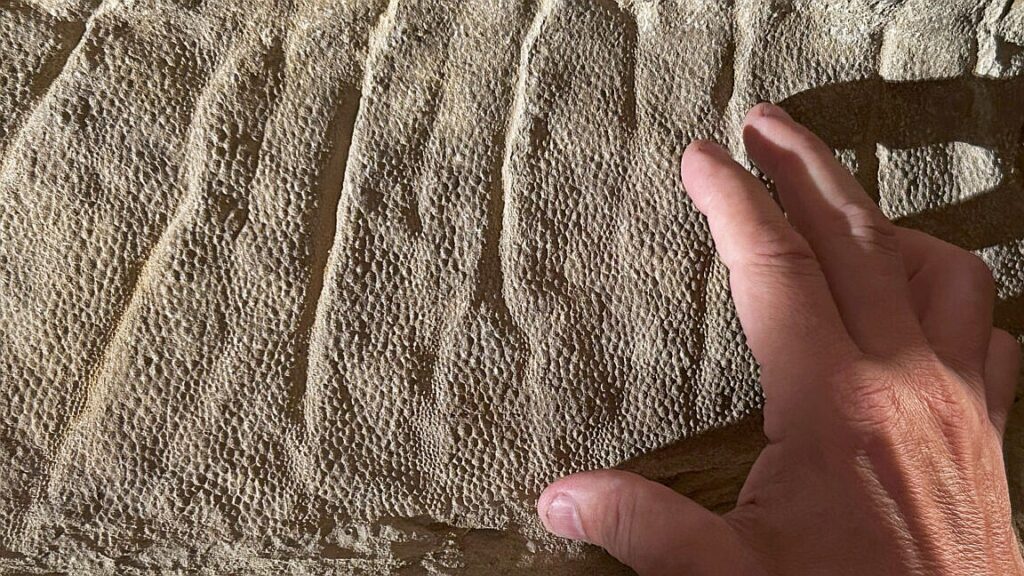
The team unearthed two additional *Edmontosaurus* mummies, preserving their external anatomy in a remarkably thin layer of clay. This unprecedented find allowed researchers to refine their understanding of what this herbivorous dinosaur looked like, revealing intricate details such as the size of its scales and the arrangement of spikes on its tail. These new discoveries challenge previous interpretations of the dinosaur’s appearance, particularly those influenced by early artistic renderings. For example, the initial drawing of *Edmontosaurus* created by renowned paleoartist Charles R. Knight in 1909 inaccurately depicted a crest extending along the entire length of the dinosaur’s body, an assumption made due to the absence of a tail in the original specimen. Sereno’s findings not only correct these misconceptions but also enhance our appreciation of the diversity of dinosaur morphology during the Cretaceous period.
This new research underscores the importance of revisiting historical fossil sites and applying modern techniques to gain deeper insights into prehistoric life. As scientists continue to analyze these new specimens, the evolving image of *Edmontosaurus* will undoubtedly enrich our understanding of dinosaur biology and ecology, offering a clearer picture of how these magnificent creatures adapted to their environments. The revelations from Sereno’s team not only contribute to the scientific community but also inspire a renewed fascination with the age of dinosaurs, reminding us that there is still much to learn from the ancient past.
Edmontosaurus annectens
, a large herbivore duck-billed dinosaur that lived toward the end of the Cretaceous period, was discovered back in 1908 in east-central Wyoming by C.H. Sternberg, a fossil collector. The skeleton, later housed at the American Museum of Natural History in New York and nicknamed the “AMNH mummy,” was covered by scaly skin imprinted in the surrounding sediment that gave us the first approximate idea of what the animal looked like.
More than a century later, a team of paleontologists led by Paul C. Sereno, a professor of organismal biology at the University of Chicago, got back to the same exact place where Sternberg dug up the first
Edmontosaurus
specimen. The researchers found two more
Edmontosaurus
mummies with all fleshy external anatomy imprinted in a sub-millimeter layer of clay. For the first time, we uncovered an accurate image of what
Edmontosaurus
really looked like, down to the tiniest details, like the size of its scales and the arrangement of spikes on its tail. And we were in for at least a few surprises.
Evolving images
Our view of
Edmontosaurus
changed over time, even before Sereno’s study. The initial
drawing
of
Edmontosaurus
was made in 1909 by Charles R. Knight, a famous paleoartist, who based his visualization on the first specimen found by Sternberg. “He was accurate in some ways, but he made a mistake in that he drew the crest extending throughout the entire length of the body,” Sereno says. The mummy Knight based his drawing on had no tail, so understandably, the artist used his imagination to fill in the gaps and made the
Edmontosaurus
look a little bit like a dragon.
Read full article
Comments