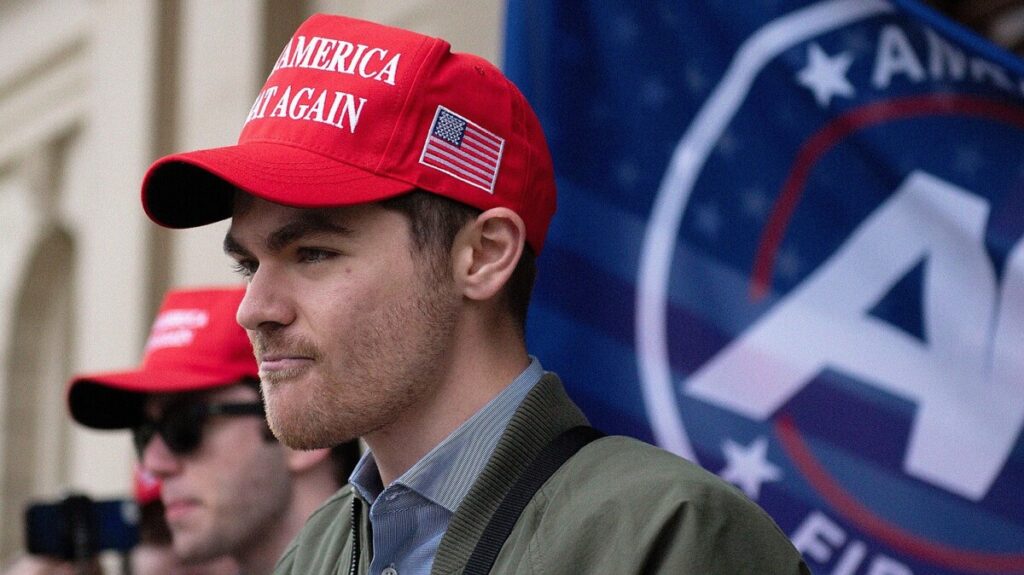
The Nick Fuentes Spiral
In a recent text exchange with Nick Fuentes, a controversial figure at the intersection of white nationalism and American conservatism, the implications of his presence in mainstream politics were starkly highlighted. Fuentes, known for his provocative and often inflammatory rhetoric—including praise for Hitler and derogatory comments about various racial and ethnic groups—has emerged as a polarizing figure within the Republican Party. His appearance on *The Tucker Carlson Show* last October reignited debates about the boundaries of acceptable discourse in conservative circles. While Carlson defended Fuentes, suggesting he is “the single most influential commentator among young men,” many prominent Republicans, including Ted Cruz and Mitch McConnell, have condemned Fuentes’s views, reflecting a deepening rift within the party.
The backlash from Fuentes’s rise has led to a significant internal struggle among conservatives, with some likening this conflict to a civil war over the soul of the movement. Figures like Ben Shapiro have explicitly rejected the Groypers—Fuentes’s followers—while others, such as Steve Bannon, have shown support for Carlson. The Heritage Foundation, a major conservative think tank, faced a staff revolt after initially backing Carlson’s decision to feature Fuentes, leading to a public disavowal of the influencer as an “evil person.” This turmoil underscores the complexities of navigating a political landscape where extremist ideologies are increasingly seeping into mainstream discussions, particularly among younger conservatives who may be more receptive to ethno-nationalist ideas.
Moreover, the implications of Fuentes’s influence extend beyond his immediate followers. As younger conservative voices adopt increasingly radical views, the boundaries of acceptable rhetoric are shifting. Influencers like Bronze Age Pervert and Charlie Kirk have echoed sentiments that align closely with Fuentes’s ideology, suggesting a growing acceptance of extreme perspectives within the right. This trend raises concerns about the long-term electoral viability of the Republican Party, as some commentators warn that the normalization of such views could alienate moderate voters. The discussion around Fuentes is not merely about one individual; it reflects a broader struggle within conservatism to define its identity and values in a rapidly changing political environment. As the party grapples with these challenges, the future of American conservatism hangs in the balance, with Fuentes at the center of an ongoing ideological battle.
On Wednesday, I texted Nick Fuentes about being the center of an existential crisis in American conservatism. Fuentes, a white-nationalist influencer, appeared on
The Tucker Carlson Show
in October, which has enraged a number of prominent figures on the right and set off a spiraling conversation about where to draw the line on whom the party welcomes into its mainstream. “I don’t consider myself to be hateful or prejudiced,” he told me. “Just provocative and maybe tribalistic.”
Fuentes has repeatedly praised Hitler, likened “organized Jewry” to a “transnational gang,” said that women should be “subordinate” to their husband, and called Chicago “nigger hell.” In our text exchange, I reminded him of a
clip
from 2019 in which he said Jim Crow “was better for them; it’s better for us.” “What that 10 seconds clip from 7 years ago that is clearly a joke?” he responded. “You think thats a fair characterization of my body of work?”
I told him that he was free to disavow his comments right then. He responded with only a “HAHA” iMessage tapback.
This is characteristically Fuentes. His winking, joking-until-he-isn’t approach has helped him amass a loyal following—his fans call themselves “
Groypers
.” Carlson explained in his interview that he wanted to speak with the influencer because “I don’t think Fuentes is going away,” and that despite attempts to unseat him, “he’s bigger than ever.” Following the backlash, Carlson doubled down, telling Megyn Kelly last week that Fuentes is “the single most influential commentator among young men.”
The interview has become the defining subject of discourse on the right over the past month. A few prominent MAGA Republican voices, including Steve Bannon, have
signaled
support for Carlson. Many others, meanwhile, have been dealing with the fallout. Politicians including Ted Cruz, Mitch McConnell, and Lindsey Graham have spoken out against Fuentes’s anti-Semitic views. Representative Randy Fine, a Florida Republican, told me that Fuentes is a “complete and total lunatic” and that everything he says is “completely wrong.” (Fine also isn’t fond of Carlson: “I’ve concluded that he’s an anti-Semite.” Carlson did not respond to a request for comment.)
“No to the Groypers,” the political commentator Ben Shapiro said on his podcast at the beginning of this month. “No to their publicists, like Tucker Carlson. No to those who champion them. No to demoralization. No to bigotry and antimeritocratic horseshit.” After Kevin Roberts, the president of the Heritage Foundation, initially supported Carlson, he faced a staff revolt that has thrown the preeminent think tank into chaos. Roberts later backpedaled and called Fuentes an “
evil person
.”
Republicans are so at odds about how to handle Fuentes’s encroachment into their ranks that many commentators have likened their infighting to a
civil war
and posed it as a battle for the soul of the conservative movement. The critics of the Groypers themselves tend to downplay the scale of the conflict. They have suggested that the deeply bigoted factions of the right are a vocal but tiny minority that can be excised. In my conversation with Fine, he described right-wing anti-Semites to me as a “small but growing” contingent that the right can still “nip in the bud.” The right-wing commentator Dinesh D’Souza
posted on X
that the rise of extreme racism on the right could be electorally ruinous “if this continues.”
This
will
continue. Fuentes is not the origin of prejudices metastasizing on the right, nor is he the end point. Today, many popular figures among young conservatives espouse some level of ethno-nationalist ideology. Consider the influencer
Bronze Age Pervert
, who has
written
that Black Africans are “so divergent from the rest of humanity,” they could be a separate subspecies. Charlie Kirk, who was heralded as a moderate against Fuentes, had drifted further rightward in the years leading up to his assassination. For instance, Kirk
called
Martin Luther King Jr. “awful” and once said that “we made a huge mistake when we passed the Civil Rights Act in the 1960s.”
“The Groyper thing is real,” Rod Dreher, a prominent right-wing writer who now lives in Hungary,
wrote on Substack this week
, after speaking with young conservatives during a trip to Washington. Even young Christians are “neck-deep in anti-Semitism,” he added. Recently
leaked chats
from Young Republican leaders suggest the same. In
internal Heritage Foundation emails discussing the Fuentes controversy
, published by the
New York Post
, one staffer for the think tank reportedly wrote: “Talking with some of the interns I think that there are a growing number of them who actually agree” with Fuentes.
In the rush to distance themselves from Fuentes, MAGA conservatives can easily downplay the extent to which Fuentes’s racist, trollish ideology has already embedded itself in the movement. It’s most apparent in younger groups, yet Groyper-speak also commonly seeps beyond those circles. Even Fuentes’s loudest critics on the right sometimes say things that sound as though they were ripped out of one of Fuentes’s notorious livestreams. Last summer, Senator Ted Cruz was among the many conservatives
who amplified the claim
that Haitian immigrants were eating cats—an unfounded notion that appears to have originated on a far-right social-media platform. At the Republican Jewish Coalition conference earlier this month, Fine called for New York City Mayor-Elect Zohran Mamdani to be deported—“the only thing I want to see him running for is his gate at JFK on the deportation flight to Uganda,” he said—and claimed that Mamdani is leading a “modern-day Hitler Youth.” In July, Fine
implied
that Representative Ilhan Omar was a “Muslim terrorist.”
When I suggested to Fine that these comments sound
Fuentes-esque
, he rejected the comparison. Mamdani and Omar should be denaturalized, he said, because they engaged in immigration fraud to become citizens. (There is no evidence for this.)
Carlson offered Fuentes his largest audience yet, but the door has been cracking open for Fuentes for years. Now MAGA Republicans, along with everyone else, have to contend with him.


