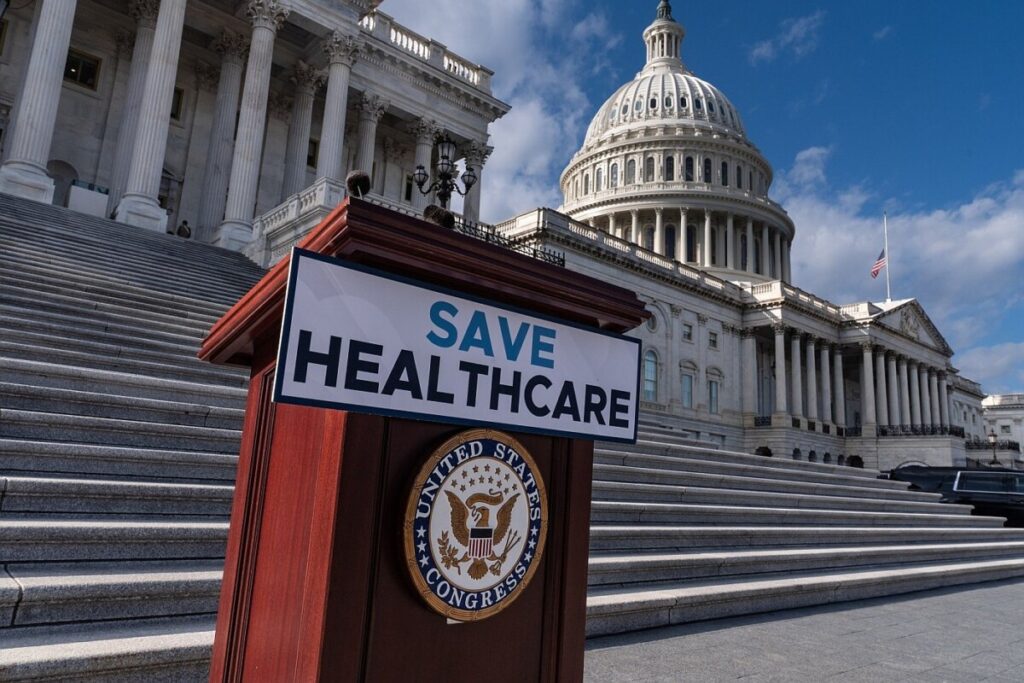
Schoen: Nobody won the shutdown, but GOP lost
The recent government shutdown, the longest in U.S. history, has concluded, and while the dust settles, it appears that President Trump and the Republican Party emerge as the clear losers. The shutdown lasted 43 days, during which Republicans struggled to present a coherent alternative to the Affordable Care Act (ACA) subsidies they aimed to let expire. Instead of addressing the pressing needs of Americans, particularly regarding healthcare and food assistance, the GOP’s stance was characterized by public opposition to feeding needy families and allowing healthcare premiums to soar. Polling data from Navigator Research during the shutdown revealed that nearly half of Americans (45%) blamed the Republicans for the impasse, with that number never dropping below a 10-point margin throughout the polling period. As the shutdown drew to a close, 48% of voters held Republicans responsible compared to just 34% blaming Democrats. This sentiment was echoed in a KFF poll, which found that 74% of Americans supported extending ACA tax credits, with a significant majority indicating they would hold Trump and the GOP accountable if those credits were not renewed.
Despite the internal strife within the Democratic Party, which has seen divisions between progressives and moderates, the Republicans’ actions during the shutdown seem to have inadvertently strengthened the Democrats’ position. The Democrats managed to secure only a promise to vote on extending healthcare subsidies and the rehiring of furloughed federal workers, leaving them with little tangible gain. However, the GOP’s failure to effectively counter the Democrats’ messaging, particularly on healthcare affordability, poses a significant risk for their electoral prospects in the upcoming midterms. The shutdown’s optics, particularly Trump’s resistance to funding Supplemental Nutrition Assistance Program (SNAP) benefits, have painted the Republicans in an unfavorable light, as they appeared to be fighting against assistance for struggling Americans.
Looking ahead, the implications of the shutdown are likely to resonate in the 2026 midterms. While Democrats may not directly benefit from the shutdown, the Republicans’ failure to support healthcare subsidies and their perceived insensitivity towards food assistance are likely to exacerbate existing trends that were evident in recent elections. The successful campaigns of Democrats in New Jersey and Virginia, which centered on affordability, showcase how voters are responding to issues of cost of living. Moreover, Democrats have previously capitalized on GOP missteps, as seen in the 2018 midterms when Trump’s attempts to repeal Obamacare without a viable alternative led to significant Democratic gains. As the GOP faces the challenge of crafting a beneficial policy response ahead of the Senate’s promised vote next month, the potential for the shutdown to serve as a tailwind for Democrats remains a pressing concern. The question now is whether the Republican Party can pivot effectively and present a viable alternative to avoid repeating the mistakes of the past.
https://www.youtube.com/watch?v=g18MTRquc_A
With the longest government shutdown in U.S. history officially over, it increasingly appears that, while there were no clear winners, the big losers were President Trump and Republicans.
Indeed, despite the intra-party fighting among Democrats, Republicans failed to present any alternative to the ACA subsidies they wanted to expire, publicly opposed feeding needy Americans, and were content to let healthcare premiums skyrocket.
Even though Democrats are weakened by divisions between progressives and moderates, it is hard to see how Republicans’ actions before and during the 43-day shutdown do not work to Democrats’ advantage.
To be sure, polling data consistently reflected that Democrats were more aligned with voters’ sentiment and attitudes.
Tracking polls from Navigator Research, conducted from the shutdown’s beginning through just before it ended, showed that initially, nearly one-half (45%) of Americans blamed the GOP, versus 32% blaming Democrats.
That advantage never slipped below 10 points in any of the six polls Navigator Research conducted, eventually settling at 48% of voters holding Republicans responsible and roughly one-third (34%) blaming Democrats just days before the shutdown ended.
Similarly, nearly three-quarters (74%) of Americans supported an extension of the ACA tax credits, with 75% of that cohort — or 56% of Americans overall — saying they would blame Trump and Republicans if they are not extended, per KFF
polling
.
Critically, this is not to say that Democrats can claim anything close to a clear “victory.”
In return for ending the shutdown, all Democrats secured was a promise to vote on extending the healthcare subsidies next month and the rehiring of furloughed federal workers.
The lack of any tangible win also worsened the ongoing ideological battle between progressives and moderates, which continues to be a drag on Democrats.
In the House of Representatives, Democrats including Minority Leader Hakeem Jeffries publicly blasted the eight moderate Senate Democrats who broke with their party to reopen the government.
Likewise, Rep. Alexandra Ocasio-Cortez blasted the whole Democratic Senate caucus, accusing them of selecting ineffective leadership, and fellow progressive Rep. Ro Khanna called for Senate Minority Leader Chuck Schumer to “resign.”
And yet, for all of the internal strife roiling the Democratic Party — not to mention Republicans’ success in ending the shutdown without any concrete agreements — President Trump and the GOP walk away the biggest losers.
By merely extending the deadline for a permanent answer to the subsidies questions, Republicans set themselves up for another fight — and potentially another shutdown — next year.
Moreover, as the government reopens, Trump and Republicans have few good options.
Their economic messaging is falling flat — the latest Morning Consult poll showed Trump’s approval on the economy to be 10 points underwater (42% to 52%) — and letting healthcare premiums skyrocket would further degrade Trump’s “affordability” message.
The optics around the just-ended shutdown also present their own challenges.
Throughout, Trump resisted efforts to fund SNAP benefits — even appealing to the Supreme Court to block lower court rulings ordering the benefits to be paid — making it appear that he was actively fighting efforts to assist hungry Americans.
Further, while it is legitimate to oppose continuing COVID-era subsidies, it is clear that Republicans were fighting for a wildly unpopular position, as the aforementioned KFF poll demonstrates.
Even conceding that Democrats perhaps should not have held the government hostage in order to achieve a win on healthcare subsidies, the GOP’s insensitivity toward making healthcare unaffordable for millions of Americans was hardly a winning message.
With that in mind, the question that remains is what, if any, electoral impact will the shutdown have on next year’s midterms?
To the extent that there are any lasting impacts, even if Democrats do not see a direct benefit, it is likely that GOP opposition to extending healthcare subsidies and responsibility for shutting off food assistance will exacerbate trends we saw in the recent off-year elections.
In New Jersey and Virginia, Democrats Mikie Sherrill and Abigail Spanberger, respectively, made affordability the center of their campaigns, and voters responded by electing them with extremely wide margins.
Furthermore, Democrats across the country were extremely successful in turning the off-year elections into referenda on Trump.
Harnessing anger toward the shutdown, state of the economy, and other policies, Democrats sidestepped their own lack of a message and used the reaction against Trump to their advantage.
Put another way, even if the shutdown does not endear voters to the Democratic Party — whose singular message remains “we are not Donald Trump” — it may well stoke anger toward Republicans.
Having been elected largely due to concerns over the cost of living under the Biden administration, Trump’s policies have either had no positive impact, or worse, actually increased costs due to tariffs.
According to both Politico and the Washington Post, White House insiders are now keenly aware that allowing the subsidies to expire without any replacement would be a severe risk ahead of midterms.
The problem facing the GOP is that it is running out of time to create or implement any beneficial policies before the Senate holds its promised vote next month.
Interestingly, we have been here before. In 2018, during Trump’s first term, he tried to repeal Obamacare without an alternative, and Democrats rode that anger to pick up 40 seats in the House.
Ultimately, whether 2026 is a repeat of the 2018 midterms remains to be seen, not least because of Democrats’ branding issues and historic unpopularity.
That being said, how Republicans navigated the shutdown figures to be a tailwind for Democrats, particularly if the GOP remains unable to provide any viable replacement to ending healthcare coverage for millions of Americans.
Douglas Schoen is a longtime Democratic political consultant.


