Supply-chain delays, rising equipment prices threaten electricity grid
The U.S. power grid is currently facing a significant crisis, exacerbated by supply chain bottlenecks that hinder the production and availability of essential electrical equipment. A striking example of this issue is highlighted by the inability of two newly built data centers in Silicon Valley to commence operations due to a lack of necessary electrical equipment. The problem extends beyond mere construction delays; it encompasses the entire infrastructure that supports the power grid, including transformers, circuit breakers, and high-voltage cables. As electricity demand in the U.S. surges—driven by the electrification of appliances, increased manufacturing, and the rapid growth of AI data centers—the need for reliable and updated grid infrastructure has never been more critical. However, the production of key components like transformers has become increasingly costly and time-consuming, with lead times stretching to unprecedented lengths; for instance, large power transformers now require up to four years for delivery.
Transformers are particularly vital to the functioning of the electrical grid, as they regulate voltage for efficient power transmission. The National Renewable Energy Laboratory estimates that over half of the 60 to 80 million high-voltage distribution transformers in service are over 33 years old, nearing the end of their operational lifespan. The escalating costs—four to six times higher than pre-2022 levels—and prolonged wait times for replacements are putting immense pressure on utility companies. The North American Electric Reliability Corporation has reported that lead times for transformers can now reach around 120 weeks, with smaller transformers also facing backorders of up to two years. This shortage is largely attributed to the reliance on a limited number of materials and suppliers, such as grain-oriented electrical steel, which is primarily produced domestically by a single company. Additionally, the logistics of transporting heavy transformers add further complications, often requiring specialized transport that can delay projects by months.
To cope with these challenges, utility companies are exploring alternative strategies, including battery storage solutions, demand management, and upgrading existing equipment. Some utilities are even stockpiling materials to mitigate delays. While the Biden administration has taken steps to address these issues—such as delaying new energy-efficiency regulations and providing funding to boost domestic production of electrical steel—experts agree that these measures are only medium-term fixes. The stark reality is that without significant investments and reforms to expand the production capabilities of crucial materials, the U.S. power grid may struggle to meet rising electricity demands in the coming years. As the country navigates these supply chain challenges, the focus must shift from merely constructing new infrastructure to effectively managing and optimizing the existing grid, ensuring reliability and sustainability for future energy needs.
https://www.youtube.com/watch?v=0UOxXzlHeJA
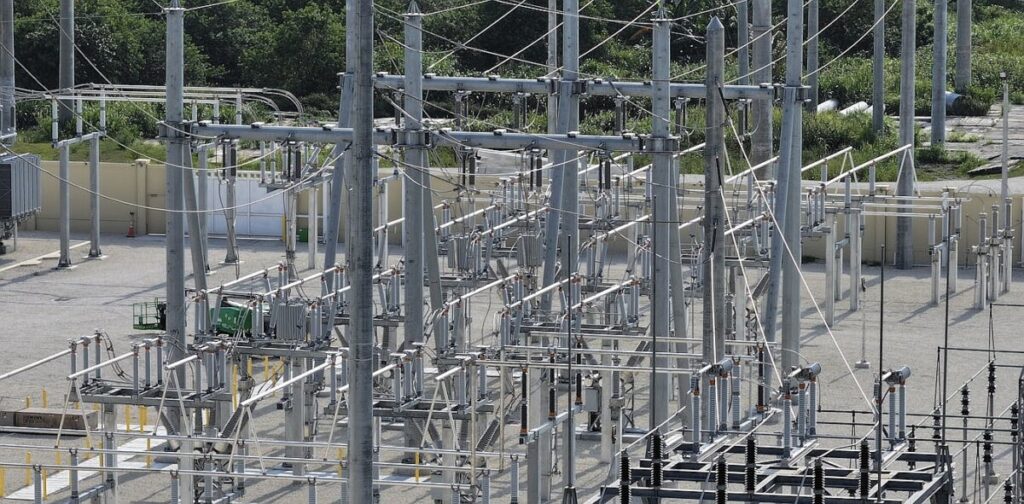
High-voltage power lines run through an electrical substation in Florida.
Joe Raedle/Getty Images
Two new data centers in Silicon Valley have been built but can’t begin processing information:
The equipment that would supply them with electricity
isn’t available.
It’s just one example of a crisis facing the U.S. power grid that can’t be solved simply by building more power lines, approving new power generation, or changing out grid software. The equipment needed to keep the grid running – transformers that regulate voltage, circuit breakers that protect against faults, high-voltage cables that carry power across regions, and steel poles that hold the network together – is hard to make, and materials are limited. Supply-chain bottlenecks are taking years to clear, delaying projects, inflating costs and threatening reliability.
Meanwhile, U.S. electricity demand is surging from several sources –
electrification
of home and business appliances and equipment,
increased domestic manufacturing
and
growth in AI data centers
. Without the right equipment, these efforts may take years longer and cost vast sums more than planners expect.
Not enough transformers to replace aging units
Transformers are key to the electricity grid: They regulate voltage as power travels across the wires, increasing voltage for more efficient long-distance transmission, and decreasing it for medium-distance travel and again for delivery to buildings.
The
National Renewable Energy Laboratory
estimates that the U.S. has about 60 million to 80 million high-voltage distribution transformers in service. More than half of them are
over 33 years old
– approaching or exceeding their expected lifespans.
Replacing them has become costly and time-consuming, with utilities reporting that transformers cost
four to six times what they cost before 2022
, in addition to the multiyear wait times.
To meet rising electricity demand, the country will need many more of them –
perhaps twice as many as already exist
.
Even smaller transformers like these are in high demand and short supply.
AP Photo/Mel Evans
The
North American Electric Reliability Corporation
says the lead time, the wait between placing an order and the product being delivered, hit roughly 120 weeks – more than two years – in 2024, with large power transformers taking as long as 210 weeks – up to four years. Even smaller transformers used to reduce voltage for distribution to homes and businesses are
back-ordered as much as two years
. Those delays have slowed both maintenance and new construction across much of the grid.
Transformer production depends heavily on a handful of materials and suppliers. The cores of most U.S transformers use
grain-oriented electrical steel
, a special type of steel with particular magnetic properties, which is made domestically only by
Cleveland-Cliffs
at plants in Pennsylvania and Ohio. Imports have long filled the gap: Roughly
80% of large transformers
have historically been imported from Mexico, China and Thailand. But
global demand has also surged
, tightening access to steel, as well as copper, a soft metal that conducts electricity well and is crucial in wiring.
In partial recognition of these shortages, in April 2024, the U.S. Department of Energy
delayed the enforcement of new energy-efficiency rules
for transformers, to avoid making the situation worse.
Further slowing progress, these items cannot be mass-produced. They must be
designed, tested and certified individually
.
Even when units are built, getting them to where they are needed can be a feat. Large power transformers often weigh between 100 tons and 400 tons and require specialized transport – sometimes needing one of only about 10 suitable
super-heavy-load railcars
in the country. Those logistics alone can add months to a replacement project, according to the
Department of Energy
.
Enormous railcars like this one in Germany are often needed to transport high-voltage transformers from where they are manufactured to where they are used.
Raimond Spekking via Wikimedia Commons
,
CC BY-SA
Other key equipment
Transformers are not the only grid machinery facing delays. A Duke University Nicholas Institute study, citing data from research and consulting firm Wood Mackenzie, shows that
high-voltage circuit-breaker lead times
reached about 151 weeks – nearly three years – by late 2023, roughly double pre-pandemic norms.
Facing similar delays are a
range of equipment types
, such as transmission cables that can handle high voltages, switchgear – a technical category that includes switches, circuit breakers and fuses – and insulators to keep electricity from going where it would be dangerous.
For transmission projects, equipment delays can derail timelines. High-voltage direct-current cables now take more than 24 months to procure, and offshore wind projects are particularly strained: Orders for undersea cables can
take more than a decade to fill
. And fewer than
50 cable-laying vessels
operate worldwide, limiting how quickly manufacturers can install them, even once they are manufactured.
Supply-chain strains are hitting even the workhorse of the power grid: natural gas turbines. Manufacturers including Siemens Energy and GE Vernova have multiyear backlogs as
new data centers, industrial electrification and peaking-capacity projects
flood the order books. Siemens recently reported a record
US$158 billion backlog
, with some turbine frames sold out for as long as seven years.
The Cleveland-Cliffs steelworks in Ohio makes a specialized type of steel that is crucial for making transformers.
AP Photo/Sue Ogrocki
Alternate approaches
As a result of these delays, utility companies are finding other ways to meet demand, such as battery storage, actively managing electricity demand,
upgrading existing equipment
to produce more power, or even reviving decommissioned generation sites.
Some utilities are
stockpiling materials for their own use
or to sell to other companies, which can shrink delays from years to weeks.
There have been various other efforts, too. In addition to
delaying transformer efficiency requirements
, the Biden administration awarded
Cleveland-Cliffs $500 million
to upgrade its electrical-steel plants – but key elements of that grant were canceled by the Trump administration.
Utilities and industry groups are
exploring standardized designs and modular substations
to cut lead times – but acknowledge that those are
medium-term fixes
, not quick solutions.
Large government incentives, including grants, loans and guaranteed-purchase agreements, could help expand domestic production of these materials and supplies. But for now, the numbers remain stark: roughly 120 weeks for transformers, up to four years for large units, nearly three years for breakers and more than two years for high-voltage cable manufacturing. Until the underlying supply-chain choke points – steel, copper, insulation materials and heavy transport – expand meaningfully, utilities are managing reliability not through construction, but through choreography.
Kyri Baker receives funding from the U.S. Department of Energy, the National Science Foundation, and The Climate Innovation Collaboratory. She is a visiting researcher at Google DeepMind. The views and opinions expressed in this article are solely those of the author and do not necessarily reflect the views of the author’s employer or any affiliated organizations.
Morgan Bazilian does not work for, consult, own shares in or receive funding from any company or organization that would benefit from this article, and has disclosed no relevant affiliations beyond their academic appointment.


