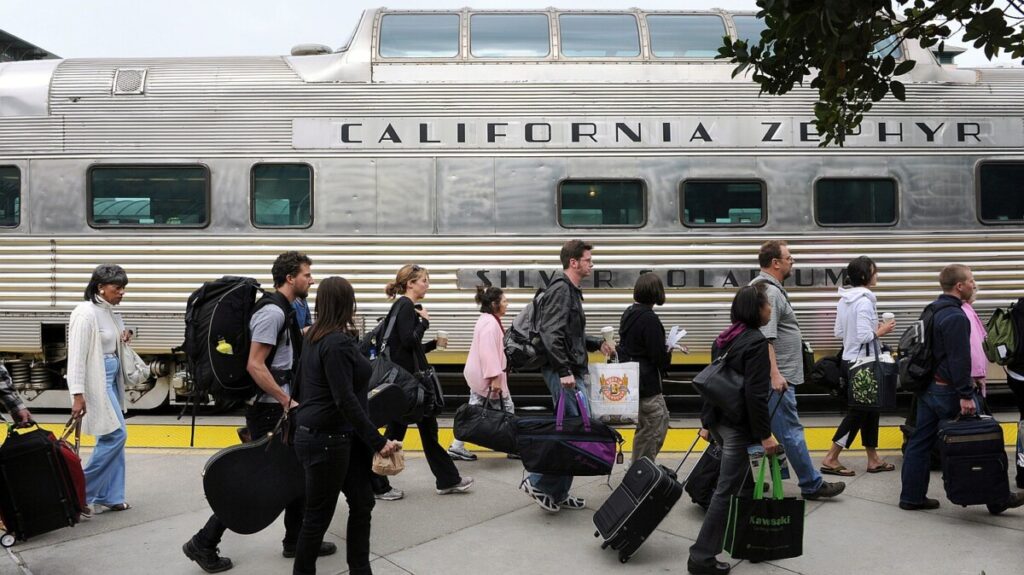
America Is Taking the Train
In a surprising turn of events, far-right Georgia Representative Marjorie Taylor Greene recently found herself praising Amtrak while traveling from Washington, D.C., to her home state due to widespread flight delays and cancellations caused by the government shutdown. Greene, who had previously voted against the Bipartisan Infrastructure Law that allocated $66 billion to improve the nation’s aging rail system, took to social media to express her newfound appreciation for train travel. She shared a video showcasing the scenic autumnal landscape of north Georgia, stating, “The sweetest people run the train,” and highlighting how the experience warmed her heart. This unexpected endorsement raises questions about the potential resurgence of rail travel in America amid ongoing chaos in air travel, which has seen thousands of flights canceled and air traffic controllers overwhelmed due to budget constraints.
As air travel remains disrupted, many travelers are turning to trains as a viable alternative. Amtrak spokesperson Jason Abrams noted that the railroad anticipates record-breaking travel for the upcoming Thanksgiving holiday, with early bookings already showing double-digit growth compared to the previous year. While train travel has historically been overshadowed by air travel—last year, only 1.2 million people opted for trains during Thanksgiving compared to approximately 18 million who flew—experts believe the current circumstances may lead to a shift in public perception. Jim Mathews, president and CEO of the Rail Passengers Association, likened the situation to the aftermath of September 11, when many travelers turned to trains due to heightened security concerns and the inconveniences of flying. With the added benefits of no TSA lines, spacious seating, and the ability to bring more luggage without extra fees, trains could attract a new generation of riders who are seeking a more comfortable and less stressful travel experience.
However, Amtrak’s challenges remain significant. The service is often plagued by delays, outdated equipment, and sparse routes, which can deter potential travelers. For example, the train connections between Albany and Boston have been disrupted for months due to a sinkhole, highlighting the infrastructure issues that still need addressing. Despite these hurdles, there is a glimmer of hope that the current travel chaos may encourage more people to consider train travel as a permanent option. Experts suggest that with effective marketing and improved service, Amtrak could capitalize on this moment to redefine its image and attract a broader audience. As Greene’s experience demonstrates, the charm of train travel might just be the antidote to the frustrations of modern air travel, offering a scenic and enjoyable alternative for those willing to embrace it.
You could almost mistake it for an ad. Last week, the far-right Georgia representative Marjorie Taylor Greene was on the Amtrak Crescent traveling from the nation’s capital to her home state, and she was enchanted. “The sweetest people run the train,” she
posted on X
, alongside a video of the autumnal landscape rushing by. “And the morning views of my north Georgia mountains made me smile and warmed my heart.”
As Greene said, she’d wound up on the train because of “flight delays and cancellations,” a result of the government shutdown. (Thousands of flights have been
canceled over the past week
, and delays have been common as unpaid air traffic controllers are overworked or walk off the job entirely.) Previously, Greene had been no particular fan of the train—in 2021, she
voted against
the Bipartisan Infrastructure Law that earmarked $66 billion to rehabilitate the country’s woefully out-of-date rail network—yet now she was embracing its charms.
[
Read: What really happens after the shutdown ends
]
Could it be that the chaos at American airports has created a small
window of opportunity
for the beleaguered rail system, which has so often been regarded as an embarrassing burden on the taxpayer? Is it possible that a form of transportation often
associated with liberal wonks
could, in the country’s hour of desperation, come through with a pleasant surprise for everyone? Is it Amtrak’s time to shine?
The shutdown is ending, but airports
won’t be back to normal
right away. Many people are turning to the train instead: Jason Abrams, a spokesperson for Amtrak, told me via email that the railroad “predicts record breaking 2025 Thanksgiving travel, with double digit growth in early bookings relative to last year.” In ordinary times, the Amtrak might appear
laughable
—it might seem ridiculous, for instance, that its trains have not been able to run between Albany and Boston or Albany and the Berkshires for the past several months because of
a sinkhole situation
affecting the tracks in Rensselaer County, New York. But these are not ordinary times, and a sinkhole is nothing compared with
Newark airport
in recent days. (Anyway, the sinkhole is almost fixed.)
[
Read: There is no good way to travel anywhere in America
]
Not everyone will be able to take a train instead of flying, obviously. Last year, 1.2 million people
traveled by train
for Thanksgiving, a pitiable number relative to the
roughly 18 million
who flew. Still, Jim Mathews, president and CEO of the nonprofit Rail Passengers Association, told me that he is “optimistic” about Amtrak’s potential to make a positive impression.
He suggested that an uptick in ridership this year could lead some to adopt Amtrak permanently and compared the post-shutdown moment, somewhat grimly, to the aftermath of September 11. Before 9/11, the most common way to travel between Washington, D.C., and New York City was via plane. Afterward, people were briefly afraid to fly, but flying also became inconvenient because of the added stress and time-sink of going through security. People tried the train and realized that it was easier and more comfortable; they could work the whole time, and they could go to a café car. In New York, they arrived in Midtown Manhattan instead of at an airport deep in Queens. And so they kept taking the train.
During the government shutdown, a lot of flight cancellations were on shorter routes. Even when that kind of flight isn’t canceled outright, a delay of something like two hours can tilt the math and make taking a train more logical. The Amtrak ride between Detroit and Chicago takes five hours, and New Orleans to Mobile, Alabama, takes four—each perhaps more appealing than getting to the airport at least an hour ahead of your flight, which may well be delayed anyway. Then there are the other, much-touted perks of trains: no TSA; no middle seat; you can bring
100 pounds of luggage for free
. Like Representative Greene, some will sit down on a train in the coming weeks for the first time in a long time, look out the window, and remember that our country, despite its current acute dysfunction, is remarkably beautiful, a pleasure to see from a new angle.
Robert Paaswell, a civil-engineering professor at the City College of New York and a very expressive train enthusiast, told me that if he were running Amtrak, he would have full-page ads in major newspapers right now. In every paper, these ads would explain to people how to find the train schedule, how to buy a ticket, how to get to the station. “That’s a generational thing,” he said. People don’t even think of the train anymore. They don’t know where it is. (I’m not sure they know where to buy a newspaper either, though.)
Actually, Amtrak does market itself
fairly successfully
to young people as a more
appealing
and
romantic
alternative to
driving
and air travel, if not a more practical one. (Over the summer, for a social-media campaign, it made the interesting choice
to depict an Amtrak locomotive
smashing a mini bag of airplane pretzels, a tiny airplane window, an uncomfortable airplane seat, and an entire airplane as it flew over a city skyline.) Over the years, Amtrak has had several great
marketing campaigns
, including the “
We’ve Been Working on the Railroad
” ads from the 1970s, which Rick Harnish, executive director of the nonprofit High Speed Rail Alliance, referred to when we spoke this week. “They did a lot of advertising to get people to come back,” he said. “And then the service wasn’t good enough to keep them.”
[
Read: A ‘death train’ is haunting South Florida
]
To name a few issues, long-distance routes are prone to dramatic delays, and the cost of sleeper rooms is extreme; you can pay thousands of dollars to spend multiple days riding in a tight space that is not nearly as cool as anything you’ve seen in a classic movie. Amtrak train cars are in many cases decades old, and the railroad is currently short on equipment, which leads to cancellations—followed, sometimes, by
seemingly random un-cancellations
.
And service is sparse. Every year, I take the train home to Rochester, New York, for Thanksgiving, which is not an eccentric thing to do but is also not common. Only about 159,000 people got
on or off a train
in Rochester in all of 2024. So, logically, only four trains from New York City stop there every day (each carrying only a few hundred people). There’s a vicious cycle: Amtrak is underfunded and thus under-used, which leads it to be further underfunded. (Why pay for a service that isn’t popular because it’s bad?) Now a significant percentage of travelers who check the Amtrak site out of curiosity will find that the train doesn’t go where they need it to, doesn’t go often enough, takes too long, or is too expensive.
When I looked this week at tickets for various routes, many of the trains for the days before Thanksgiving were sold out. Those that remain are a test of a person’s mettle—would you pay $500 to sit in an upright position for more than 20 hours to get from New York to Chicago? Would you sign up for a 10-hour-and-40-minute layover in the middle of your multiday trip from Raleigh to Syracuse, which on an ordinary day is a less-than-four-hour flight?
I suppose you wouldn’t, in regular times. This year, your choices are limited. The train may be slow, dingy, and stupid, but at least it stays on the ground.


