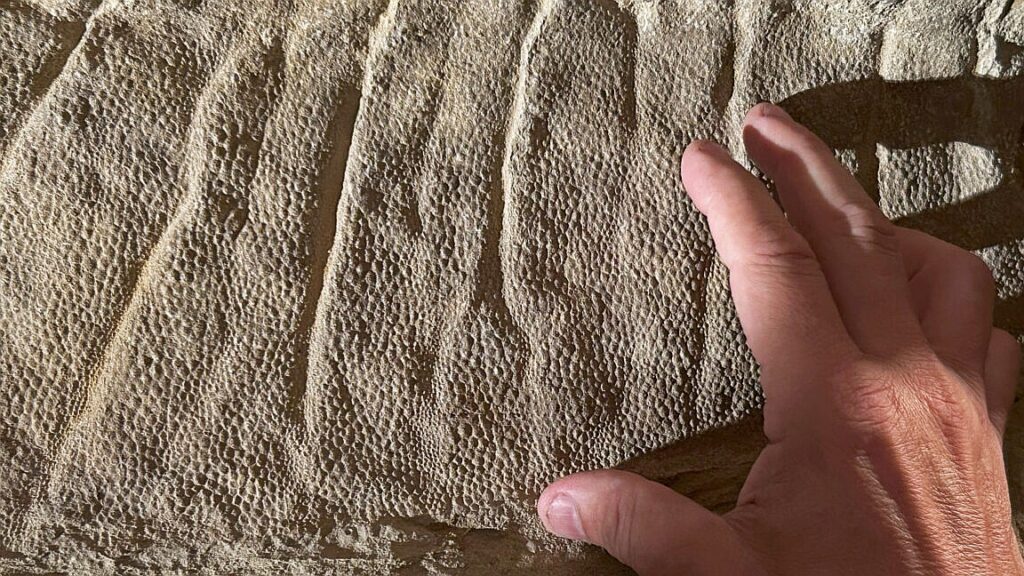
Wyoming dinosaur mummies give us a new view of duck-billed species
**Unveiling the Secrets of Edmontosaurus: A Journey Through Time**
The Edmontosaurus annectens, a prominent herbivorous dinosaur from the late Cretaceous period, has long fascinated paleontologists and dinosaur enthusiasts alike. Originally discovered in 1908 by fossil collector C.H. Sternberg in east-central Wyoming, the first skeleton of this duck-billed dinosaur, famously dubbed the “AMNH mummy,” provided groundbreaking insights into its physical appearance. Housed at the American Museum of Natural History in New York, the fossil was remarkable not only for its skeletal remains but also for the scaly skin impressions found in the sediment surrounding it, which offered an early glimpse into the dinosaur’s external features.
Fast forward over a century, and a team of paleontologists led by Paul C. Sereno, a professor at the University of Chicago, returned to the same excavation site where Sternberg made his historic find. Their efforts yielded two additional Edmontosaurus mummies, which were remarkably preserved in a thin layer of clay. This discovery marks a significant advancement in our understanding of this dinosaur, allowing researchers to examine intricate details such as the size of its scales and the arrangement of spikes on its tail. The findings have not only confirmed some previously held beliefs about Edmontosaurus but also introduced unexpected elements that challenge earlier interpretations of its appearance.
The evolution of our understanding of Edmontosaurus has been a fascinating journey. The first artistic representation of the dinosaur was created by renowned paleoartist Charles R. Knight in 1909, based solely on the initial specimen discovered by Sternberg. While Knight’s illustration captured certain aspects accurately, it also contained notable inaccuracies, such as depicting a crest that extended along the entire length of the body—an embellishment stemming from the incomplete nature of the original fossil, which lacked a tail. This highlights the challenges faced by early paleontologists and artists who relied heavily on imagination to fill in the gaps of fossil evidence. Sereno’s recent study, however, provides a more accurate depiction of Edmontosaurus, showcasing how far paleontology has come in reconstructing the lives of these ancient creatures and emphasizing the importance of ongoing research in revealing the complexities of prehistoric life.
Edmontosaurus annectens
, a large herbivore duck-billed dinosaur that lived toward the end of the Cretaceous period, was discovered back in 1908 in east-central Wyoming by C.H. Sternberg, a fossil collector. The skeleton, later housed at the American Museum of Natural History in New York and nicknamed the “AMNH mummy,” was covered by scaly skin imprinted in the surrounding sediment that gave us the first approximate idea of what the animal looked like.
More than a century later, a team of paleontologists led by Paul C. Sereno, a professor of organismal biology at the University of Chicago, got back to the same exact place where Sternberg dug up the first
Edmontosaurus
specimen. The researchers found two more
Edmontosaurus
mummies with all fleshy external anatomy imprinted in a sub-millimeter layer of clay. For the first time, we uncovered an accurate image of what
Edmontosaurus
really looked like, down to the tiniest details, like the size of its scales and the arrangement of spikes on its tail. And we were in for at least a few surprises.
Evolving images
Our view of
Edmontosaurus
changed over time, even before Sereno’s study. The initial
drawing
of
Edmontosaurus
was made in 1909 by Charles R. Knight, a famous paleoartist, who based his visualization on the first specimen found by Sternberg. “He was accurate in some ways, but he made a mistake in that he drew the crest extending throughout the entire length of the body,” Sereno says. The mummy Knight based his drawing on had no tail, so understandably, the artist used his imagination to fill in the gaps and made the
Edmontosaurus
look a little bit like a dragon.
Read full article
Comments