NASA sends twin spacecraft to Mars with a push from Blue Origin
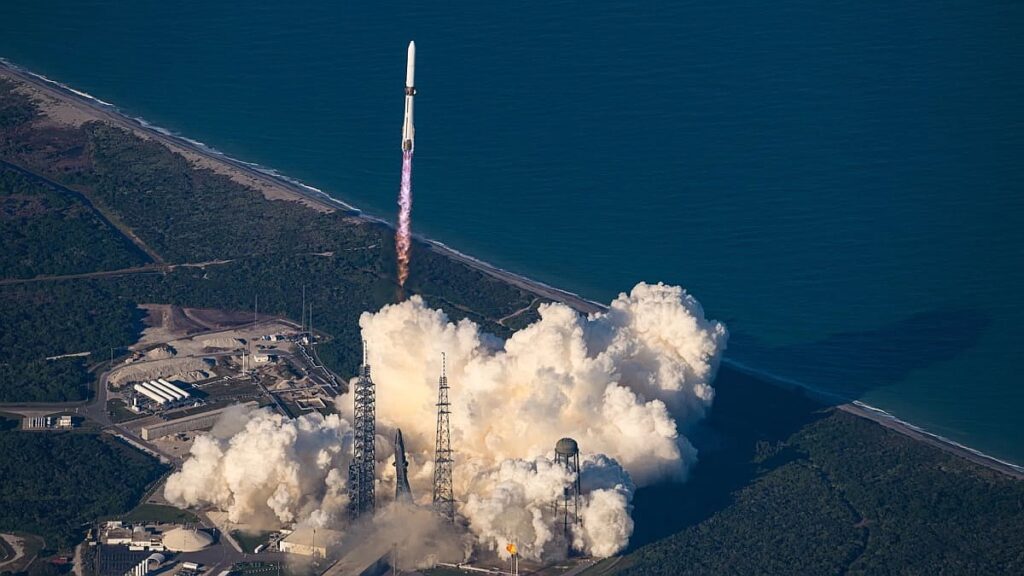
NASA has successfully launched its latest mission to explore Mars, utilizing the innovative capabilities of Jeff Bezos’ space company, Blue Origin. The mission, named Escapade (Escape and Plasma Acceleration and Dynamics Explorers), features two spacecraft, affectionately dubbed Blue and Gold in honor of the University of California, Berkeley’s school colors. The spacecraft were launched aboard a Blue Origin New Glenn rocket from Cape Canaveral Space Force Station at 3:55 p.m. ET on Thursday. By 10:35 p.m. ET, NASA confirmed that ground communications had been established with both spacecraft, marking a significant milestone in the mission’s early stages. The launch was celebrated by Blue Origin’s CEO, who shared videos of the spacecraft separating from the rocket while Earth receded in the background.
The primary objective of the Escapade mission is to investigate how solar activity influences the Martian environment, particularly how solar winds and eruptions affect the planet’s surface. This research is critical as it lays the groundwork for future human exploration of Mars. Acting NASA Administrator Sean Duffy expressed enthusiasm about the mission, stating that it would enhance understanding of how Mars transitioned into a desert-like planet. The Escapade mission is part of NASA’s Small Innovative Missions for Planetary Exploration program, with a budget of $80 million, a relatively modest sum compared to traditional missions that can run into the billions. Rocket Lab, which built the spacecraft in just 3.5 years for $57 million, exemplifies the potential for cost-effective innovation in space exploration, challenging the conventional cost-plus-fixed-fee contracts that have historically plagued NASA projects.
The Escapade mission not only promises to provide valuable insights into Mars’ environmental dynamics but also sets a precedent for future collaborations between NASA and the burgeoning commercial space industry. By successfully launching this mission with a lower budget and faster turnaround, it demonstrates a new approach to interplanetary exploration that could reshape how such projects are undertaken in the future. As the scientific community eagerly anticipates the data that will emerge from this mission, it is clear that Escapade represents a significant step forward in our quest to understand the red planet and prepare for human presence there. For those interested in the launch, Blue Origin has made the event accessible for viewing, showcasing the exciting developments in space exploration.
NASA
has launched
its latest mission to study Mars
, with a little push from Jeff Bezos’ space company
Blue Origin
.
Hitching a ride on a Blue Origin New Glenn rocket,
NASA’s pair of Escapade (Escape and Plasma Acceleration and Dynamics Explorers) spacecrafts
were launched at at 3:55 p.m. ET Thursday from Cape Canaveral Space Force Station in Florida.
Built by
Rocket Lab
, the spacecrafts are part of
NASA’s first mission led by the University of California, Berkeley
. In a frankly adorable post on X, Rocket Lab posted an image of the twins (named Blue and Gold for the school colours of UC Berkeley), confirming ground communications with both spacecrafts —
NASA said
contact was established by 10:35 p.m. ET.
This Tweet is currently unavailable. It might be loading or has been removed.
Blue Origin CEO Bezos also posted clips on X showing the spacecrafts in orbit, separating from the New Glenn rocket, with Earth far below.
This Tweet is currently unavailable. It might be loading or has been removed.
SEE ALSO:
NASA quietly sends two spacecraft to Mars — and they’re going a new way
According to NASA
, the spacecraft will be deployed to study how Mars’ environment is impacted by the sun and solar winds, and provide crucial data for preparing human exploration of the red planet.
“Congratulations to Blue Origin, Rocket Lab, UC Berkeley, and all our partners on the successful launch of ESCAPADE. This heliophysics mission will help reveal how Mars became a desert planet, and how solar eruptions affect the Martian surface,” said acting NASA Administrator Sean Duffy in a statement.
Mashable science reporter Elisha Sauers
describes more details of the Escapade mission, what it could achieve, and how much it cost
, writing:
Escapade could set a precedent for how NASA and the commercial space industry approach interplanetary missions in the future. From soup to nuts, Escapade had a budget of $80 million, under NASA’s
Small Innovative Missions for Planetary Exploration
program.
Rocket Lab
built the twin probes in just 3.5 years for $57 million, a relatively cheap price compared to the billions the agency would
normally spend
. Those costly missions are a product of legacy aerospace contracts based on the
cost-plus-fixed-fee
model, which allowed the builders to run over budget without picking up the tab.
If you want to watch the New Glenn rocket take NASA’s Escapades into the sky, you can watch Blue Origin’s stream below (the launch sits around the one hour, 40-minute mark):
For a much more detailed analysis of the Escapade mission,
Mashable’s got you covered
. And if you’re looking for a way to mark the occasion, there’s really only one song: