‘Simulation theory’ brings an AI twist out of ‘The Matrix’ to ideas mystics and religious scholars have voiced for centuries
In an intriguing blend of science fiction and philosophical inquiry, the concept of simulation theory has gained traction in recent years, echoing themes from the iconic 1999 film “The Matrix.” In a recent immersive screening of the film in Inglewood, California, discussions surrounding the simulation hypothesis resurfaced, suggesting that our reality may be a sophisticated virtual construct created by advanced artificial intelligence. This theory, popularized by philosopher Nick Bostrom in his 2003 paper, posits that as technology advances, it may become possible for future civilizations to create virtual worlds indistinguishable from our own. Bostrom argues that if such technology is achievable, it is plausible that we are living within one of these simulations, raising profound questions about existence, consciousness, and the nature of reality.
The implications of simulation theory resonate deeply with age-old philosophical and religious inquiries about the nature of existence and the possibility of a higher intelligence. For instance, the hypothesis suggests that there is a creator or a greater intelligence that has constructed our universe, paralleling beliefs in various religious traditions, particularly the Abrahamic faiths. The notion that our world could be the result of coded commands rather than divine creation aligns with narratives found in sacred texts, where creation is depicted as an act of will or speech. Furthermore, the relationship between the soul and the body in simulation theory mirrors religious concepts of incarnation, where the soul (or player) exists beyond the physical form (or character) in a game-like reality. This analogy raises questions about free will, identity, and the continuity of existence beyond physical death, much like the teachings found in Hinduism and Buddhism regarding the nature of the self and the illusion of the material world.
As technology progresses, particularly with advancements in artificial intelligence, the lines between reality and simulation continue to blur. Innovations like Google’s Genie 3, which allows users to create expansive, interactive virtual environments, suggest that the dream of living in a simulated reality is becoming increasingly tangible. This evolution invites us to contemplate our existence and challenges us to consider whether we are merely characters in a grand narrative orchestrated by an unseen creator. As Rizwan Virk, who explores these themes in his upcoming book, suggests, the parallels between simulation theory and religious thought prompt us to question the essence of our reality—are we simply players in a vast, intricate game? In a world where technology mirrors the fantastical, perhaps the most appropriate response is to echo Neo’s astonished realization: “Whoa.”
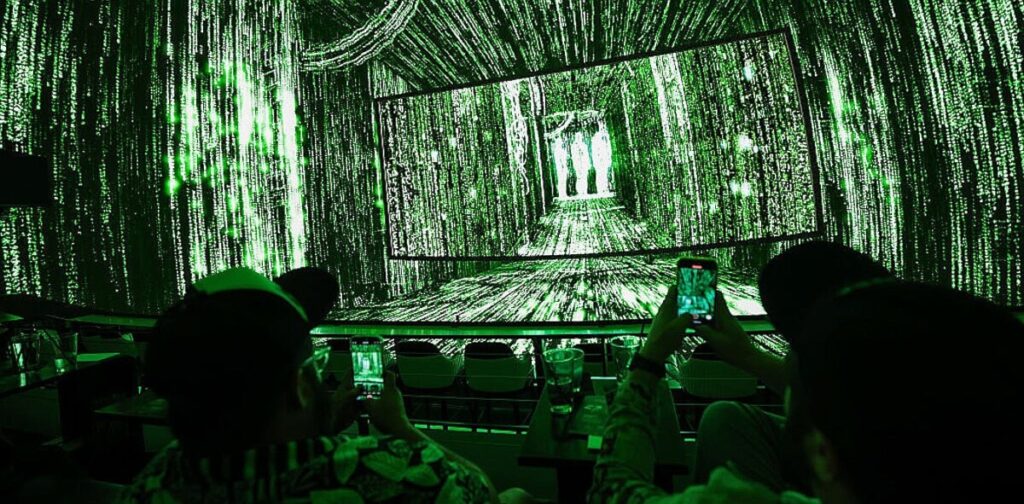
Computer code appears during an immersive reality screening of the 1999 movie ‘The Matrix,’ held in Inglewood, Calif., on May 28, 2025.
Patrick T. Fallon/AFP via Getty Images
In the most talked-about film from the final year of the 20th century, “
The Matrix
,” a computer hacker named Neo finds that the world he lives and works in isn’t real. It’s a virtual reality, created by artificial intelligence.
At the time, the idea seemed like science fiction. In the years since, however, that concept has become an increasingly credible theory: “
the simulation hypothesis
.” This theory posits that, like Neo, living things are characters inside a computer-generated simulation – or, as I describe in
my 2025 book
, a massively multiplayer video game. In this hypothesis, the physical world around us is actually
part of a virtual reality
.
Simulation theory raises the kind of questions
once reserved for mystics and religious scholars
: Why are we here? Is there more to reality than we can see? Is there a creator? Are we more than our physical bodies?
The science and technology may be modern, but in some ways, this hypothesis echoes ideas that faith traditions have explored for centuries.
Living in a game?
Simulation theory
became popular from the work
of
philosopher Nick Bostrom
, particularly a paper he published in 2003. The basic argument goes like this: If technology continues to improve, humans will be able to build virtual worlds indistinguishable from physical reality, and AI characters indistinguishable from biological beings. This suggests it’s possible that a more advanced civilization has already reached that point – and that we are inside one of their simulations.
Philosopher Nick Bostrom, pictured in 2015, first proposed the simulation hypothesis in 2003.
Tom Pilston for The Washington Post via Getty Images
Physicists
,
mathematicians
, technologists and computer scientists have
jumped into the game
. Opinions span a wide range of probabilities. Columbia University astronomer
David Kipping
tried to
evaluate the odds
we live in a simulation and came up with about 50/50. Some thinkers doubt that the question is even answerable, while others think the theory is impossible – like a
2025 paper
arguing that no purely algorithmic system can explain the universe.
The simulation hypothesis does not have to mean that people in the simulation are only soulless, computed AI inside someone else’s creation. In “The Matrix,” for example, even though Neo and other humans are characters inside the simulation, they also existed outside of the virtual world.
Higher intelligence
Simulation theory implies there is a greater intelligence than our own that exists beyond the physical world and may have created our universe – echoing foundational beliefs in many religious traditions. Transhumanist philosopher David Pearce, in fact, called Bostrom’s argument “the first interesting
argument for the existence of a Creator
in 2000 years.”
The Abrahamic religions of Judaism, Christianity and Islam, for example, all worship a single creator. The biblical
Book of Genesis
describes God creating the world in six days, and there is
a similar narrative
in the Quran
. According to these scriptures, God simply spoke, and it happened.
Similarly, the simulation hypothesis argues that the world was created through commands – that is, through code. Today, users of AI issue verbal prompts to automatically create realistic pictures and videos that are nearly indistinguishable from real people and landscapes.
In fact, users can even prompt AI programs to create characters that insist they aren’t virtual, as some
have done in recent months
– a phenomenon
called “prompt theory
.”
In August 2025,
Google released Genie 3
, which lets users create realistic-looking worlds that they can navigate through, like in a video game. In the past, these virtual worlds needed to be created by hand by teams of designers, limiting how big or complex they could be. Today, as AI advances, the idea that vast virtual worlds could be created to seem as large as our own is no longer considered such a fantasy.
Body and soul
A second way modern simulation theory echoes traditional religions is in the idea of the relationship between the soul and the body.
One version of the hypothesis
– what I call the RPG, or “role-playing game,” version – suggests the simulation
is like a multiplayer video game
. Each character inside the game represents the external player who controls them, meaning that, in some sense, the characters exhibit free will.
The term for such a character, an “avatar,” is rooted in Sanskrit,
the language of many Hindu, Buddhist and Jain texts
. In Hinduism, an “avatar” refers to the incarnation of a divine being in the form of a human body.
The 10 main avatars of the Hindu deity Vishnu.
Nomu420/Wikimedia Commons
,
CC BY-SA
The idea of incarnation, or a soul entering a body, is one of the most mysterious aspects of many religious traditions. Describing the development of an unborn child, the Hadith – the sayings of the Prophet Muhammad – describe a moment when “
the soul is breathed into him
.” The Bible, too,
uses the metaphor of breath
to describe incarnation: “And the LORD God formed man of the dust of the ground, and breathed into his nostrils the breath of life; and man became a living soul.”
Another common metaphor is that the soul dons the body, just as the body puts on clothing. Rumi, whose poetry often explores mystic Sufi themes,
compared the body to a garment
that could be
taken off or changed
.
A similar metaphor was used in
the Bhagavad Gita
, a Hindu scripture: “Just as you throw out used clothes and put on other clothes, new ones, the Self discards its used bodies and puts on others that are new.”
If we think about the soul as the player of a virtual reality game, and the body as merely their character inside who has forgotten about the outside world, then the parallels between religion and simulation theory are clear. The game may end, or the character may die, but the player continues to exist outside the game. Some religions teach that each soul can be reincarnated, having many lives – as though the player goes in and plays the game again and again, playing many different characters.
Immersed in a dream
A first- or second-century C.E. depiction of the Buddha from Gandhara, in present-day Afghanistan.
Tokyo National Museum/World Imaging via Wikimedia Commons
There is also an even more fundamental way simulation theory echoes some religious teachings: the idea that the physical world is not real, or is not all there is to reality.
This is clear in the Hindu and Buddhist traditions, which describe the world being a result of “maya,” or an illusion. Often, this is expressed through the metaphor of the world being like a dream that one can awaken from. Indeed, a popular definition of the term “Buddha” is someone who has “awakened.”
The “Samadhiraja Sutra,” or “
King of Samadhi Sutra
,” for example, teaches:
Know all things to be like this:
A mirage, a cloud castle,
A dream, an apparition,
Without essence, but with qualities that can be seen.
Paramahansa Yogananda
, a Hindu monk who died in 1952, wrote “Autobiography of a Yogi,” which introduced meditation and yoga to many in the West. Trying to explain the idea of “maya,” which is often translated as “illusion,” he compared people’s sense of physical reality
to actors playing in a motion picture
– relatively new technology in the 1920s, when he came from India to make his home in the United States.
As I wrote in
my 2023 book about Yogananda
, were the famous swami alive today, perhaps he would update the metaphor to use today’s technology: video games.
In a critical scene in “The Matrix,” Neo’s mentor, Morpheus – named after the Greek god of dreams – tells him that he has been living in a dream world. The simulation hypothesis, too, proposes that people may be living in a dream world, albeit one that is virtual, created and maintained by AI.
Perhaps the only reaction is to echo Neo and say: Whoa.
Rizwan Virk owns shares in Google, and in various video game companies. He is also a venture partner in Griffin Gaming Partners, a venture capital fund dedicated to investing in video game-related startups.


