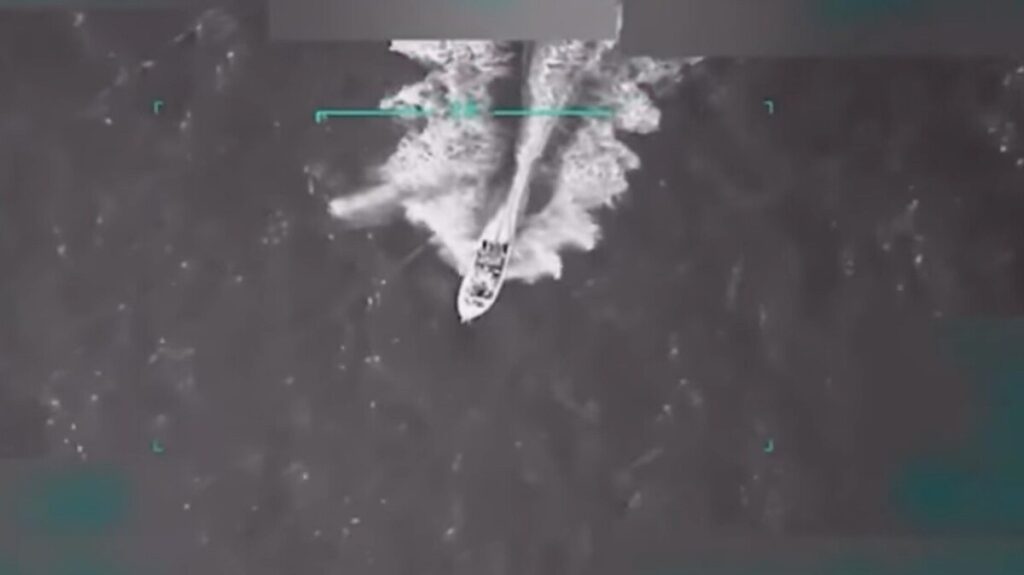
20 U.S. Boat Strikes in Three Months
In a recent edition of The Atlantic Daily, the newsletter sheds light on a series of U.S. military strikes in the Caribbean and Pacific, which have resulted in numerous fatalities purportedly linked to drug trafficking. Since early September, there have been 20 strikes, with a noticeable increase in frequency over the past month. These military actions, often accompanied by dramatic announcements from Secretary of Defense Pete Hegseth, have raised significant legal and ethical concerns. Hegseth’s statements suggest a simple narrative: that those killed are “narco-terrorists” threatening the U.S. homeland. However, critics argue that the lack of substantial evidence, the absence of judicial proceedings, and the questionable legal basis for these strikes render them extrajudicial killings—essentially, murder.
The administration’s rationale for these strikes hinges on framing the targets as “unlawful combatants” while simultaneously claiming that the strikes do not constitute hostilities under the War Powers Act, creating a contradictory legal posture. This has sparked skepticism among legal experts and former military officials, with some suggesting that the strikes could serve ulterior motives, such as a broader agenda against the Venezuelan government. Admiral Alvin Holsey’s recent resignation from his post overseeing these operations, coupled with reports of unusual nondisclosure agreements for military personnel, indicates rising unease within the ranks regarding the legality and implications of these actions. As the strikes become more routine, the lack of transparency and accountability raises critical questions about U.S. military engagement and its implications for international law and human rights.
This situation is reminiscent of past military deployments under the guise of law enforcement, drawing parallels to the National Guard’s controversial role in U.S. cities. Just as those deployments were criticized as overreach, the current military strikes may be masking a larger strategy, potentially aimed at regime change in Venezuela. The implications of these actions extend beyond immediate drug interdiction, suggesting a complex interplay of military policy, domestic politics, and international relations that warrants closer scrutiny. As public awareness grows, the normalization of such strikes may pose a significant challenge to the principles of justice and accountability that underpin democratic governance.
https://www.youtube.com/watch?v=VQNRolXUL10
This is an edition of The
Atlantic
Daily, a newsletter that guides you through the biggest stories of the day, helps you discover new ideas, and recommends the best in culture.
Sign up for it here.
The bulletins come every few days now. On Tuesday,
a U.S. strike
in the Caribbean Sea killed four people. On Sunday, two
strikes in the Pacific Ocean
killed six, and two people died in a November 4 strike. The MO rarely changes: a bellicose announcement from Secretary of Defense Pete Hegseth. Claims that the dead were involved in drug trafficking, though never much evidence to back it up. Usually a grainy image of the attack—an enormous explosion engulfing a small boat, sometimes with small figures visible on board, until they’re not.
Since the first of these strikes, in early September, there have been 19 more that we know of. The pace has increased since last month—15 of them have come in that time. When the strikes began, each one got lots of attention, but the Trump administration has adopted its usual strategy of doing things over and over until the public is lulled into a sense that this is normal. News is, definitionally, something fresh; when an event happens 20 times, it loses its novelty. But repetition has not made these strikes any less troubling or any more legal, and the more the public learns about how they’re conducted, the shakier the arguments for them look.
Hegseth portrays the situation as simple. “To all narco-terrorists who threaten our homeland: if you want to stay alive, stop trafficking drugs,”
he wrote on X last week
. “If you keep trafficking deadly drugs—we will kill you.” Nearly every part of this statement demands skepticism. First, the Pentagon has not generally provided evidence for its claims, other than to cite “intelligence,” and the administration’s pattern of
misleading
and
outright lying
makes it hard to give it the benefit of the doubt.
Second, even if the intelligence is correct, these people have not been convicted in any court, which makes their deaths extrajudicial killings. There’s another, more common term for that:
murder
, as
Rachel VanLandingham
, a law professor and retired judge advocate in the Air Force, recently told CNN. (The administration doesn’t seem confident about its chances at a conviction: When two men survived a strike last month, the United States handed them over to their home countries rather than attempting to try them.) Third, even if they had been found guilty, no federal law establishes the
death penalty for drug trafficking
. Donald Trump has previously called for instituting capital punishment for drug dealing, though he has also used his clemency power to pardon
people convicted of that crime
.
In the absence of a clear criminal-justice rationale, the White House is playing a slippery game. On the one hand, officials argue that involving the military, which doesn’t otherwise have a
law-enforcement role
, in these boat strikes is necessary, because drug shipments pose a
direct threat to the United States; the
Trump administration calls those killed “
unlawful combatants
.” On the other hand, the administration has also said that Congress has no authority to intervene under the
War Powers Act
, because these strikes don’t rise to the level of hostilities—no U.S. troops are in danger. The result is absurd: As Brian Finucane, a former State Department legal adviser, told
The Washington Post
, “What they’re saying is anytime the president uses drones or any standoff weapon against someone who cannot shoot back, it’s not hostilities.”
Other warning lights are flashing. Admiral Alvin Holsey abruptly announced his resignation last month as head of the U.S. Southern Command—which oversees the strikes—less than a year into his posting. Although Holsey has not made any public comment about the strikes,
The New York Times
reports that he privately raised questions about them. Reuters reported last month that military officials involved in operations in Latin America are being asked to sign
unusual nondisclosure agreements
, even though national-security secrets are already restricted. And CNN reported this week that
British officials
have decided to stop sharing intelligence about suspected drug trafficking in the Caribbean because they believe the boat strikes are illegal. Even as the strikes become more routine, more reservations among people close to them are emerging.
One useful way to understand the boat strikes might be to compare them to threatened or executed National Guard deployments in several U.S. cities. When Trump first called up Guard troops in Washington, D.C., he contended that they were needed to fight street crime—even though the Guard generally isn’t trained in law enforcement and has limits on policing powers. What has become clear since is that the real goal is aggressive enforcement of immigration laws.
Similarly, drug interdiction may just be an excuse for broader actions in Latin America. As
my colleague Nick Miroff
has reported, the administration has used fentanyl as a justification for military deployments, but the Coast Guard doesn’t actually encounter fentanyl in the Caribbean. Instead, the boat strikes seem to be a cover for a huge military deployment designed to oust Venezuelan President Nicolás Maduro,
as
The Atlantic
reports
. If this is all a prelude to regime change in Caracas, that’s another reason to treat the strikes as anything but normal.
Related:
The boat strikes are just the beginning.
Why Venezuela?
Here are three new stories from
The Atlantic
:
Wait, are the Epstein files real now?
Annie Lowrey: What tariffs did
Trump’s animal-research plan has a missing step.
Today’s News
After the longest government shutdown in U.S. history ended last night,
federal workers began returning to their jobs and agencies began reopening
, though some services and museums remained closed as operations slowly resumed. Many employees are expected to start receiving back pay in the coming days.
The Trump administration sued to block
California’s effort to draw new congressional maps
, claiming that the plan amounts to unconstitutional racial gerrymandering. The case could influence control of the U.S. House after the 2026 midterms.
In a 2015 email, Jeffrey Epstein offered a then–
New York Times
reporter
photos “of donald and girls in bikinis in my kitchen.”
The email was part of more than 20,000 pages of documents from Epstein’s estate that the House Oversight Committee released yesterday. The White House called the documents “selectively leaked emails to the liberal media to create a fake narrative.”
Evening Read
Illustration by Tim Enthoven
The End of Naked Locker Rooms
By Jacob Beckert
Not long ago, after a day of work, a colleague and I met for a friendly game of racquetball at our university gym. In the newly designed locker room, I began pulling off my shirt to change when he quickly stopped me: “You can’t do that here.” Undressing, it turned out, was now permitted only in small private stalls—which struck me as odd. This was a gym with a pool, where someone could go directly from a shirts-on locker room to a shirtless swim. But the logic was clear enough: The space had been redesigned as “universal,” for people of all genders. The locker room, once a place for casual and normative nudity, had quietly become a place where modesty was expected.
Read the full article.
More From
The Atlantic
Hotel cancellation has been canceled.
Arthur C. Brooks: An evening ritual to realize a happier life
Thomas Chatterton Williams: The left’s new moralism will backfire.
Radio Atlantic
: What if AI is a bubble?
The criminal enterprise behind that fake toll text
Culture Break
Illustration by Ben Kothe / The Atlantic
Read.
Bumbling your way through any language will always be better than popping in AirPods. The literary translator Ross Benjamin writes on
what we stand to lose in a world of instant translation
.
Watch.
All’s Fair
(out now on Hulu), which stars a hodgepodge cast including Kim Kardashian and Glenn Close, is
an atrocity
, Sophie Gilbert writes.
Play our daily crossword.
Explore all of our newsletters here.
Rafaela Jinich
contributed to this newsletter.
When you buy a book using a link in this newsletter, we receive a commission. Thank you for supporting
The Atlantic
.


