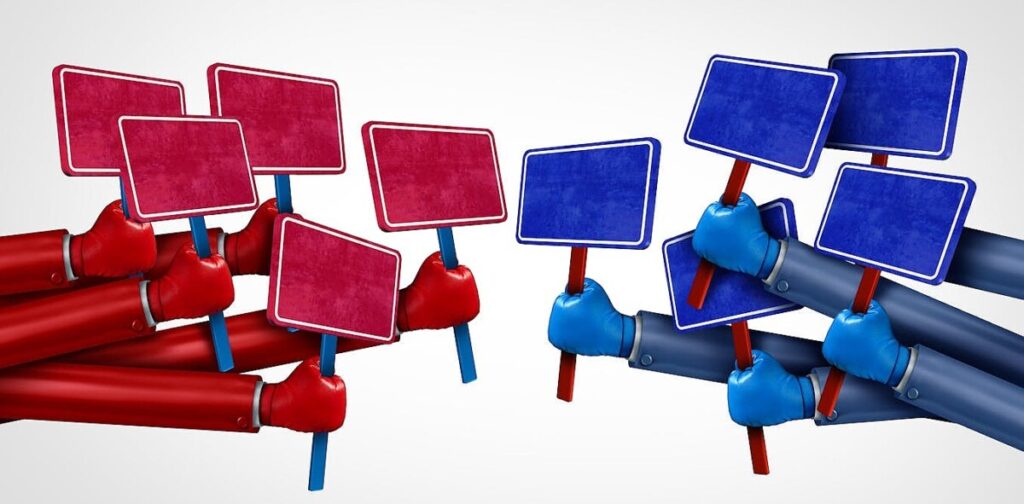
Blame the shutdown on citizens who prefer politicians to vanquish their opponents rather than to work for the common good
The United States is currently experiencing the longest government shutdown in its history, lasting 40 days, which has led to significant hardships for millions of citizens. While many tend to blame politicians for this prolonged disruption, a deeper examination reveals that the electorate itself shares a considerable amount of responsibility. The current political climate in the U.S. has become increasingly tribal, where citizens prioritize partisan victories over effective governance. This shift has resulted in a political landscape where obstructionism is rewarded, and cooperation is viewed as weakness. As a result, elected officials feel incentivized to engage in deadlock rather than seek compromise, contributing to a government that fails to fulfill its fundamental purpose of serving the public.
The shutdown has illuminated two critical types of polarization affecting American democracy: political polarization and belief polarization. Political polarization refers to the growing divide between the two major parties, making bipartisan cooperation increasingly difficult. However, belief polarization, which occurs within individual political groups, is equally concerning. This phenomenon leads individuals to become more extreme in their views and less tolerant of differing perspectives, fostering a culture of animosity and contempt toward political opponents. The result is a society where everyday life is saturated with politics, yet citizens remain largely uninformed about policy issues. This disconnect between heightened animosity and stable policy disagreements further complicates the political landscape, as politicians capitalize on negative sentiments to galvanize support, often at the expense of their responsibility to govern effectively.
As the shutdown continues, the consequences are felt across the nation, with over a million government employees unpaid and essential services disrupted. While there may be a potential resolution on the horizon, the underlying issues driving this shutdown—polarization and the desire for political spectacle—remain unresolved. To prevent future crises, it is crucial for citizens to demand competent governance instead of succumbing to the allure of partisan dominance. Only through a collective commitment to collaboration and compromise can the government hope to fulfill its essential role in promoting the common good and serving the interests of all Americans.
Who is really responsible for the longest government shutdown in history?
iStock/Getty Images Plus
The United States was founded on the idea that government exists to serve its people. To do this, government must deliver services that promote the common good. When the government shuts down, it fails to meet its fundamental purpose.
While government shutdowns are not new in the U.S., most have lasted
less than a week
. At 40 days, the current shutdown may
well be on the way to an end this week
, as enough Senate Democratic caucus members have voted with Republicans on a measure to reopen the government. But it will remain the
longest in the history of the nation
.
When the government shuts down for such a long time, it inflicts
hardships, anxieties and irritations
on its citizens. You might wonder why elected officials allow lengthy disruptions to happen.
It is common to
blame the politicians
for the shutdown. However,
as a philosopher who researches democracy
, I think the fault lies also with us, the citizens. In a democracy, we generally get the politics we ask for, and the electorate has developed a taste for political spectacle over competent leadership.
American democracy has grown
increasingly tribal
, leading us to become more invested in
punishing our partisan rivals
than in demanding competent government. We are infatuated with the spectacle of
our side dominating the other
.
Understandably, politicians have embraced obstruction. They have learned that deadlock can pay, because they have the support of their voters in behaving this way. Politics is no longer about representation and policy, it’s now about vanquishing and even humiliating the other side.
U.S. Sen. Maggie Hassan speaks at a press conference with other Senate Democratic caucus members who voted to restore government funding, in Washington, D.C., on Nov. 9, 2025.
Nathan Posner/Anadolu via Getty Images
More fervent, not better informed
To see this, we must examine polarization. Let’s start by distinguishing
two kinds of polarization
.
First is political polarization. It measures the divide between the U.S.’s two major parties. When political polarization is severe, the common ground among the parties falls away. This naturally undermines cooperation. That
Republicans and Democrats are politically polarized
is certainly part of the explanation for the shutdown.
But that’s not the entire story. As I argue in my book “
Civic Solitude
,” the deeper trouble has to do with
belief polarization
.
Unlike political polarization, which measures the distance between opposing groups, belief polarization occurs within a single group. In belief polarization, like-minded people transform into more extreme version of themselves: Liberals become more liberal, conservatives become more conservative, Second Amendment advocates become more pro-gun, environmentalists become more green, and so on.
Importantly, this shift is driven by the desire to
fit in with one’s peers
, not by evidence or reason. Hence, we become more fervent but no better informed.
Additionally, our more extreme selves are also more tribal and conformist. As we shift, we become more antagonistic toward outsiders. We also become more insistent on uniformity within our group, less tolerant of differences.
Animosity and obstruction
The combination of intensifying antagonism toward those on the “other side” and escalating cohesion among those on “your side” turns all aspects of life into politics.
In the U.S. today,
liberals and conservatives are heavily socially segregated
. They live in different neighborhoods, work in different professions, vacation in different locations, drive different vehicles and shop in different stores. Everyday behavior has become an
extension of partisan affiliation
.
Ironically, as everyday life becomes politically saturated, politics itself becomes
more about lifestyle
and
less about policy
.
Research
suggests
that while
animosity across the parties
has intensified significantly, citizens’ disagreements over policy have either
remained stable or eased
. We dislike one another more intensely yet are not more divided.
This paints a grim portrait of U.S. democracy. Note that this condition incentivizes politicians to
amplify their contempt
for political rivals. Politicians seek to win elections, and stoking negative feelings such as fear and indignation are
potent triggers of political behavior
, including voting.
Consequently, when citizens are belief-polarized, animosity and obstruction become winning electoral strategies. Meanwhile, politicians are released from the task of serving the common good.
U.S. Speaker of the House Mike Johnson speaks during a news conference with House Republican leadership at the U.S. Capitol on Nov. 6, 2025.
Saul Loeb/AFP via Getty Images
Channeling contempt
It is no surprise that discussions of the shutdown have consistently focused on blame.
The Republicans, who hold the congressional majority, have sought to score points by
depicting the shutdown as the Democrats’ fault
. Several
official
websites
maintained
by the
federal government
included
statements
denouncing
the
shutdown
as
strictly
the
doing of the Democrats
. Their aim has been to channel citizens’ frustration into contempt for the Democratic Party.
At the beginning of the shutdown, House Speaker Mike Johnson claimed that there was “
literally nothing to negotiate
” with congressional Democrats.
But there’s the rub. Democratic government is fundamentally a matter of negotiation. Neither winning an election nor being a member of the majority party means that you can simply call the shots. The constitutional procedures by which our representatives govern are designed to force cooperation, collaboration and compromise.
Thanks to polarization, however, these noble ideals of political give-and-take have dissolved. Cooperation is now seen as
surrender to political enemies
. That’s very clear in many
Democrats’ outraged reactions
to the eight senators from their caucus who
have now voted with Republicans to end the shutdown
.
Meanwhile, more than 1 million
government employees haven’t been paid
, many
crucial government services
have been interrupted, diminished or suspended, and, with the Thanksgiving holiday approaching, travelers are experiencing
flight disruptions
. While there may be
an end to the shutdown
on the near horizon, any deal could simply postpone crucial policy debates and could well end in another shutdown in the new year.
The key to avoiding this kind of failure is to become a citizenry that demands competent government over partisan domination.
Robert B. Talisse does not work for, consult, own shares in or receive funding from any company or organization that would benefit from this article, and has disclosed no relevant affiliations beyond their academic appointment.


