Scientists detect solar storm bursting from a nearby star
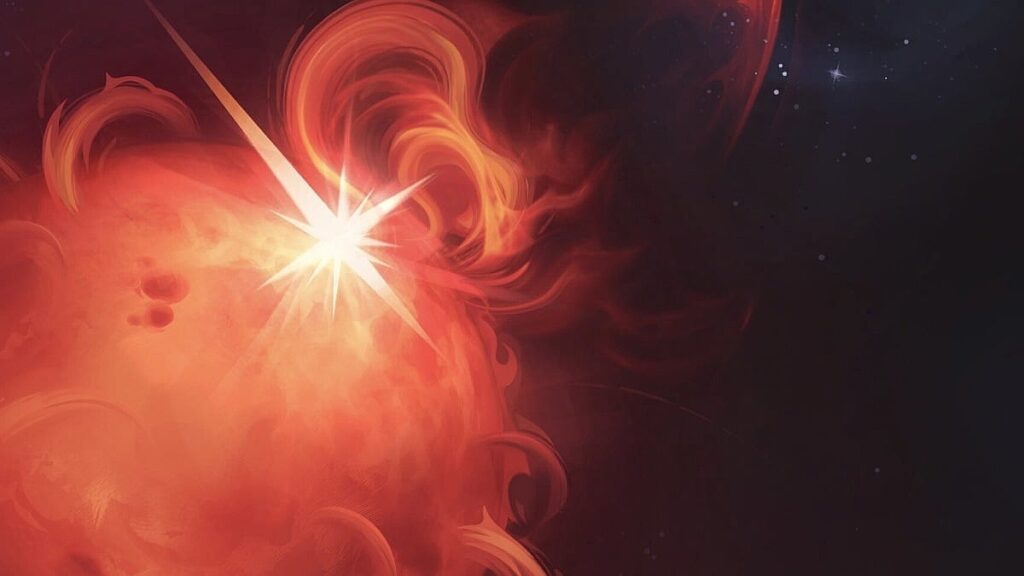
Astronomers have recently made a groundbreaking discovery, capturing the first clear evidence of a coronal mass ejection (CME) from a distant red dwarf star, StKM 1-1262, located approximately 130 light-years away. This monumental finding marks a significant turning point in the study of space weather, providing insights into the explosive phenomena that occur beyond our solar system. The eruption, which was detected as a two-minute burst of radio waves, confirms long-held speculations about the existence of similar stellar outbursts on other stars. Joe Callingham from the Netherlands Institute for Radio Astronomy emphasized the importance of this discovery, stating that such radio signals would not exist unless material had completely escaped from the star’s magnetic grip.
This CME is particularly noteworthy because red dwarf stars, like StKM 1-1262, are smaller, dimmer, and much more magnetically active than our sun. They constitute the majority of stars in the Milky Way and are known to host numerous exoplanets. However, the intense stellar activity associated with these stars poses significant challenges for any nearby planets, potentially stripping away their atmospheres and rendering them inhospitable to life. The ejected material from StKM 1-1262 was moving at a staggering speed of about 5.37 million mph, a velocity recorded in only a small fraction of the sun’s CMEs. This extreme force could devastate any rocky planet in close orbit, exposing its surface to harmful radiation and transforming it into a barren rock devoid of atmosphere.
The implications of this discovery extend beyond the immediate observation of the CME. It raises critical questions about the habitability of exoplanets orbiting red dwarf stars, which lie in habitable zones much closer to their host stars than Earth is to the sun. As scientists continue to explore these distant worlds, future missions, including those utilizing NASA’s James Webb Space Telescope, aim to investigate whether these planets can retain their atmospheres amidst such fierce space weather. The results of these investigations could reshape our understanding of planetary systems and the conditions necessary for life, suggesting that if these exoplanets lack atmospheres, it underscores the uniqueness of our own solar system. Overall, this discovery paves the way for further research into stellar eruptions and their effects on planetary environments across the galaxy.
https://www.youtube.com/watch?v=uxCY3-Mnw2k
Astronomers have captured the first clear evidence of a giant eruption of charged gas from a distant star, marking a turning point in the study of
space weather
.
The outburst came from a
red dwarf star
about 130
light-years
away in
space
. It was identified as a
coronal mass ejection
, or CME, the kind of explosive event many people just witnessed coming from the
sun
in the form of psychedelic
auroras
. Those curtains of colors in the sky are the result of huge clouds of magnetized plasma whooshing toward the planet and interacting with gases in Earth’s air.
Scientists have long wondered whether other stars produce the same kinds of explosions. Many
exoplanets
orbit extremely close to their small, violent hosts. That proximity places them in the firing line of stellar eruptions that could strip away their atmospheres. If these stars have frequent and powerful blasts, it’s unlikely the nearby worlds could support life.
Detecting a CME beyond the sun ends decades of speculation about whether
other stars unleash similar eruptions
. Prior to this observation, researchers had only found clues, like sudden dimming or shifts in a star’s light. But an international team was able to make the discovery by detecting a two-minute burst of radio waves racing away from the star.
“This kind of radio signal just wouldn’t exist unless material had completely left the star’s bubble of powerful magnetism,” Joe Callingham of the Netherlands Institute for Radio Astronomy said in
a statement
.
SEE ALSO:
NASA has a broken giant antenna that could upend its 2026 plans
The
finding
, published in
Nature
this week, used data from two major European observatories: the Low Frequency Array, a continent-wide network of
radio telescopes
, and the XMM-Newton space observatory operated by the European Space Agency.
Coronal mass ejection effects
As a CME travels, it produces a shock wave that blasts out radio waves sliding from high to low frequencies over time. The team identified this distinct pattern in the signal from the red dwarf, known as StKM 1-1262, confirming that the eruption had broken free of the star’s magnetic field and escaped into
interstellar space
.
“This eruption would be devastating for a planet around such a star,”
said Callingham
, first author of the paper.
Don’t miss out on our latest stories:
Add Mashable as a trusted news source in Google
.
On Earth, the atmosphere and magnetic field shield creatures against the most
harmful health impacts
of solar radiation during solar storms. But these events can knock out satellites and power grids. A
solar flare in March 1989
, for example, caused all of Quebec, Canada, to experience a 12-hour power outage. It also jammed radio signals for Radio Free Europe.
The red dwarf’s blast was extreme even by solar standards. The ejected material was moving at about 5.37 million mph, a speed recorded in only a tiny fraction of the sun’s CMEs. Such force would be enough to strip the atmosphere from any planet orbiting close to the star, leaving its surface exposed to radiation and transforming it into a bald rock, according to the research.
Red dwarf star systems and habitability
Astronomers don’t know whether rocky worlds orbiting close to red dwarf stars can hold onto their atmospheres.
Credit: NASA / ESA / G. Bacon / J. de Wit illustration
Red dwarfs like StKM 1-1262 are smaller and dimmer than the sun but much more magnetically active. They make up most of the stars in the Milky Way and host the largest number of known planets roughly the size of Earth. Because their habitable zones — regions in space where the temperature is just right for liquid water to pool on surfaces — lie much closer to the stars, these planets are likely subjected to far more frequent stellar storms.
“It seems intense space weather may be even more extreme around smaller stars — the primary hosts of potentially habitable exoplanets,” said Henrik Eklund, a European Space Agency research fellow based in the Netherlands, in a statement.
Scientists leading a high-priority observing program with
NASA
’s
James Webb Space Telescope
are trying to answer the question of whether rocky planets circling these stars, also called M-dwarfs, can hold onto their atmospheres.
The campaign,
first reported by Mashable
in 2024, will use Webb to look for signs of carbon dioxide, a heat-trapping gas, using a novel method for studying atmospheres, called the
secondary eclipse technique
. Meanwhile, the Hubble Space Telescope will focus on the stars themselves, studying their ultraviolet radiation output.
“If you found out that none of them have atmospheres, that would be pretty sad,” Néstor Espinoza, an astronomer leading the program, told Mashable, “but also pretty interesting. It would mean that our planetary system is actually really, really special.”
Future observatories will build on this discovery to identify more stellar eruptions and map how they influence the environments of planets throughout the galaxy.