Curiosity Blog, Sols 4695-4701: Searching for Answers at Monte Grande
NASA’s Mars Curiosity rover has reached a significant milestone by successfully drilling its 44th hole on the Red Planet, specifically within the intriguing “Monte Grande” hollow at the “Valle de la Luna” site. This drilling activity, which occurred during Sol 4693 (October 19, 2025), is part of a broader investigation into the unique geological features known as the “boxwork unit.” These formations consist of resilient ridges that encircle pits filled with less durable rock, raising questions about their formation and composition. The analysis of the drill tailings will be conducted using the rover’s advanced instruments, including the Sample Analysis at Mars (SAM) and CheMin, which will offer critical insights into the mineralogical characteristics of the samples and help clarify the differences between the ridge and hollow terrains.
In addition to the drilling, the Curiosity team has been engaged in a photometry study, which examines how the apparent brightness of Martian rocks and soils changes based on the position of the Sun. This study, typically performed during extended stationary periods, allows scientists to gather multiple images of the same areas at different times of day, enhancing their understanding of the surface materials. The ongoing analysis will also include an evolved gas analysis (EGA), where the drilled samples will be heated to release volatile molecules like water and carbon dioxide, further aiding in the characterization of the geological materials. As the mission progresses, Curiosity is set to continue its exploration by searching for another drilling location on a ridge, allowing for comparative studies with the results obtained from the Monte Grande hollow.
This latest phase of Curiosity’s mission not only highlights the rover’s ongoing contributions to our understanding of Mars but also exemplifies the intricate and meticulous nature of planetary exploration. As scientists analyze the data collected from the Valle de la Luna, they hope to uncover the mysteries surrounding the boxwork features and gain deeper insights into the geological history of Mars. With each drill and analysis, Curiosity continues to pave the way for future missions and our understanding of the Red Planet’s past and potential for life.
Curiosity Navigation
Curiosity Home
Mission Overview
Where is Curiosity?
Mission Updates
Science
Overview
Instruments
Highlights
Exploration Goals
News and Features
Multimedia
Curiosity Raw Images
Images
Videos
Audio
Mosaics
More Resources
Mars Missions
Mars Sample Return
Mars Perseverance Rover
Mars Curiosity Rover
MAVEN
Mars Reconnaissance Orbiter
Mars Odyssey
More Mars Missions
Mars Home
3 min read
Curiosity Blog, Sols 4695-4701: Searching for Answers at Monte Grande
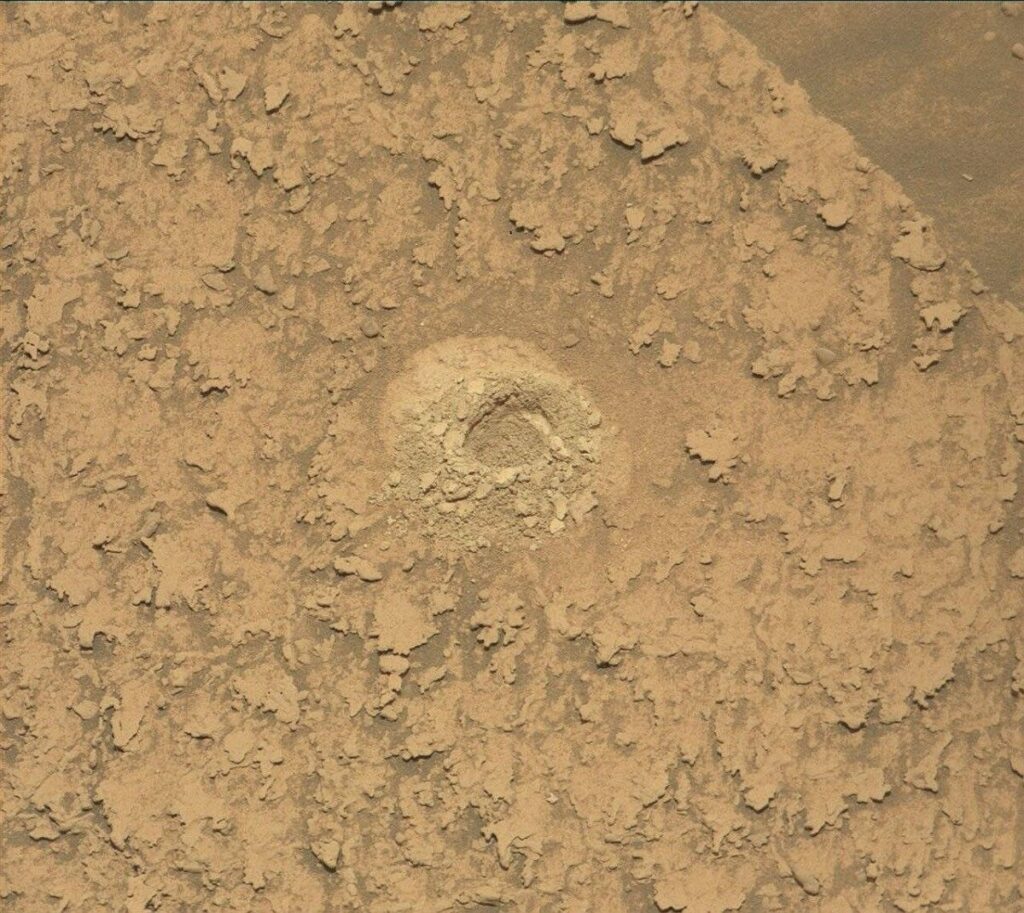
NASA’s Mars rover Curiosity acquired this image of the “Valle de la Luna” drill hole using its Mast Camera (Mastcam) on Oct. 19, 2025 — Sol 4693, or Martian day 4,693 of the Mars Science Laboratory mission — at 02:04:29 UTC.
NASA/JPL-Caltech/MSSS
Written by William Farrand, Senior Research Scientist, Space Science Institute
Earth planning date: Friday, Oct. 24, 2025
Curiosity has successfully drilled its 44
th
hole on Mars, which is a major milestone in our investigation of the enigmatic “boxwork unit,” a region of resistant ridges surrounding pits or “hollows” of less-resistant rock. The drilling took place over the past weekend within the “Monte Grande” hollow at the “Valle de la Luna” target.
Rover planning this week consisted of ensuring that the granular drill tailings from Valle de la Luna were transferred to the SAM (Sample Analysis at Mars) and CheMin (X-ray diffraction) instruments, and analyzing the results. Results from these instruments, which will provide mineralogical and other compositional information, will be especially critical for determining how the boxwork features formed, since chemistry from the APXS and ChemCam instruments and reflectance spectra from ChemCam have revealed subtle, but not striking, differences between the rocks making up the ridges and those making up the hollows. Thus, a compositional explanation for the differences between the two terrain types has yet to be determined.
While these internal studies of the Valle de la Luna samples were going on, remote sensing data were collected by Mastcam of a series of targets, as well as atmospheric remote sensing. Among the Mastcam studies being conducted is a photometry study, a kind of study usually only carried out during an extended stationary period, such as the current drill campaign. Photometry is the study of changes in the apparent reflected brightness of rocks and soils based on the illumination geometry (for example, whether the Sun is low on the horizon or high in the sky). During this photometry campaign, multiple images are collected of the same target regions at different times of day.
In the final plan of the week, as part of the ongoing assessment of the Valle de la Luna sample, material will undergo an evolved gas analysis (EGA) in which the drilled sample is baked in an oven in SAM and volatile molecules including H
2
O, CO
2
, and SO
2
are released and used to further aid in the characterization of the target materials. Mastcam observations will include further images collected as part of the photometry campaign. Also mosaics of the west wall of the Monte Grande hollow will be collected as well as several atmospheric measurements.
Next week the rover will continue analyzing the drilled sample with more SAM experiments, and also analyze the tailings. The team is also starting to search for a suitable drilling location on a ridge as the next drilling site, in order to compare with the results from the Monte Grande hollow.
Want to read more posts from the Curiosity team?
Visit Mission Updates
Want to learn more about Curiosity’s science instruments?
Visit the Science Instruments page
NASA’s Mars rover Curiosity at the base of Mount Sharp
NASA/JPL-Caltech/MSSS
Share
Details
Last Updated
Nov 13, 2025
Related Terms
Blogs
Explore More
4 min read
Curiosity Blog, Sols 4702-4708: It’s Only Spooky Here on Earth Today!
Article
38 minutes ago
3 min read
Curiosity Blog, Sols 4689-4694: Drill in the Boxwork Unit is GO!
Article
43 minutes ago
4 min read
Curiosity Blog, Sols 4682-4688: Seven Mars Years
Article
50 minutes ago
Keep Exploring
Discover More Topics From NASA
Mars
Mars is the fourth planet from the Sun, and the seventh largest. It’s the only planet we know of inhabited…
All Mars Resources
Explore this collection of Mars images, videos, resources, PDFs, and toolkits. Discover valuable content designed to inform, educate, and inspire,…
Rover Basics
Each robotic explorer sent to the Red Planet has its own unique capabilities driven by science. Many attributes of a…
Mars Exploration: Science Goals
The key to understanding the past, present or future potential for life on Mars can be found in NASA’s four…


