What is time? Rather than something that ‘flows,’ a philosopher suggests time is a psychological projection
In a thought-provoking exploration of the nature of time, philosopher Adrian Bardon challenges our conventional understanding of time as a flowing entity, arguing instead that it might be a psychological projection rather than a tangible phenomenon. Throughout history, thinkers from ancient philosophers like Parmenides and Aristotle to modern physicists like Albert Einstein have grappled with the complexities of time, raising questions about its reality and our perception of it. Bardon highlights that while we often describe time as if it flows—using phrases like “time flies” or “time waits for no one”—the actual mechanics of time reveal a much more intricate and less intuitive reality.
The article delves into the philosophical skepticism regarding time, pointing out that ancient thinkers questioned how events could transition from the future to the present if the future is not real and the past no longer exists. This skepticism laid the groundwork for modern discussions, particularly Einstein’s revolutionary theories of relativity, which dismantled the notion of time as an absolute, unchanging backdrop against which events occur. According to relativity, time is relative and varies based on the observer’s frame of reference, leading to the conclusion that all points in time—past, present, and future—are equally real. This view, known as “eternalism,” posits that the passage of time is not a dynamic flow but rather a static arrangement of events perceived differently by various observers.
Bardon proposes that our sense of time’s passage is not a mere illusion but a cognitive projection shaped by our experiences and perceptions. He compares this to the way we perceive color—not as an inherent quality of an object but as a reflection of how we process light. Just as we cannot describe the world without referencing colors, our understanding of reality is deeply intertwined with our perception of time. This perspective invites readers to reconsider how they conceptualize time, suggesting that while the passage of time may not exist in a physical sense, it remains a crucial framework through which we interpret our experiences and navigate the world. In essence, Bardon encourages a deeper reflection on the nature of time, urging us to distinguish between our subjective experience of it and its objective reality as understood by physics.
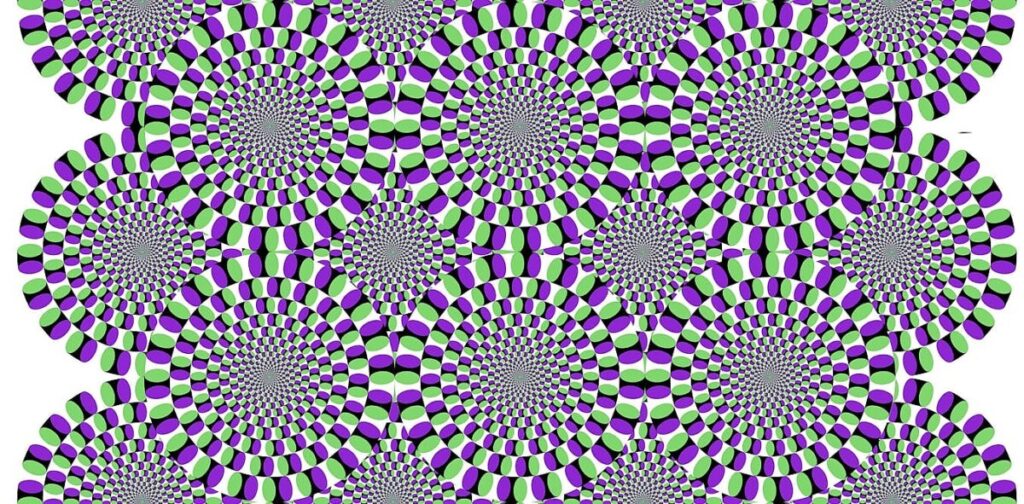
Time isn’t an illusion, unlike optical illusions that trick your eyes. There’s nothing to ‘trick’ because it has no physical basis.
BSIP/UIG Via Getty Image
“Time flies,” “time waits for no one,” “as time goes on”: The way we speak about time tends to strongly imply that the passage of time is some sort of real process that happens out there in the world. We inhabit the present moment and move through time, even as events come and go, fading into the past.
But go ahead and try to actually verbalize just what is meant by the flow or passage of time. A flow of what? Rivers flow because water is in motion. What does it mean to say that time flows?
Events are more like happenings than things
, yet we talk as though they have ever-changing locations in the future, present or past. But if some events are future, and moving toward you, and some past, moving away, then where are they? The future and past don’t seem to have any physical location.
Human beings have been thinking about time for as long as we have records of humans thinking about anything at all. The concept of time inescapably permeates every single thought you have about yourself and the world around you. That’s why,
as a philosopher
, philosophical and scientific developments in our understanding of time have always seemed especially important to me.
Ancient philosophers on time
Parmenides of Elea was an early Greek philosopher who thought about the passage of time.
Sergio Spolti/Wikimedia Commons
,
CC BY-SA
Ancient philosophers were very suspicious about the whole idea of time and change. Parmenides of Elea was a Greek philosopher of the sixth to fifth centuries BCE.
Parmenides wondered
, if the future is not yet and the past is not anymore, how could events pass from future to present to past?
He reasoned that, if the future is real, then it is real now; and, if what is real now is only what is present, the future is not real. So, if the future is not real, then the occurrence of any present event is a case of something inexplicably coming from nothing.
Parmenides wasn’t the only skeptic about time. Similar reasoning regarding contradictions inherent in the way we talk about time appears in
Aristotle
, in the ancient Hindu school known as the
Advaita Vedanta
and in the work of
Augustine of Hippo
, also known as St. Augustine, just to name a few.
Einstein and relativity
The early modern physicist Isaac Newton
had presumed
an unperceived yet real flow of time. To Newton, time is a dynamic physical phenomenon that exists in the background, a regular, ticking universe-clock in terms of which one can objectively describe all motions and accelerations.
Then, Albert Einstein came along.
In 1905 and 1915, Einstein proposed his
special
and
general theories of relativity
, respectively. These theories validated all those long-running suspicions about the very concept of time and change.
Relativity rejects Newton’s notion about time as a universal physical phenomenon.
By Einstein’s era, researchers
had shown
that the speed of light is a constant, regardless of the velocity of the source. To take this fact seriously, he argued, is to take all object velocities to be relative.
Nothing is ever really at rest or really in motion; it all depends on your “
frame of reference
.” A frame of reference determines the spatial and temporal coordinates a given observer will assign to objects and events, on the assumption that he or she is at rest relative to everything else.
Someone floating in space sees a spaceship going by to the right. But the universe itself is completely neutral on whether the observer is at rest and the ship is moving to the right, or if the ship is at rest with the observer moving to the left.
This notion affects our understanding of what clocks actually do. Because the speed of light is a constant, two observers moving relative to each other will assign different times to different events.
In a famous example, two equidistant lightning strikes occur simultaneously for an observer at a train station who can see both at once. An observer on the train, moving toward one lightning strike and away from the other,
will assign different times
to the strikes. This is because one observer is moving away from the light coming from one strike and toward the light coming from the other. The other observer is stationary relative to the lightning strikes, so the respective light from each reaches him at the same time. Neither is right or wrong.
In a famous example of relativity, observers assign different times to two lightning strikes happening simultaneously.
How much time elapses between events, and what time something happens,
depends on the observer’s frame of reference
. Observers moving relative to each other will, at any given moment, disagree on what events are happening now; events that are happening now according to one observer’s reckoning at any given moment will lie in the future for another observer, and so on.
Under relativity, all times are equally real. Everything that has ever happened or ever will happen is happening now for a hypothetical observer. There are no events that are either merely potential or a mere memory. There is no single, absolute, universal present, and thus there is no flow of time as events supposedly “become” present.
Change just means that the situation is different at different times. At any moment, I remember certain things. At later moments, I remember more. That’s all there is to the passage of time. This doctrine, widely accepted today among both physicists and philosophers, is
known as “eternalism
”.
This brings us to a pivotal question: If there is no such thing as the passage of time, why does everyone seem to think that there is?
Time as a psychological projection
One common option has been to suggest that the passage of time is an “illusion” – exactly as Einstein
famously described it
at one point.
Calling the passage of time “illusory” misleadingly suggests that our belief in the passage of time is a result of misperception, as though it were some sort of optical illusion. But I think it’s more accurate to think of this belief as resulting from misconception.
As I propose in my book “
A Brief History of the Philosophy of Time
,” our sense of the passage of time is an example of psychological projection – a type of cognitive error that involves misconceiving the nature of your own experience.
The
classic example is color
. A red rose is not really red, per se. Rather, the rose reflects light at a certain wavelength, and a visual experience of this wavelength may give rise to a feeling of redness. My point is that the rose is neither really red nor does it convey the illusion of redness.
The red visual experience is just a matter of how we process objectively true facts about the rose. It’s not a mistake to identify a rose by its redness; the rose enthusiast isn’t making a deep claim about the nature of color itself.
Similarly, my research suggests that the passage of time is neither real nor an illusion:
It’s a projection
based on how people make sense of the world. I can’t really describe the world without the passage of time any more than I can describe my visual experience of the world without referencing the color of objects.
I can say that my GPS “thinks” I took a wrong turn without really committing myself to my GPS being a conscious, thinking being. My GPS has no mind, and thus no mental map of the world, yet I am not wrong in understanding its output as a valid representation of my location and my destination.
Similarly, even though physics leaves no room for the dynamic passage of time, time is effectively dynamic to me as far as my experience of the world is concerned.
The passage of time is inextricably bound up with how humans represent our own experiences. Our picture of the world is inseparable from the conditions under which we, as perceivers and thinkers, experience and understand the world. Any description of reality we come up with will unavoidably be infused with our perspective. The error lies in confusing our perspective on reality with reality itself.
Adrian Bardon does not work for, consult, own shares in or receive funding from any company or organization that would benefit from this article, and has disclosed no relevant affiliations beyond their academic appointment.


