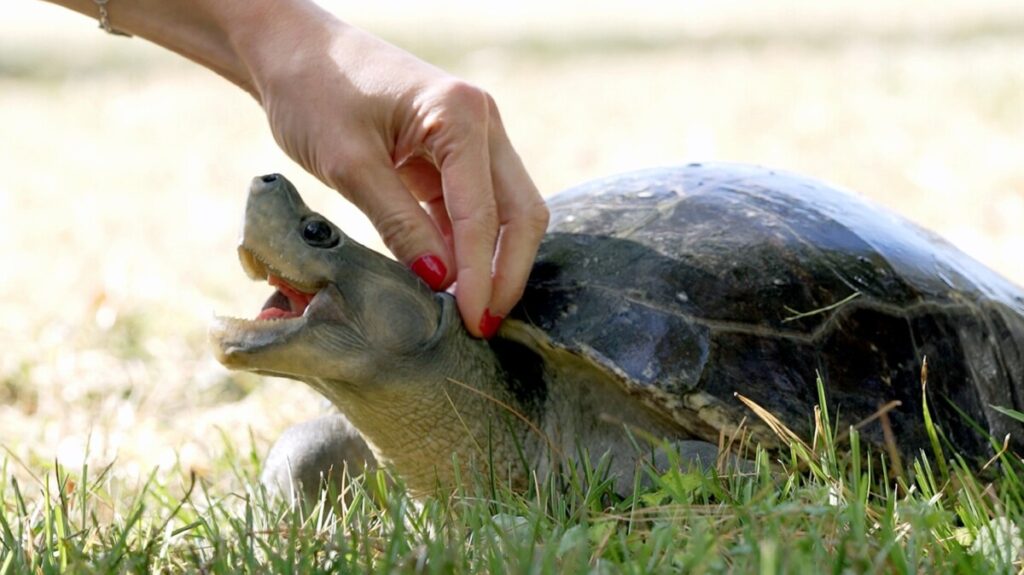
Trafficked turtles get a second chance at life in New Jersey sanctuary
In the serene hills of rural New Jersey lies a remarkable sanctuary dedicated to the rescue and rehabilitation of turtles and tortoises, a hidden gem that is part of the Turtle Conservancy. Co-founded by conservation biologist Maurice Rodrigues and filmmaker Eric Goode in 2005, this sanctuary provides a safe haven for abandoned, homeless, and illegally trafficked reptiles, particularly those confiscated at airports in the New York City metro area. Notably, law enforcement officials report that approximately 600 to 1,000 native turtles are seized annually at John F. Kennedy International Airport alone. The sanctuary not only cares for these turtles but also aims to rehabilitate them for eventual release back into the wild, showcasing the urgent need for such a refuge as turtle populations face increasing threats from habitat loss and climate change.
At the New Jersey sanctuary, Rodrigues and a dedicated team of volunteers create a nurturing environment for their occupants. The enclosures are thoughtfully designed with natural elements, including shrubs and a stream, allowing the turtles to thrive in a setting that mimics their natural habitats. Among the diverse residents are critically endangered species such as Burmese narrow-headed softshell turtles and Indian spotted turtles, along with local hatchlings like the spotted turtle. One of the standout residents is Ruby, a Burmese roofed turtle whose story embodies hope for her species. Once on the brink of extinction, Ruby represents a potential founder for future breeding efforts aimed at reintroducing her species to the wild. Despite her challenging past, she is thriving under the care of the Turtle Conservancy, which emphasizes the importance of assurance colonies in preserving endangered species.
The sanctuary’s efforts extend beyond mere rescue; they also involve extensive care and preparation for the turtles’ future. Rodrigues highlights the challenges of maintaining such a facility, from the financial burdens of feeding the reptiles to the need for a greenhouse that would better accommodate tropical species. With a commitment to conservation and a deep passion for these vulnerable creatures, Rodrigues and his team strive to ensure that turtles do not become the first group of vertebrates to face extinction. Their mission is not only about saving individual animals but also about preserving the genetic diversity of species at risk, making the Turtle Conservancy’s sanctuary a beacon of hope in the fight against wildlife trafficking and habitat destruction.
Nestled in rural New Jersey’s rolling hills, a top secret
animal
sanctuary is keeping its occupants safe. The oasis is not for the
official state animal
(the horse) or even birds rescued from the Jersey shore. This hidden refuge belongs to turtles and tortoises.
“The goal with most of these is to get them back into the wild,”
Maurice Rodrigues
told
Popular Science
during a recent visit to the sanctuary.
A conservation biologist and realtor by training, Rodrigues co-founded the
Turtle Conservancy
in 2005 with entrepreneur and filmmaker Eric Goode. This eastern outpost of the Turtle Conservancy takes in abandoned, homeless, and
illegally trafficked reptiles
confiscated at airports in the New York City metro area. According to law enforcement officers working with the United States Fish and Wildlife Service,
inspectors seize about 600 to 1,000 native turtles
a year at John F. Kennedy International Airport alone. The non-profit has a separate sanctuary in Ojai, California that hosts turtles rescued from places closer to the West Coast.
Maurice Rodrigues holds an Eastern Box Turtle.
Image: Popular Science
At both facilities, the reptiles are fed, sheltered, and cared for by dedicated volunteers until they recover enough for release. In New Jersey, Rodrigues has built several enclosures filled with shrubs and other plants for the turtles to live in and forage. One raised bed is fed by a natural stream, giving the semi-aquatic reptiles access to freshwater amidst all of that greenery. The tropical species soak up the sun all summer before moving inside when the temperatures begin to drop below 50 degrees Fahrenheit, while the local turtles hibernate naturally outside.
A package of turtles intercepted at the International Mail Facility at John F. Kennedy International Airport.
Image: USFWS
Meet the ‘bale’
In the wild, a group of turtles is known as a bale or a nest. The turtles currently in this
New Jersey bale
include critically endangered Burmese narrow-headed softshell turtles (
Chitra vandijki)
, Indian spotted turtles (
Geoclemys hamiltoni
), and alien-esque Mata Mata turtles (
Chelus fimbriata
) from the Amazon. The habitat is not only home to reptiles from far off places–threatened species from the Midwest and Northeast also have a home here. In August, several
spotted turtles (
Clemmys guttata
)
hatchlings about the size of a quarter were born on site. Rodrigues tries to keep these
tiny turtles
safe from the natural predators in the area, including vultures and some unlikely animals.
A spotted turtle hatchling born in August.
Image: Popular Science
“Even frogs and toads will eat a baby turtle, so they’re very vulnerable,” says Rodrigues. “That’s why these come indoors. I usually get them to a decent size before I put them back outside, and then they’ll live their life outside until we’re ready to release them.”
And they have Ruby, the
undisputed star of the sanctuary
and queen of the bale. The expressive 35-pound reptile with a distinctive nose is a
Burmese roofed turtle
(
Batagur trivittata
), who represents some hope for a struggling species. Her previous owner was a veterinarian and taxonomist who passed away, leaving her in Rodrigues’ care.
“She’s one of the rarest animals on the planet, so it’s bizarre that she ended up here at my house,” Rodrigues says with a laugh. “I normally don’t name the turtles, but she’s from Myanmar, and their number one gemstone is the ruby, so that’s her name.”
Ruby the turtle.
Image: Popular Science
In the early 2000s, Burmese roofed turtles
almost went extinct
. Five females and three males were found and placed together to form the first captive assurance colonies for the species.
Assurance colonies
keep animals at risk of extinction in zoos, aquariums, or semi-wild conditions like at the turtle sanctuary so that they can hopefully breed and keep the species going.
With assurance colonies,
preserving DNA
and trying to get the species able to breed and return to the wild is the ultimate goal when it’s possible.
“It’s not always safe,” says Rodrigues. “There are species where we’ve been breeding them in captivity, but we can’t release them yet, since there’s no safe place for them, because their habitats are still being destroyed, or there’s too much poaching, or the government the laws are not in place to protect them.”
All of today’s Burmese roofed turtles originate from those five females. Ruby has the potential of becoming the sixth founder female, if the conservancy volunteers can get her to breed and produce viable offspring. They are currently trying to find a male, preferably two since these turtles need males to fight over the females in order to breed. That offspring could end up back in Myanmar to contribute to the captive breeding program in their homeland.
Despite her already impressive size, Ruby should be even larger. She currently weighs about 35 pounds, but should be about 80.
“Because she was kept in captivity for so long and not in the greatest conditions, she’s a little stunted in growth,” says Rodrigues. “She’s primarily a vegetarian, but she is an omnivore. She’ll incidentally catch things while she’s eating vegetation, like snails, fish, all kinds of things.”
Fortunately, under the Turtle Conservancy’s care, she is gaining weight and growing.
“We’re getting her ready to go meet some males that we’re going to bring,” says Rodrigues.
A hatchling ringed map turtle and a hatchling Japanese Pond Turtle.
Image: Popular Science
Building towards the future
For the army of volunteers taking care of these somewhat unconventional pets, it’s equal parts scientific commitment and calling. Rodrigues, who also has a dog, even finds caring for the shelled reptiles a bit easier than his canine—but much more expensive. Rodrigues spends hundreds of dollars per month on live fish to feed the animals.
“Luckily, I have solar. But in the winter, the electric bill could be $500 a month just in electricity,” he says. “Then you have the labor, which I do myself, and I have volunteers to help me.”
Some of those volunteers are
helping raise funds through the arts
and other fundraisers to keep those lights on and help the Turtle Conservancy raise funds to build a greenhouse. This new structure will give the species from more tropical locales that the Garden State’s climate can’t mimic more room to roam and in an environment more similar to their native habitats. Still, even with the dedicated volunteers and motivation, caring for animals like these is not for the faint of heart.
“I do not recommend them for people that don’t have the means to do it,” Rodrigues cautions. “If you don’t have the means, the animals will suffer. They’ll be kept just inhumanely. Personally, I don’t like keeping them indoors here, which is why I’m struggling and working hard to get this greenhouse built.”
It’s not easy being green
Along with
amphibians
, turtles are among the
most threatened groups
of vertebrates due to the continued pressures of habitat loss and
climate change
. Those continued threats help fuel the team taking care of Ruby and her compatriots, preserving their precious DNA and keeping species going.
“I’m fascinated by turtles. I think they’re beautiful. I also just feel that they’re so vulnerable,” says Rodrigues. “The first group of animals to go extinct will be turtles. That really bothers me, and I want to be part of the team that keeps that from happening.”
The post
Trafficked turtles get a second chance at life in New Jersey sanctuary
appeared first on
Popular Science
.


