What to know as hundreds of flights are grounded across the US – an air travel expert explains
On November 7, 2025, the Federal Aviation Administration (FAA) implemented a significant 4% reduction in flights across major U.S. airports as the ongoing government shutdown began to take its toll on air travel. This decision comes in response to air traffic controllers working without pay since the shutdown commenced on October 1, forcing the FAA to take measures to alleviate the strain on these essential personnel. While nonessential government workers were furloughed, air traffic controllers continued to operate, necessitating a reduction in flight volume to ensure safety and efficiency in the skies. The FAA has indicated that if the shutdown continues, this reduction could escalate to 10% by November 14, impacting high-volume hubs such as Atlanta, New York, Chicago O’Hare, and Los Angeles International.
The implications of this flight reduction are substantial for travelers. The FAA’s strategy focuses on minimizing disruption by primarily targeting domestic flights, particularly high-frequency routes, while international flights remain unaffected for now. For example, American Airlines plans to reduce its Miami to Orlando service from nine flights to eight over the weekend. As a result, passengers can expect fuller flights, increased delays, and the necessity to arrive at airports earlier than usual. The current lull in travel demand before the Thanksgiving holiday may provide some relief, as there are still available seats to accommodate passengers from canceled flights. However, if the situation worsens during the busy holiday season, the impact on airlines and travelers could become more severe, leading to longer delays and potential changes in travel behavior, with some opting for car travel over flying.
As the situation evolves, airlines are responding proactively by allowing customers to change flights or request refunds without penalties, even for nonrefundable fares. This flexibility is crucial in maintaining passenger confidence during this uncertain period. Historically, significant disruptions in air travel, such as those experienced after the September 11 attacks or during the COVID-19 pandemic, have led to shifts in consumer behavior, with many travelers opting for road trips instead of flying for shorter journeys. As the FAA, the U.S. Department of Transportation, and airlines navigate this unprecedented scenario, travelers are advised to stay informed through airline apps, consider booking flights earlier than usual, and minimize connections to avoid complications.
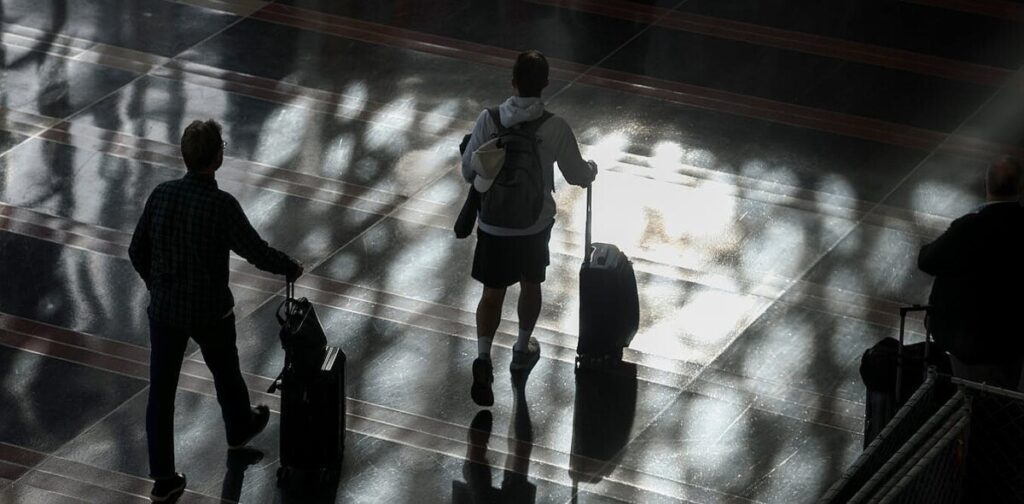
Passengers walk through the Ronald Reagan Washington National Airport on Nov. 7, 2025.
Anna Moneymaker/Getty Images
Major airports across the United States were subject to
a 4% reduction in flights
on Nov. 7, 2025, as the government shutdown began to affect travelers.
The move by the
Federal Aviation Administration
is intended to ease pressure on air traffic controllers, many of whom have been
working for weeks without pay
after the government shut down on Oct. 1. While nonessential employees were furloughed, workers deemed essential, such as air traffic controllers, have continued to do their jobs.
But what does that mean for the
many Americans
who take to the skies every day? To find out, The Conversation U.S. spoke with
Laurie A. Garrow
, a civil aviation expert at Georgia Tech.
What do we know about the FAA’s plans so far?
The first thing to note is that things can change fast. But as of this morning, 4% of flights are being canceled across 40 “high-volume” airports. The list is
publicly available
, but it includes most of the big hubs across the United States, such as Atlanta, New York’s airports, Chicago O’Hare, Los Angeles International and Dallas/Fort Worth.
The plan is to
ramp this up to 10% by Nov. 14
should the shutdown extend that long.
The FAA, the U.S. Department of Transportation and the airlines are working together on the details of which flights and routes are affected – and this will no doubt be monitored as the days go on.
But they are trying to make the cancellations in a way that cause the least disruption to customers.
So we are looking at cuts to domestic, not international, flights – flights across the Atlantic, Pacific and to Latin America are not, for now at least, subject to cuts.
The 4% of cancellations we are seeing are really targeting the high-frequency routes. This should help mitigate the impact. For example, typically American Airlines flies nine flights a day from Miami to Orlando, but
they are planning to fly eight
this weekend.
And carriers are looking at reducing regional flights. For example, my mom lives near Erie, Pennsylvania, where American Airlines
flies three daily flights
to their hub in Charlotte – I would expect that to go down to two, or one.
But the FAA was clear that it wasn’t going to cut flights to markets entirely, just reduce them.
What will this mean for existing flights?
For starters, you are going to see more passengers on them. It is fortunate that we are in the lull before Thanksgiving. This isn’t
like the summer
. There is more slack in the system – so there are extra seats available. If one flight gets canceled on a busy route, it will at this stage be fairly easy to accommodate on another flight.
And I expect customers will be asked to get to airports a little earlier than they would normally.
But people should expect more delays on existing flights. This is because of the way we maintain safety in the air transportation system. Air traffic control can only safely watch a certain number of flights. So when you have someone not at work, or a reduction in number of controllers, you will need to reduce the number of airplanes in the sky. You can’t ask a controller to watch, say, 20 flights when they usually watch 10. So what you do is put in
more ground delay programs
to limit the number of aircraft coming into or out of an airport. This causes delays but is necessary in peak periods.
What impact will this have on airlines?
At 4%, probably not too much of an impact. When you look at the list of airports affected, it is balanced from the point of view that many are large hubs and the pain is being shared across all U.S. carriers.
As for the impact on other types of businesses, at the moment it is mainly the industries that air transportation supports. According to the International Air Transport Association, the air transport sector in the U.S. – covering airlines, airports and tourism enabled by aviation –
contributes about US$1.3 trillion, or about 4.7%, to GDP
and supports about 7.6 million jobs. If these wider sectors are severely affected, it could create a longer-term impact on the economy.
And if this continues into the holiday season?
That is when it will get painful for the carriers. If we are looking at reduction of 10% going into the holiday season with additional delays, then that is when the real pain will be felt.
Will this affect how Americans choose to travel?
Air travel is what I call an emotional mode of transport – we use it for the events that are most significant in our life, such as big family meet-ups, holidays and major face-to-face business deals. So this may affect how people choose to travel going into the holiday season if it is more difficult to get people back to their families in time.
Robert Isom, CEO of American Airlines, said on Nov. 7 that
they are seeing an impact on bookings
, with people postponing and rescheduling travel.
I certainly think for people looking at a 500- to 600-mile trip, the option of traveling by car is looking more appealing right now.
Will passengers be compensated for canceled flights?
Typically, compensation depends on whether the delay or cancellation was within the airline’s control. The U.S. Department of Transportation has
created a dashboard
showing “what services U.S. airlines provide to mitigate passenger inconveniences when the cause of a cancellation or delay was due to circumstances within the airline’s control.”
However, delays and cancellations caused by ATC staffing shortages are not considered to be within the airline’s control, and it is up to each airline to decide if and how they will compensate passengers.
As of Nov. 7,
many airlines
had announced
they were allowing customers
to change their flights or request a refund without penalty, including nonrefundable fares such as basic economy.
After all, it is in their interest, too, that people continue to fly.
Typically, major carriers offer more services for delayed and canceled flights within their control than low-cost carriers.
A Southwest Airlines plane taxis in front of the air traffic control tower at Los Angeles International Airport.
Mario Tama/Getty Images
Is there any precedent for this? What happened then?
There is no real precedent for what we are seeing: a 4% to 10% reduction across the board due to a government shutdown. But we have seen major disruptions, such as after the Sept. 11, 2001, terrorist attacks and during the pandemic, when COVID-19
ran through flight attendants and pilots
before the holidays – that caused flight cancellations and delays.
Historically, when we have seen something like this, we have seen consumer behavior change for a short period. After 9/11, when U.S. travelers had the hassle of increased security, there was a shift to more automobile travel for those 500- to 600-mile journeys.
What advice would you give would-be flyers now?
First off, download the app for the airport and airline carrier so you get up-to-date, reliable information. And if you can book for a day earlier than you normally would for a major event, do so – it provides a buffer in case your flight is delayed or canceled.
And try to avoid connections at all costs. The fewer legs, the fewer things can go wrong.
Also, don’t check bags if you can. There is nothing worse than getting to an airport, finding your flight is canceled, and then having to wait for your luggage to get returned.
Laurie A. Garrow is Past President of AGIFORS, a non-profit organization dedicated to using advanced analytics to improve airline planning and operations.


