Runaway black hole mergers may have built supermassive black holes
A groundbreaking new simulation is shedding light on two of astronomy’s most intriguing mysteries: the rapid formation of supermassive black holes and the enigmatic “little red dots” observed by the James Webb Space Telescope (JWST). Supermassive black holes, which are believed to reside at the centers of nearly all of the estimated 2 trillion galaxies in the universe, have puzzled astronomers for decades. These cosmic giants, some reaching billions of times the mass of the Sun, appeared shortly after the Big Bang and grew at astonishing rates, raising questions about the mechanisms that enabled their swift accumulation of mass.
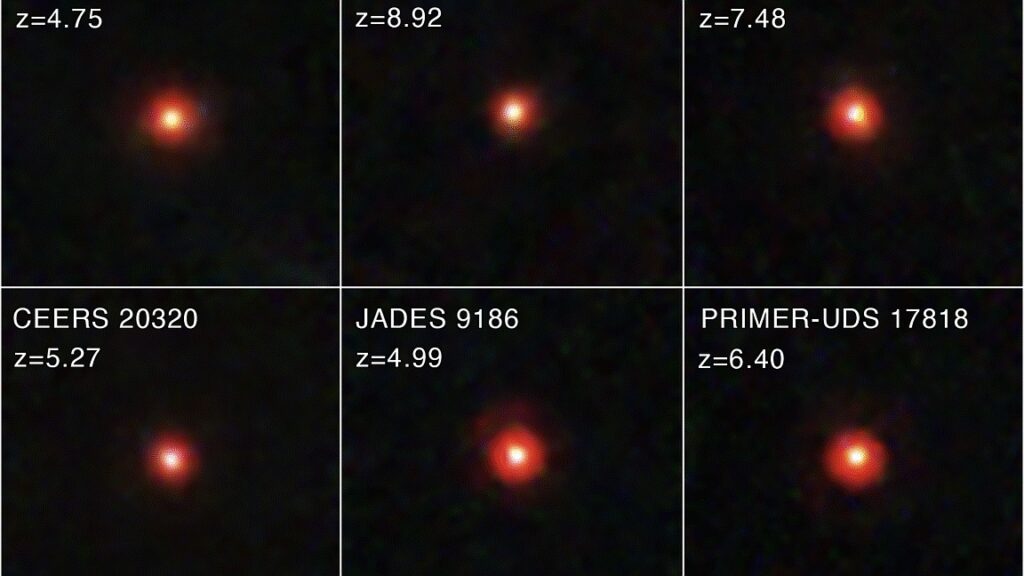
The mystery deepened in 2022 with the discovery of the “little red dots” in JWST images, which sparked intense debate among scientists regarding their identity. Initially, their nature was uncertain, but as researchers gathered data on hundreds of these dots, a consensus began to emerge. Many astronomers now propose that these dots represent nascent supermassive black holes in the early stages of formation. This hypothesis is supported by the simulation that not only explores the conditions necessary for the rapid growth of these black holes but also provides insights into the environment in which they might be forming. The findings suggest that the early universe was rife with conditions conducive to the birth and growth of these cosmic giants, potentially offering a clearer picture of their origins.
The implications of this research are profound, as they could reshape our understanding of black hole evolution and the formation of galaxies. By linking the little red dots to the rapid growth of supermassive black holes, astronomers are not only addressing a longstanding question but also paving the way for future investigations into the early universe. The JWST’s capabilities in observing distant galaxies are proving invaluable, providing a deeper understanding of cosmic history and the fundamental processes that govern the universe. As more data is collected and analyzed, the mysteries of supermassive black holes and their early formation may finally be unraveled, revealing the intricate tapestry of the cosmos.
https://www.youtube.com/watch?v=5a_ixib8cB4
A new simulation could help solve one of astronomy’s longstanding mysteries—how supermassive black holes formed so rapidly—along with a new one: What are the James Webb Space Telescope’s (JWST) “little red dots?”
Invisible leviathans lurk at the cores of nearly all of the 2 trillion or so galaxies strewn throughout space-time. Monster black holes entered the cosmic scene soon after the Universe’s birth and grew rapidly, reaching millions or even billions of times the Sun’s mass in less than a billion years. Astronomers have long wondered how these supermassive black holes could have grown so hefty in such little time.
The monster black hole mystery became even more perplexing in 2022 when “
little red dots
” were spotted at the far edges of space. When these tiny scarlet orbs began unexpectedly popping up in JWST images of the distant Universe, their nature was hotly debated. Now that scientists have amassed a sample of
hundreds of them
, many think the dots are
growing supermassive black holes
.
Read full article
Comments