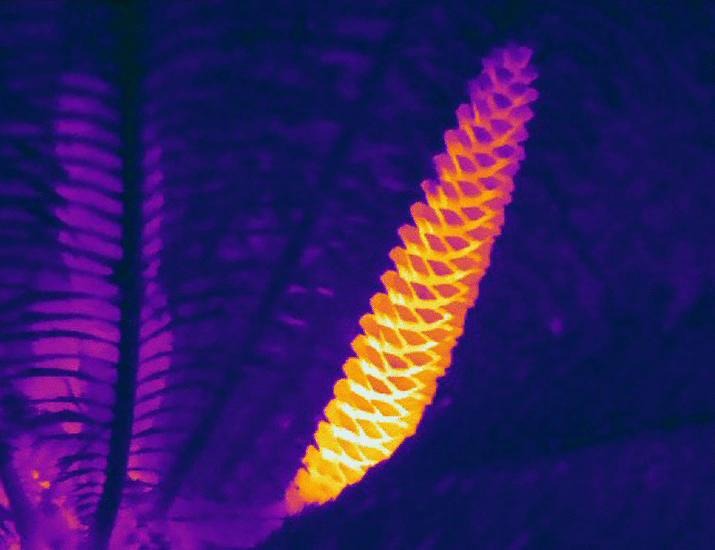
Infrared as a pollination signal | Science
Recent research has uncovered intriguing insights into the evolutionary trajectory of cycads, ancient plants that have survived for millions of years. Scientists propose that cycads may have relied more heavily on infrared communication rather than visual color cues for reproduction and interaction with pollinators. This reliance on infrared signals could have significantly influenced their evolutionary development, potentially limiting their adaptability in a world where visual cues are paramount for many other plant species.
Cycads, which first appeared over 300 million years ago, have a unique reproductive system involving specialized cones that produce seeds. The study highlights a fascinating aspect of their biology: cycads emit infrared radiation that may attract certain pollinators, particularly insects that are sensitive to these wavelengths. This form of communication, while effective in specific contexts, may have restricted cycads from evolving more vibrant colors and diverse visual signals that could attract a wider range of pollinators. As a result, cycads may have missed opportunities for diversification, which is crucial for survival in changing environments.
The implications of this research extend beyond understanding cycad evolution; they also raise questions about how different plant species adapt to their environments and interact with their ecosystems. For instance, while many flowering plants have evolved bright colors to attract a variety of pollinators, cycads’ focus on infrared communication could explain their relatively static appearance over millennia. This study not only sheds light on the unique evolutionary path of cycads but also invites further exploration into the complex relationships between plants and their pollinators, emphasizing the importance of communication methods in shaping biodiversity.
https://www.youtube.com/watch?v=PlID4NE1t4A
Relying on infrared communication over visual color could have limited cycad evolution


