Trump says US seizes massive Venezuelan oil tanker as showdown with Maduro erupts into new phase
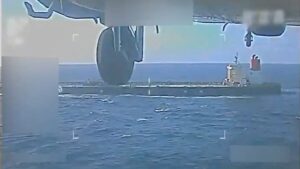
In a significant escalation of U.S.-Venezuelan tensions, President Donald Trump announced the seizure of a large oil tanker off the coast of Venezuela, marking the largest such action in history. During a recent White House roundtable, Trump stated, “We’ve just seized a tanker on the coast of Venezuela,” indicating that more developments related to this operation would unfold in the near future. This seizure is part of a broader strategy by the Trump administration to increase pressure on Nicolás Maduro’s government, which the U.S. has long deemed illegitimate. The action comes amidst a backdrop of ongoing U.S. military operations targeting alleged narcotraffickers in the region, with at least 22 strikes conducted since September, resulting in 87 fatalities.
The implications of this seizure extend beyond mere maritime law enforcement; they signify a potential shift in U.S. military engagement in Latin America. Trump has hinted at the possibility of land strikes within Venezuelan territory, a move that would further heighten tensions between Washington and Caracas. The Venezuelan government, already under extensive U.S. sanctions that have crippled its oil sector, faces an increasingly precarious situation. Historically, Venezuela has been a major oil supplier to the U.S., but sanctions imposed on its state oil company, Petróleos de Venezuela SA (PDVSA), have drastically reduced imports since 2019. While there was a brief period of limited sanctions relief allowing some crude oil to flow to U.S. refineries, this has since been curtailed, with Trump revoking Chevron’s license to purchase oil from Venezuela earlier this year.
As the U.S. continues to exert pressure on Maduro’s regime, the geopolitical ramifications of these actions could be profound. Venezuela, which boasts some of the largest oil reserves in the world, exports around 750,000 barrels of oil daily, with a significant portion directed to China. The U.S. government’s aggressive stance could further isolate Venezuela economically and politically, potentially destabilizing the region. As this situation evolves, observers will be closely monitoring the U.S.’s next moves and the response from Maduro’s government, which has already faced unprecedented challenges in recent years. This developing story promises to have lasting impacts on U.S.-Latin American relations and the global oil market.
https://www.youtube.com/watch?v=fhdtDCvZqVo
The U.S. has seized a Venezuelan oil tanker, President
Donald Trump
announced Wednesday, marking a sharp escalation in tensions with Caracas.
“We’ve just seized a tanker on the coast of Venezuela,” Trump said at a White House roundtable. “Large tanker, very large. Largest one ever seized action. And, other things are happening. So you’ll be seeing that later. And you’ll be talking about that later with some other people.”
The move is likely to further strain relations with
Nicolás Maduro’s government,
which already is subject to extensive U.S. sanctions targeting Venezuela’s oil sector. It comes after U.S. military strikes have targeted alleged narcotraffickers near Venezuela at least 22 times since September, killing 87 people.
The Trump administration is considering launching land strikes on Venezuelan territory in an effort to further ramp up pressure on Maduro, who the U.S. views as the illegitimate leader of Venezuela and the leader of the Cartel de Los Soles drug trafficking cartel.
Trump recently said Maduro’s “days are numbered” and refused to rule out a ground operation in the South American country.
“I don’t want to rule in or out. I don’t talk about it,” Trump told Politico Tuesday.
Venezuela has some of the largest oil reserves in the world and exports close to 750,000 barrels per day. Around half goes to China, according to Kplr data.
Prior to broad sanctions, Venezuela historically was a major crude-oil supplier for the U.S.
After sanctions on Venezuela’s state oil company Petróleos de Venezuela SA (PDVSA) in 2019, imports dropped sharply. Limited sanctions relief and occasional licensing, notably for Chevron, allowed some Venezuelan crude to flow again to U.S. refineries in 2024 and 2025.
Trump revoked Chevron’s license to purchase oil from Caracas earlier in 2025.
This is a developing story. Please check back for updates.