Lucas: The Charlie Baker effect looms large
In the evolving landscape of Massachusetts politics, Mike Minogue, a newcomer to the Republican scene, is navigating a complex path that echoes the legacy of former Governor Charlie Baker. Baker, often labeled a RINO (Republican In Name Only) by figures such as Donald Trump, managed to secure two terms in a state that leans heavily Democratic. His ability to effectively collaborate with a Democrat-controlled legislature and appeal to a broad base of voters made him a popular figure, even as his style diverged from the more traditional, hardline Republican image. As Baker’s progressive successor, Governor Maura Healey, stumbles through her administration, Baker’s tenure is increasingly viewed in a favorable light, highlighting the challenges that lie ahead for Minogue and other Republican contenders.
Minogue, alongside Mike Kennealy and Brian Shortsleeve, is vying for the Republican nomination to succeed Healey. Despite their business acumen and backgrounds of working under Baker, all three face the daunting task of balancing their appeal to both the Republican base and the independent voters who dominate Massachusetts’ electorate. Minogue has stirred controversy by suggesting he doesn’t fully identify with the Republican Party, a stance that has drawn criticism from his opponents. He insists that his allegiance lies with his principles rather than party politics, a sentiment that could resonate with the significant number of independent voters in the state. However, political experts warn that to secure a nomination, he must first court Republican voters, as the GOP convention and primary elections will largely be influenced by party loyalists.
Minogue’s political strategy is further complicated by his past support for Trump, including a hefty $100,000 donation to the Trump 47 Committee, which could either bolster his standing among Trump supporters or alienate moderate Republicans. As he attempts to carve out his identity in a party still grappling with the Trump legacy, Minogue’s challenge will be to balance his appeal to independents while also solidifying his position within the GOP. With the political landscape shifting and the influence of both Trump and Baker looming large, Minogue’s journey could redefine what it means to be a Republican in Massachusetts, potentially paving the way for a new generation of leaders in a state where party affiliation often takes a backseat to pragmatic governance.
https://www.youtube.com/watch?v=AZpk8oti7lQ
Mike Minogue need not worry about not being much of a Republican.
Former Gov. Charlie Baker was not much of a Republican either, yet he was elected twice and probably would have won a third time had he run in 2022.
Baker, according to President Donald Trump and others, was not only a RINO (Republican In Name Only), but a RINO’S RINO.
“He shouldn’t even be considered a Republican,” Trump said of Baker.
But it worked. Baker was a popular and — with exceptions — an effective governor in progressive and heavily Democrat Massachusetts, and he found ways to work with an overwhelmingly Democrat controlled Legislature.
Baker looked Republican but talked Democrat.
The stumbling around of Democrat Gov. Maura Healey, Baker’s progressive successor, makes Baker, in retrospect, appear to be an even better governor than he was.
Healey is running for a second term.
Baker was just not Donald Trump’s kind of Republican, which is why Democrats liked and supported him, and why the Trump faction of the divided GOP did not.
Baker may be gone now, as is much of the division in the GOP. But Trump is still here, and the three quite qualified Republicans running for governor must figure out how to deal with him.
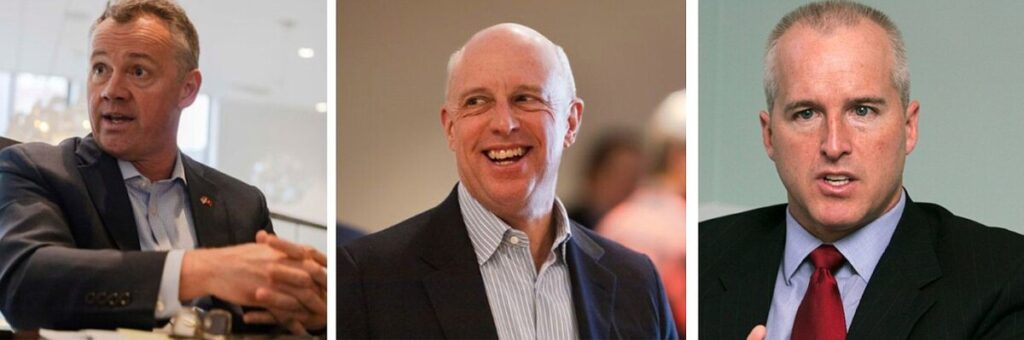
They are Minogue, 56, of Hamilton, Mike Kennealy, 45, of Lexington, and Brian Shortsleeve, 52, of Barnstable. None has run for public office before, although both Kennealy and Shirtsleeve worked for Baker.
While all three are successful in the business world, Minogue’s success has been most impressive. Before leaving Abiomed, creator of the world’s smallest heart pump, he earned $3 million a year and has a net worth $90 million.
An early but interesting development in the three-way contest is that Minogue has come under fire from Shortsleeve and Kennealy for apparently appearing to distance himself from the GOP.
In a WBUR interview, Minogue said, “I don’t identify with a party.” He added, however, that he aligned with the party on his principles, though.
After he was attacked by the Shortsleeve and Kennealy campaigns for keeping the party at arm’s length while running as a Republican, Minogue told the Herald, “I swore an oath to the Constitution at West Point, not to a political party. I won’t put party politics ahead of what is best for Massachusetts or America.”
Minogue, a political newcomer, is right. And his comments will appeal to independent voters, who make up the bulk of the voting public.
However, Minogue made his remarks too soon.
There are 3,119,486 independent or unenrolled voters in Massachusetts compared to 1,236,762 Democrats and 402,327 Republicans
Minogue must first make his case to Republicans, not independents, if he plans to win the GOP convention endorsement or prevail in a Republican primary. There will be no independents at the convention and few voting in a GOP primary.
Then there is the Trump or the White House factor
While Minogue has been an important Trump contributor, coming up, for instance, with a $100,000 contribution to the Trump 47 Committee, this does not translate into an endorsement, which Minogue may or may not want.
This is Massachusetts, after all, where progressive Democrats and their leftist media allies treat an endorsement from Trump like a slap on the back from Hitler.
While Trump may stay out of the race, it does not mean that the White House will stay out, too.
Minogue, after all, did host a high-end Massachusetts fundraiser for Vice President JD Vance last July. That could mean a lot.
Veteran political reporter Peter Lucas can be reached at: peter.lucas@bostonherald.com
Former Gov. Charlie Baker may be gone, but he’s not forgotten. (Nancy Lane/Boston Herald)


