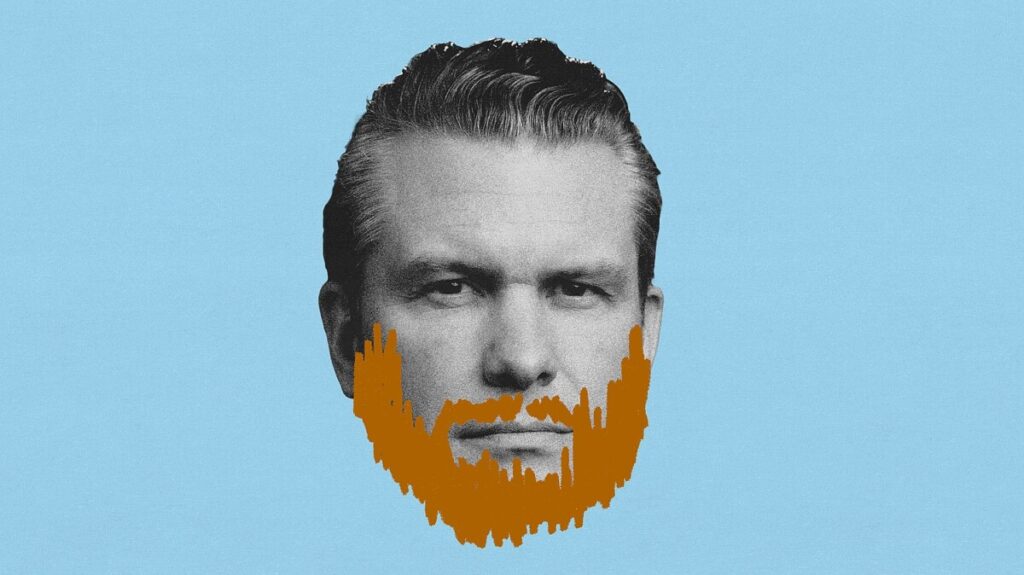
The Origin of Hegseth’s Anti-Beard Obsession
In a recent article, the scrutiny surrounding Secretary of Defense Pete Hegseth’s controversial stance on military grooming standards highlights a broader cultural clash within the U.S. military. During his trip to Asia last month, Air Force leadership issued a directive to prevent Hegseth from meeting any service member sporting a beard, a move that underscores his belief that facial hair undermines the military’s “warrior ethos” and poses a threat to readiness. At a global military conference, Hegseth declared, “No more beardos,” signaling a hardline stance against beards, which he associates with a decline in military discipline and effectiveness. This perspective is steeped in historical context, particularly the Vietnam War era, when many military leaders linked lax grooming standards to poor morale and military failures.
The debate over grooming standards has evolved significantly over the years, especially following landmark changes during the Obama administration, which opened combat roles to women and addressed the inclusion of transgender personnel. Notably, the issue of religious accommodations for bearded service members—primarily Sikhs, Jews, and Muslims—has been contentious. Legal battles, including a pivotal federal court ruling in 2015, established that the military had previously granted numerous exceptions to its grooming policies, primarily for medical reasons, but also for religious ones. Despite extensive testing demonstrating that neatly trimmed beards do not impede the effectiveness of gas masks, the military’s leadership has remained hesitant to embrace a more inclusive grooming policy. Hegseth’s recent directive to limit medical shaving profiles and restrict religious accommodations has reignited these debates, raising concerns about morale and inclusivity within the ranks.
Critics argue that Hegseth’s policies are less about operational readiness and more about personal preferences rooted in outdated notions of military discipline. The article highlights that the military’s resistance to change in grooming standards reflects a broader struggle with evolving societal norms, as beards have become increasingly accepted in various professional settings outside the military. By enforcing rigid grooming standards, Hegseth risks alienating service members who seek to express their identity while fulfilling their duties. Ultimately, the military must reconcile its grooming policies with the realities of a diverse force and the evidence supporting the effectiveness of such inclusivity, lest it undermine the very morale and cohesion it seeks to uphold.
On Secretary of Defense
Pete Hegseth’s trip to Asia last month, Air Force leadership issued
an unusual directive
: Keep him from seeing a service member with a beard. The instruction was surreal, the kind of stage management usually reserved for celebrities with eccentric phobias. Yet for Hegseth, facial hair has become a symbol of everything he believes has gone wrong in the U.S. military—a distraction from its “warrior ethos,” and, somehow, a threat to military readiness. In late September, he lectured on the subject of beards at an unprecedented global convening of the military’s most senior leaders, where—framed by the American flag—he proclaimed, “No more beardos. The era of rampant and ridiculous shaving profiles is done.”
I served as assistant secretary of the Air Force during the Biden administration, as well as the Army secretary’s chief of staff during the Obama administration. Shaving profiles—exceptions to the general grooming policy that members of the military must be clean-shaven, save for mustaches—were without question the most emotional military-personnel matter I worked on in nearly a decade as a political appointee in the Pentagon.
The final year of the Obama administration brought a significant amount of change to military-personnel issues. In late 2015, Secretary of Defense Ash Carter
ordered
the military to open all combat jobs to women, a policy that required the development of detailed implementation plans to integrate women into ground-combat career fields including infantry, armor, and special operations. In June 2016, Carter
directed
the services to develop procedures to support the inclusion of transgender personnel. Yet within the Army, the question of whether service members whose faith requires facial hair—such as Sikhs, Jews, and Muslims—were entitled to permanent religious accommodations provoked the loudest objections from the brass.
[
Read: Pentagon Report: Hegseth risked endangering troops with Signal messages
]
The Army had been trying to avoid directly resolving this question for years. In 2014, a Sikh ROTC cadet at Hofstra University
sued the Army
, claiming he could not receive his officer’s commission unless he shaved his beard and cut his hair—actions that would effectively force him to choose between his faith and his country. In 2015, a federal court ruled in his favor, noting that the Army had previously granted more than 100,000 exceptions to its prohibition on beards. Although the great majority were related to a painful razor-bump medical condition called
pseudofolliculitis barbae
that disproportionately affects Black men, some of these exceptions were granted for religious or mission-related reasons; Special Forces operating in Afghanistan and Iraq were allowed to grow beards to blend in. That ruling, alongside another lawsuit seeking to make religious waivers to grooming standards permanent, brought the issue to a head in mid-2016.
The Army’s uniformed leadership appeared surprisingly resistant to changing policy to provide permanent accommodations so that soldiers wouldn’t need to request one each time they changed units. The generals objected that such accommodations undermined uniformity, an important attribute of a professional military that helps transform geographically, culturally, and ethnically diverse recruits into cohesive teams bound by a common purpose. A shared standard of dress and discipline is essential to that transformation. They were also concerned that soldiers with shaving profiles would not be able to achieve effective seals on gas masks—which the military calls “respirators”
—
posing a risk to themselves and to others in the unit who would need to rescue them.
The problem with those arguments, at least according to the courts that had considered them, was that the existence of thousands of soldiers with medical shaving profiles, plus the few with religious accommodations, had not resulted in any documented deficiencies in unit cohesion or discipline. Nor was there any conclusive evidence that those with beards could not succeed in sealing their gas mask.
To properly evaluate the respirator-seal argument, Secretary of the Army Eric Fanning ordered extensive testing in late 2016 at the Army’s Aberdeen Proving Ground. After Sikh volunteers with neatly trimmed beards were able to achieve proper seals, it began to look less likely that the Army’s stated objections would be strong enough to withstand legal review. As a result, days before the end of the Obama administration, Fanning signed a memo
authorizing permanent religious accommodations
with the support of Army Chief of Staff General Mark Milley, who appeared concerned that a federal judge would end up dictating Army policy in this domain.
Additional scientific testing would follow, including a 2018
Navy Safety Center study
that found that 98 percent of participants with short, well-groomed beards achieved proper respirator seals—comparable to clean-shaven users. Over the next few years, the
Air Force
and the
Navy
largely came around to the Army policy. However, it wasn’t until 2024, after the Marine Corps
failed to gain
U.S. Supreme Court review of lower-court rulings, that the Marines began granting religious grooming accommodations to trainees.
When I returned to the Pentagon in 2022, this time to the Air Force, my responsibilities for military-personnel policy thrust me back into some of these same debates. On military social media, the instances of derision aimed at bearded personnel were often swamped by fierce calls for the Pentagon to catch up with a changing culture where athletes, actors, and musicians all sport beards. Around this time, service leaders began to
recognize that the stigma
of having a beard in the force—even when the profile was authorized—carried negative implications for career advancement and obtaining prominent assignments.
Notably, developing a broader facial-hair policy to address these cultural changes nearly became a legal requirement in 2024, until the Senate removed a House-passed
provision
from the annual defense bill that would have required the Air Force to conduct a pilot program authorizing beards. The culture had changed: Facial hair had become more mainstream in American society, a shift reflected even in
People
magazine’s annual “Sexiest Man Alive”
selections
.
T
hroughout my time
in the Pentagon, I struggled to understand the opposition to neatly maintained, professional beards and certainly the disdain that often accompanied authorized exemptions for religious or medical reasons. I wondered why the Army’s uniformed leadership remained so opposed to beards when their resistance to the defense secretary’s orders to integrate women into combat units or enable transgender Americans to serve was comparatively muted—both publicly and in internal meetings I attended.
After years of listening to officers try to explain their discomfort with beards, I eventually came to believe that their opposition was less about policy and more about memory. Perhaps seeing troops returning from losing in Vietnam with beards and tattered uniforms had made an indelible impression.
In 2016, nearly all of the Army’s 11 four-star generals had earned their commissions during the late 1970s and early 1980s. They grew up as the Vietnam War protest movement was at its height. The May Day protests of 1971 might have been the largest anti-war demonstrations in American history.
At the same time, military experts were beginning to recognize the profound impact that the strategic and moral challenges of the war were having on those fighting it. An
Armed Forces Journal
article
published in 1971 noted that “morale, discipline and battle worthiness of the U.S. armed forces are, with a few salient exceptions, lower and worse than at any time in this century and possibly in the history of the United States.” The armed forces also struggled in these years with drug use and racial tension.
Those patriotic teens who were drawn to military service—and who would eventually become generals—couldn’t be blamed for believing that the military’s failure in Vietnam stemmed directly from lax discipline and eroding standards. They wanted to rebuild a military that could win again, and rigorous adherence to grooming standards rose to the top of their list.
Yet most of these same young men would have attended West Point sometime after the first class of women arrived in 1976. Performing their field and physical training and classroom-based learning alongside women, who were required to fulfill many of the same standards as men, might have made it easier for them to accept the eventual integration of women into combat disciplines.
W
hich brings me back
to Hegseth. Perhaps Hegseth’s worldview is stunted by the same Vietnam-era fear as those Army generals: that discipline is fragile, that appearance is synonymous with order, and that a military that loosens its grip on grooming will soon lose its grip on everything else. It follows that the military must appear to look a certain way in order to be effective, ready, and lethal. Hegseth’s physical appearance—certainly more than his national-security credentials or executive experience—may have been what led President Donald Trump to select him for defense secretary. And the primacy Hegseth places on outward appearances apparently extends to those he deems
not sufficiently physically fit
or the
wrong gender
for the war movie he imagines himself casting.
This fixation on appearance doesn’t just shape Hegseth’s rhetoric; it now informs his policy. On the day of his speech to the department’s command leadership at Marine Corps Base Quantico, he issued a
new policy
requiring that existing medical shaving profiles expire within a year—after which time those who could not find effective treatment would be processed for discharge. The policy also rendered service members who rely on legally required religious accommodations ineligible to deploy, typically a career-ending measure. The stated justification is that this will improve “survivability, interoperability, and mission execution.”
But both the past decade of authorized shaving profiles and the extensive studies demonstrating that those with neatly maintained facial hair can meet safety requirements illustrate that this policy is about preference over readiness.
Hegseth himself made this explicit when he
told
the generals at Quantico, “If you want a beard, join Special Forces. If not, then shave.” Today, with specialized military units
operating largely outside the Middle East
, that logic strains any tenuous credibility it may have once had. In what world do elite operators still require beards more than troops with legitimate medical or religious reasons?
Hegseth’s willingness to grant exceptions for appearance when it flatters his obsession with imagined toughness, while denying them to those with legitimate needs, reveals his outdated vision of military effectiveness.
However, uniformity and standards do matter. The military must maintain clear, consistent, and enforceable uniform and grooming policies. In his Quantico address, Hegseth came closest to coherence when
he noted
that “we don’t have a military full of Nordic pagans. But unfortunately, we have had leaders who either refuse to call BS and enforce standards, or leaders who felt like they were not allowed to enforce standards.” Over time, the Air Force’s waiver system became unevenly applied and poorly documented. As assistant secretary, I worked alongside then–Air Force Chief of Staff David Allvin
to improve the clarity of these policies
. Strengthening oversight and consistency is the sensible thing to do.
[
Read: Holy warrior
]
But rather than continue to identify ways to improve adherence to grooming standards, Hegseth seeks to diminish and marginalize those who sought accommodations. For Black service members who suffer from painful razor bumps and ingrown hairs, or for Sikhs and Jews who maintain facial hair as an article of faith, these policy changes send the message that their difference is disqualifying. By declaring that the “era of rampant and ridiculous shaving profiles is done,” Hegseth is likely to weaken morale, narrow the talent pool, and harm readiness more than a few beards ever could.
The military has changed; the country it serves has changed. What remains is a memory of disorder associated with facial hair, long after the evidence has ceased to sustain it. In my experience across three services, two military departments, and the Office of the Secretary of Defense, service members will meet high standards when they believe those standards are rooted in logic and necessity. But they will lose faith when those same standards are enforced arbitrarily, or in ways that seem to single out and diminish particular communities who meet every other standard.
The question is not whether we can maintain standards without clean-shaven troops. Both the science and the experience of our
NATO allies
, including
the United Kingdom
, already prove that beards don’t compromise mission effectiveness. The question is whether we have the courage to align military policy with evidence, fairness, and the diverse composition of the nation our military draws from and defends. Based on those criteria, as well as by every other measure since taking office, Hegseth has failed.


