Hubble Spots a Storm of New Stars
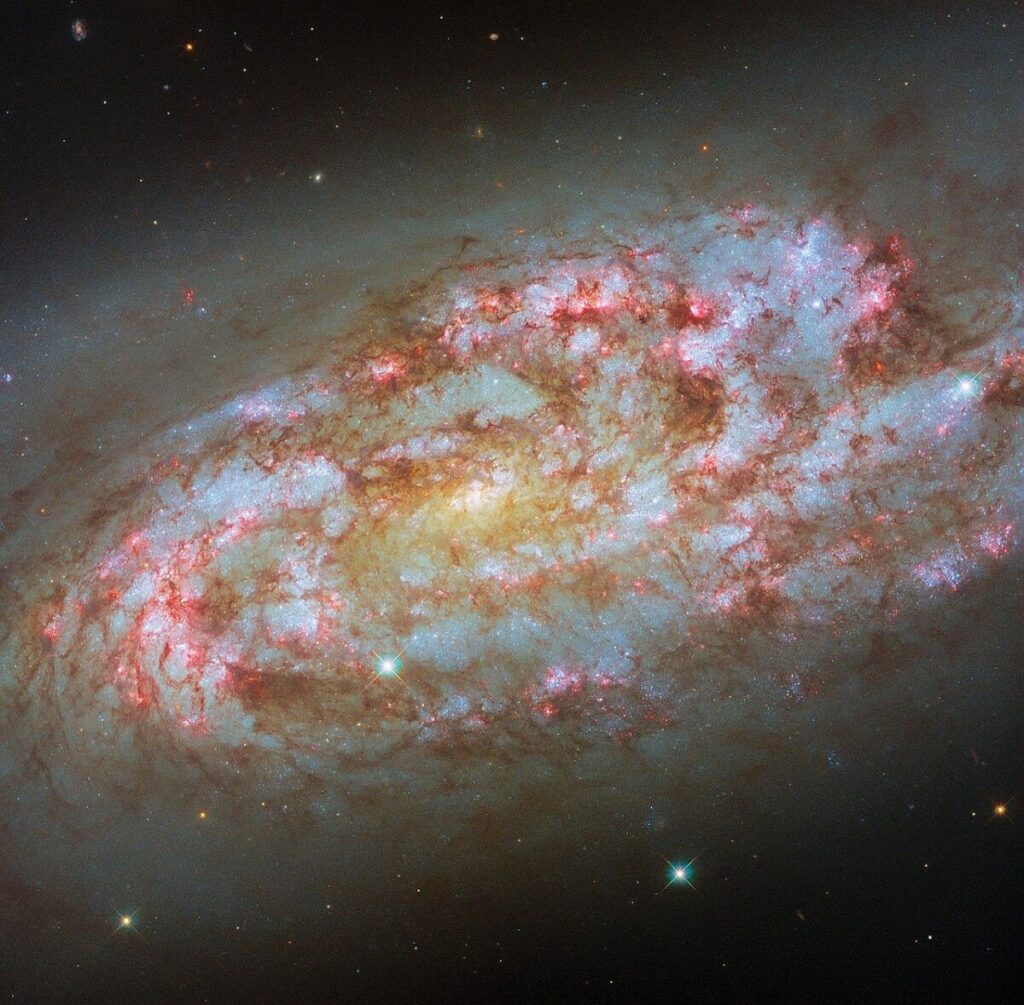
The Hubble Space Telescope continues to unveil the mysteries of the universe, recently capturing a stunning image of the spiral galaxy NGC 1792, located over 50 million light-years away in the constellation Columba. Known for its chaotic beauty, NGC 1792 is classified as a starburst galaxy, which means it is an active site for star formation. The galaxy’s bright center is surrounded by swirling spiral arms that are rich in star-forming regions, creating a mesmerizing vista that captures the attention of astronomers and space enthusiasts alike. The intense gravitational interaction with its larger neighbor, NGC 1808, has stirred up gas reserves within NGC 1792, leading to an explosion of star formation, particularly on the side closest to this gravitational influence.
This latest observation by Hubble builds upon previous studies, with new data collected throughout 2025 that provides deeper insights into the galaxy’s tumultuous activity. The image highlights bright red emissions, indicative of Hydrogen-alpha (H-alpha) light, which signals the presence of dense clouds of hydrogen molecules where new stars are forming. These stars emit powerful ultraviolet radiation, which ionizes the surrounding hydrogen gas, causing it to glow in a distinctive red hue. This phenomenon not only showcases the dynamic processes at play within NGC 1792 but also aids astronomers in understanding the intricate interactions between gas, star clusters, and supernovae in galaxies. As Hubble continues its mission, it remains an invaluable tool in the quest to uncover the complexities of the universe, offering a window into the birth and evolution of stars and galaxies.
With its 35th anniversary approaching, the Hubble Space Telescope’s contributions to astrophysics and our understanding of the cosmos are more significant than ever. From its breathtaking images to its role in advancing scientific knowledge, Hubble has profoundly impacted both the scientific community and public interest in space exploration. The insights gained from observing galaxies like NGC 1792 not only expand our knowledge of the universe but also inspire future generations to look to the stars, fostering a deeper appreciation for the vastness of space and our place within it.
https://www.youtube.com/watch?v=CfQhMvy8pMI
Explore Hubble
Hubble Home
Overview
About Hubble
The History of Hubble
Hubble Timeline
Why Have a Telescope in Space?
Hubble by the Numbers
At the Museum
FAQs
Impact & Benefits
Hubble’s Impact & Benefits
Science Impacts
Cultural Impact
Technology Benefits
Impact on Human Spaceflight
Astro Community Impacts
Science
Hubble Science
Science Themes
Science Highlights
Science Behind Discoveries
Universe Uncovered
Hubble’s Partners in Science
AI and Hubble Science
Explore the Night Sky
Observatory
Hubble Observatory
Hubble Design
Mission Operations
Science Operations
Astronaut Missions to Hubble
Hubble vs Webb
Team
Hubble Team
Career Aspirations
Hubble Astronauts
Multimedia
Images
Videos
Sonifications
Podcasts
e-Books
Online Activities
3D Hubble Models
Lithographs
Fact Sheets
Posters
Hubble on the NASA App
Glossary
News
Hubble News
Social Media
Media Resources
More
35th Anniversary
Online Activities
2 min read
Hubble Spots a Storm of New Stars
This NASA/ESA Hubble Space Telescope image features the spiral galaxy named NGC 1792.
ESA/Hubble & NASA, D. Thilker, F. Belfiore, J. Lee and the PHANGS-HST Team
This NASA/ESA
Hubble Space Telescope
image features a stormy and highly active spiral galaxy named NGC 1792. Located over 50 million light-years from Earth in the constellation Columba (the Dove), the bright glow of the galaxy’s center is offset by the flocculent and sparkling spiral arms swirling around it.
NGC 1792 is just as fascinating to astronomers as its chaotic look might imply. Classified as a starburst galaxy, it is a powerhouse of star formation, with spiral arms rich in star-forming regions. In fact, it is surprisingly luminous for its mass. The galaxy is close to a larger neighbor, NGC 1808, and astronomers think the strong gravitational interaction between the two stirred up the reserves of gas in this galaxy. The result is a torrent of star formation, concentrated on the side closest to its neighbor, where gravity has a stronger effect. NGC 1792 is a perfect target for astronomers seeking to understand the complex interactions between gas, star clusters, and supernovae in galaxies.
Hubble studied this galaxy before
. This new image includes additional data collected throughout 2025, providing a deeper view of the tumultuous activity taking place in the galaxy. Blossoming red lights in the galaxy’s arms mark Hydrogen-alpha (H-alpha) emission from dense clouds of hydrogen molecules. The newly forming stars within these clouds shine powerfully with ultraviolet radiation. This intense radiation ionizes the hydrogen gas, stripping away electrons which causes the gas to emit H-alpha light. H-alpha is a very particular red wavelength of light and a tell-tale sign of new stars.
@NASAHubble
Instagram logo
@NASAHubble
Linkedin logo
@NASAHubble
Media Contact
:
Claire Andreoli
(
claire.andreoli@nasa.gov
)
NASA’s
Goddard Space Flight Center
,
Greenbelt, MD
Share
Details
Last Updated
Dec 05, 2025
Editor
Andrea Gianopoulos
Location
NASA Goddard Space Flight Center
Related Terms
Hubble Space Telescope
Astrophysics
Astrophysics Division
Galaxies
Goddard Space Flight Center
Spiral Galaxies
Stars
The Universe


