NASA Selects 2 Instruments for Artemis IV Lunar Surface Science
NASA has made significant strides in its Artemis program by selecting two innovative instruments for the upcoming Artemis IV mission, aimed at exploring the lunar south pole. These instruments, the DUSTER (DUst and plaSma environmenT survEyoR) and the South Pole Seismic Station (SPSS), are designed to enhance our understanding of the Moon’s environment, which is critical for future human exploration of both the Moon and Mars. Nicky Fox, associate administrator of NASA’s Science Mission Directorate, emphasized the importance of these scientific endeavors, stating that the knowledge gained will serve as a “interplanetary survival guide” for astronauts venturing beyond Earth.
The DUSTER instrument suite, which will be mounted on a Mobile Autonomous Prospecting Platform (MAPP) rover, aims to study the abrasive lunar dust that poses challenges for long-term exploration. Led by Xu Wang from the University of Colorado Boulder, DUSTER will measure various characteristics of dust and plasma around the landing site, providing insights into how these elements interact with human activities on the Moon. With a contract worth $24.8 million over three years, this investigation will help mitigate health risks associated with lunar dust exposure. The second instrument, SPSS, led by Mark Panning at NASA’s Jet Propulsion Laboratory, will deploy a seismometer to monitor seismic activity and meteorite impacts on the Moon’s surface. This $25 million project will also involve an active-source experiment to survey the Moon’s shallow structure, contributing to our understanding of its geological processes.
Both instruments were selected for their potential to address high-priority science questions identified by NASA and the broader scientific community. As part of the Artemis program, these missions will not only facilitate scientific discovery but also lay the groundwork for human exploration of Mars. Joel Kearns, deputy associate administrator for exploration at NASA, expressed excitement about integrating these instruments into the Artemis IV Science Team, highlighting the mission’s dual focus on scientific inquiry and the practical needs of astronauts. As NASA prepares for this next chapter in lunar exploration, the data collected from these instruments will be pivotal in informing future missions and ensuring the safety and success of human endeavors beyond Earth. For more information about the Artemis program, visit NASA’s official website.
4 min read
NASA Selects 2 Instruments for Artemis IV Lunar Surface Science
NASA has selected two science instruments designed for astronauts to deploy on the surface of the Moon during the Artemis IV mission to the lunar south polar region. The instruments will improve our knowledge of the lunar environment to support NASA’s further exploration of the Moon and beyond to Mars.
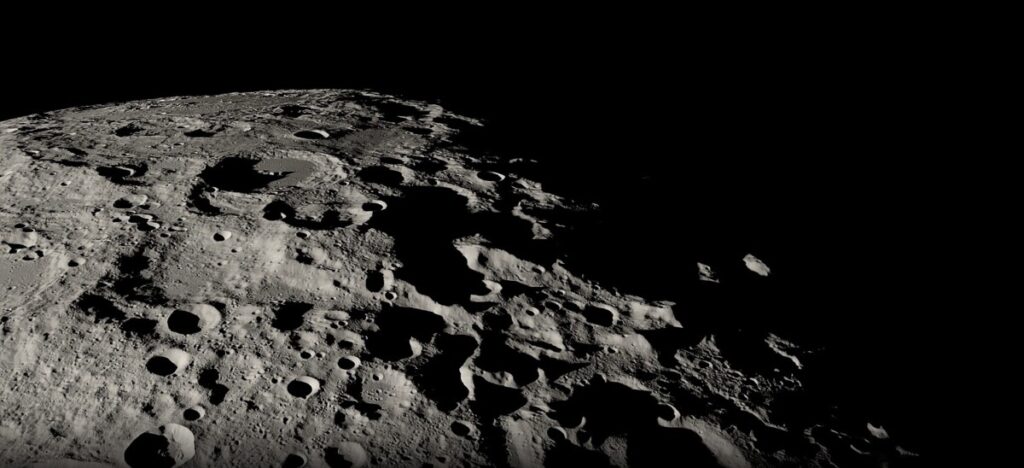
A visualization of the Moon’s South Pole region created with data from NASA’s Lunar Reconnaissance Orbiter, which has been surveying the Moon with seven instruments since 2009.
NASA’s Scientific Visualization Studio/Ernie Wright
“The Apollo Era taught us that the further humanity is from Earth, the more dependent we are on science to protect and sustain human life on other planets,” said Nicky Fox, associate administrator, Science Mission Directorate at NASA Headquarters in Washington. “By deploying these two science instruments on the lunar surface, our proving ground, NASA is leading the world in the creation of humanity’s interplanetary survival guide to ensure the health and safety of our spacecraft and human explorers as we begin our epic journey back to the Moon and onward to Mars.”
After his voyage to the Moon’s surface during Apollo 17, astronaut Gene Cernan acknowledged
the challenge that lunar dust
presents to long-term lunar exploration. Moon dust sticks to everything it touches and is very abrasive. The knowledge gained from the DUSTER (DUst and plaSma environmenT survEyoR) investigation will help mitigate hazards to human health and exploration. Consisting of a set of instruments mounted on a small autonomous rover, DUSTER will characterize dust and plasma around the landing site. These measurements will advance understanding of the Moon’s natural dust and plasma environment and how that environment responds to the human presence, including any disturbance during crew exploration activities and lander liftoff. The DUSTER instrument suite is led by Xu Wang of the University of Colorado Boulder. The contract is for $24.8 million over a period of three years.
A model of the DUSTER instrument suite consisting of the Electrostatic Dust Analyzer (EDA)—which will measure the charge, velocity, size, and flux of dust particles lofted from the lunar surface—and Relaxation SOunder and differentiaL VoltagE (RESOLVE)—which will characterize the average electron density above the lunar surface using plasma sounding. Both instruments will be housed on a Mobile Autonomous Prospecting Platform (MAPP) rover, which will be supplied by Lunar Outpost, a company based in Golden, Colorado, that develops and operates robotic systems for space exploration.
LASP/CU Boulder/Lunar Outpost
Data from the SPSS (South Pole Seismic Station) will enable scientists to characterize the lunar interior structure to better understand the geologic processes that affect planetary bodies. The seismometer will help determine the current rate at which the Moon is struck by meteorite impacts, monitor the real-time seismic environment and how it can affect operations for astronauts, and determine properties of the Moon’s deep interior. The crew will additionally perform an active-source experiment using a “thumper” that creates seismic energy to survey the shallow structure around the landing site. The SPSS instrument is led by Mark Panning of NASA’s Jet Propulsion Laboratory in Southern California. The award is for $25 million over a period of three years.
An artist’s concept of SPSS (South Pole Seismic Station) to be deployed by astronauts on the lunar surface.
NASA/JPL-Caltech
“These two scientific investigations will be emplaced by human explorers on the Moon to achieve science goals that have been identified as strategically important by both NASA and the larger scientific community”, said Joel Kearns, deputy associate administrator for exploration, Science Mission Directorate at NASA Headquarters. “We are excited to integrate these instrument teams into the Artemis IV Science Team.”
The two payloads were selected for further development to fly on Artemis IV; however, final manifesting decisions about the mission will be determined at a later date.
Through Artemis, NASA will address high priority science questions, focusing on those that are best accomplished by on-site human explorers on and around the Moon and by using the unique attributes of the lunar environment, aided by robotic surface and orbiting systems. The Artemis missions will send astronauts to explore the Moon for scientific discovery, economic benefits, and build the foundation for the first crewed missions to Mars.
For more information on Artemis, visit:
https://www.nasa.gov/humans-in-space/artemis
Karen Fox / Molly Wasser
Headquarters, Washington
202-358-1600
karen.c.fox@nasa.gov
/
molly.l.wasser@nasa.gov
Facebook logo
@NASA
@NASASolarSystem
@NASA
@NASASolarSystem
Instagram logo
@NASA
@NASASolarSystem
Linkedin logo
@NASA
Keep Exploring
Discover More Topics From NASA
Artemis
Planetary Science
NASA’s planetary science program explores the objects in our solar system to better understand its history and the distribution of…
Earth’s Moon
The Moon makes Earth more livable, sets the rhythm of ocean tides, and keeps a record of our solar system’s…
Solar System


