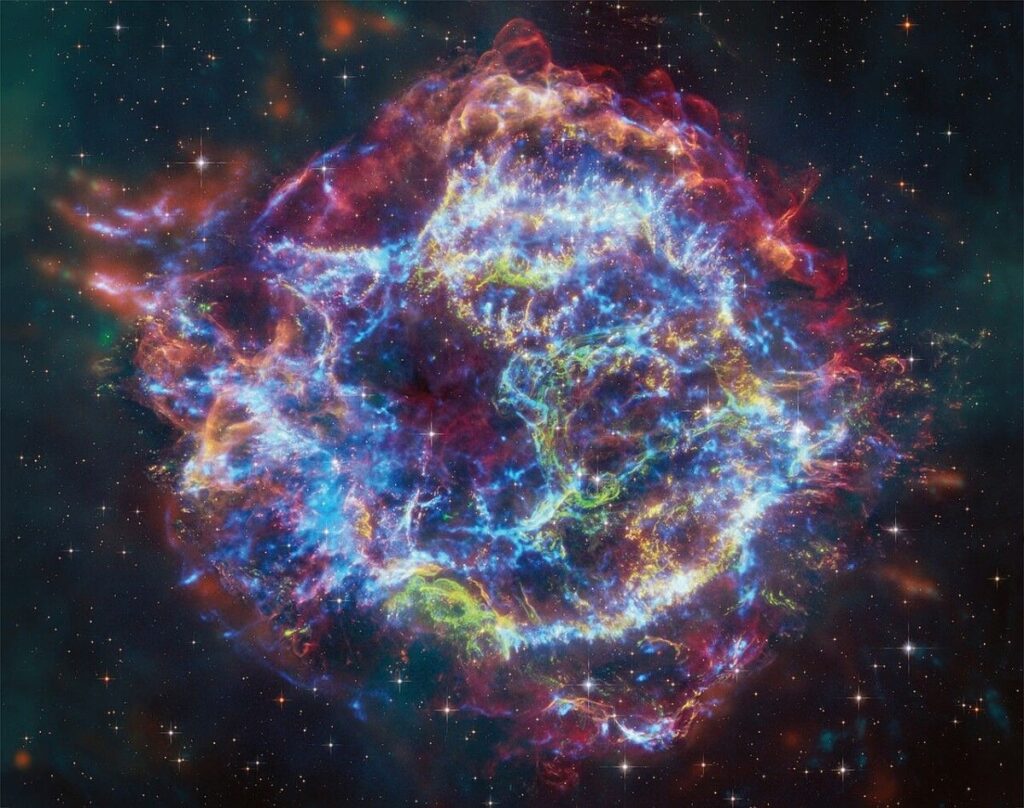
NASA-JAXA XRISM Finds Elemental Bounty in Supernova Remnant
NASA and JAXA’s XRISM (X-ray Imaging and Spectroscopy Mission) has made a groundbreaking discovery by detecting chlorine and potassium in the remnants of a supernova, specifically in the well-known Cas A (Cassiopeia A) supernova remnant, located approximately 11,000 light-years away. This significant achievement marks the first time these elusive elements have been clearly identified in a stellar explosion’s aftermath. The findings, led by Toshiki Sato from Meiji University and published in *Nature Astronomy*, underscore the profound connection between stellar death and the elemental building blocks of life on Earth. According to Sato, stars are not just distant points of light; they actively create the materials that form planets and sustain life, making the study of their remnants crucial for understanding the universe’s elemental makeup.
The XRISM’s Resolve instrument, developed in collaboration with NASA, allowed scientists to conduct detailed observations of Cas A, which spans about 10 light-years and is over 340 years old. Previous studies using the Chandra X-ray Observatory had identified more common elements like iron and silicon, but the detection of chlorine and potassium is particularly noteworthy as these elements play essential roles in biological processes. For instance, potassium is vital for cellular function in living organisms. The observations revealed that these elements are concentrated in specific regions of the remnant, suggesting that the original star may have experienced asymmetries before its explosive demise, which could have influenced the distribution of elements produced during the supernova event. This discovery not only enhances our understanding of the life cycles of stars but also sheds light on the processes that contribute to the formation of life-sustaining elements in the cosmos.
The implications of this research extend beyond mere elemental detection; they provide insights into the dynamics of stellar explosions and the nuclear fusion processes that occur within stars. As researchers like Paul Plucinsky from the Center for Astrophysics | Harvard & Smithsonian emphasize, understanding the conditions under which these rarer elements are formed is crucial for unraveling the mysteries of stellar evolution and supernova mechanics. With XRISM’s advanced capabilities, scientists are now better equipped to explore the cosmos and piece together the complex tapestry of elements that ultimately contribute to the formation of life on Earth. As we continue to investigate the universe’s elemental origins, discoveries like these remind us of the intricate connections between the stars and our own existence.
4 min read
NASA-JAXA XRISM Finds Elemental Bounty in Supernova Remnant
For the first time, scientists have made a clear X-ray detection of chlorine and potassium in the wreckage of a star using data from the Japan-led XRISM (X-ray Imaging and Spectroscopy Mission) spacecraft.
The
Resolve
instrument aboard
XRISM
, pronounced “crism,” discovered these elements in a supernova remnant called Cassiopeia A or Cas A, for short. The expanding cloud of debris is located about 11,000 light-years away in the northern constellation Cassiopeia.
“This discovery helps illustrate how the deaths of stars and life on Earth are fundamentally linked,” said Toshiki Sato, an astrophysicist at
Meiji University
in Tokyo. “Stars appear to shimmer quietly in the night sky, but they actively forge materials that form planets and enable life as we know it. Now, thanks to XRISM, we have a better idea of when and how stars might make crucial, yet harder-to-find, elements.”
A
paper
about the result published Dec. 4 in Nature Astronomy. Sato led the study with Kai Matsunaga and Hiroyuki Uchida, both at
Kyoto University
in Japan.
JAXA (Japan Aerospace Exploration Agency)
leads XRISM in collaboration with NASA, along with contributions from
ESA (European Space Agency)
. NASA and JAXA also codeveloped the Resolve instrument.
Observations of the Cassiopeia A supernova remnant by the Resolve instrument aboard the NASA-JAXA XRISM (X-ray Imaging and Spectroscopy Mission) spacecraft revealed strong evidence for potassium (green squares) in the southeast and northern parts of the remnant. Grids superposed on a multiwavelength image of the remnant represent the fields of view of two Resolve measurements made in December 2023. Each square represents one pixel of Resolve’s detector. Weaker evidence of potassium (yellow squares) in the west suggests that the original star may have had underlying asymmetries before it exploded.
NASA’s Goddard Space Flight Center; X-ray: NASA/CXC/SAO; Optical: NASA/ESA/STScI; IR: NASA/ESA/CSA/STScI/Milisavljevic et al., NASA/JPL/CalTech; Image Processing: NASA/CXC/SAO/J. Schmidt and K. Arcand
Download high-resolution images from NASA’s Scientific Visualization Studio
Stars produce almost all the elements in the universe heavier than hydrogen and helium through nuclear reactions. Heat and pressure fuse lighter ones, like carbon, into progressively heavier ones, like neon, creating onion-like layers of materials in stellar interiors.
Nuclear reactions also take place during explosive events like
supernovae
, which occur when stars run out of fuel, collapse, and explode. Elemental abundances and locations in the wreckage can, respectively, tell scientists about the star and its explosion, even after hundreds or thousands of years.
Some elements — like oxygen, carbon, and neon — are more common than others and are easier to detect and trace back to a particular part of the star’s life.
Other elements — like chlorine and potassium — are more elusive. Since scientists have less data about them, it’s more difficult to model where in the star they formed. These rarer elements still play important roles in life on Earth.
Potassium
, for example, helps the cells and muscles in our bodies function, so astronomers are interested in tracing its cosmic origins.
The roughly circular Cas A supernova remnant spans about 10 light-years, is over 340 years old, and has a superdense neutron star at its center — the remains of the original star’s core. Scientists using NASA’s
Chandra X-ray Observatory
had previously
identified
signatures of iron, silicon, sulfur, and other elements within Cas A.
In the hunt for other elements, the team used the Resolve instrument aboard XRISM to look at the remnant twice in December 2023. The researchers were able to pick out the signatures for chlorine and potassium, determining that the remnant contains ratios much higher than expected. Resolve also detected a possible indication of phosphorous, which was previously
discovered
in Cas A by infrared missions.
Watch to learn more about how the Resolve instrument aboard XRISM captures extraordinary data on the make-up of galaxy clusters, exploded stars, and more using only 36 pixels.
Credit: NASA’s Goddard Space Flight Center
“Resolve’s high resolution and sensitivity make these kinds of measurements possible,” said Brian Williams, the XRISM project scientist at NASA’s
Goddard Space Flight Center
in Greenbelt, Maryland. “Combining XRISM’s capabilities with those of other missions allows scientists to detect and measure these rare elements that are so critical to the formation of life in the universe.”
The astronomers think stellar activity could have disrupted the layers of nuclear fusion inside the star before it exploded. That kind of upheaval might have led to persistent, large-scale churning of material inside the star that created conditions where chlorine and potassium formed in abundance.
The scientists also mapped the Resolve observations onto an image of Cas A captured by Chandra and showed that the elements were concentrated in the southeast and northern parts of the remnant.
This lopsided distribution may mean that the star itself had underlying asymmetries before it exploded, which Chandra data
indicated
earlier this year in a study Sato led.
“Being able to make measurements with good statistical precision of these rarer elements really helps us understand the nuclear fusion that goes on in stars before and during supernovae,” said co-author Paul Plucinsky, an astrophysicist at the
Center for Astrophysics | Harvard & Smithsonian
in Cambridge, Massachusetts. “We suspected a key part might be asymmetry, and now we have more evidence that’s the case. But there’s still a lot we just don’t understand about how stars explode and distribute all these elements across the cosmos.”
By
Jeanette Kazmierczak
NASA’s
Goddard Space Flight Center
, Greenbelt, Md.
Media Contact:
Claire Andreoli
301-286-1940
NASA’s Goddard Space Flight Center, Greenbelt, Md.
Facebook logo
@NASAUniverse
@NASAUniverse
Instagram logo
@NASAUniverse
Share
Details
Last Updated
Dec 05, 2025
Related Terms
XRISM (X-Ray Imaging and Spectroscopy Mission)
Astrophysics
Chandra X-Ray Observatory
Galaxies, Stars, & Black Holes Research
Goddard Space Flight Center
Stars
Supernova Remnants
Supernovae
The Universe
X-ray Astronomy


