Everything everywhere all at once: How Zohran Mamdani campaigned both online and with a ground game
In the recent New York City mayoral election, candidate Zohran Mamdani emerged victorious with 50.4% of the vote, surpassing many pre-election predictions. His campaign has been noted for its unique approach, combining a robust online presence with an extensive ground game. Mamdani’s team mobilized over 100,000 volunteers who engaged in door-to-door canvassing across the city, a strategy that some experts argue may not have been as impactful as it seems. The effectiveness of in-person canvassing has been debated among political communication scholars, with recent studies indicating limited effects unless conducted under specific circumstances. However, Mamdani’s campaign appears to have successfully integrated traditional and digital methods, suggesting that his ground efforts were bolstered by a strong online campaign.
The interplay between Mamdani’s online and offline strategies illustrates the emergence of what researchers call “hybrid campaigns.” In today’s political landscape, candidates are increasingly required to tailor their messages across various platforms, from social media to traditional media. This adaptability was evident in Mamdani’s campaign, which not only produced engaging online content but also effectively converted virtual support into tangible activism. Concerns about “slacktivism”—where online engagement does not translate into real-world action—have been prevalent in political discussions, yet Mamdani’s campaign seems to have mitigated this issue by fostering a sense of community and urgency among supporters.
Ultimately, Mamdani’s success may not be attributed solely to his ground game or online presence but rather to the seamless integration of both. His campaign exemplifies the modern political environment, where in-person efforts are enhanced through social media visibility, creating a feedback loop that energizes and mobilizes voters. As campaigns continue to evolve, Mamdani’s approach serves as a case study in the effectiveness of hybrid strategies in engaging a diverse electorate and achieving electoral success.
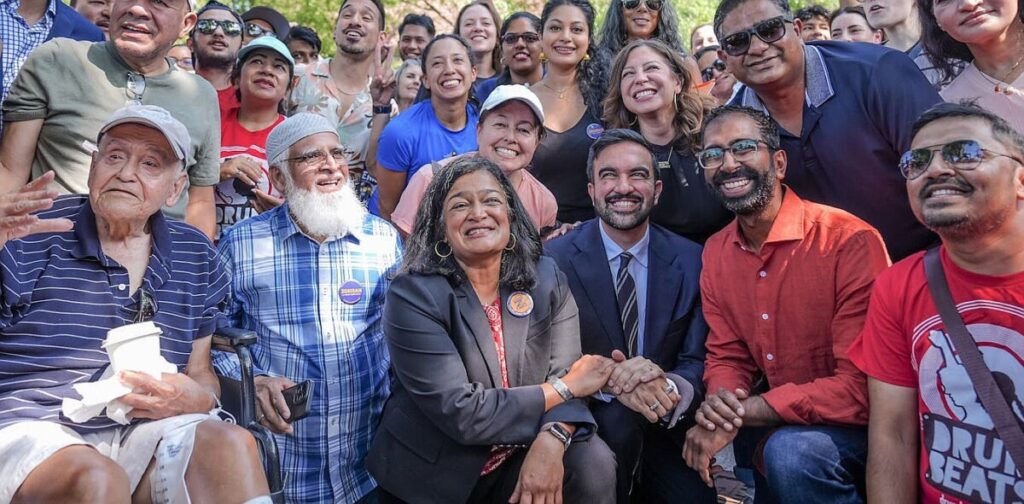
New York mayoral candidate Zohran Mamdani and U.S. Rep. Pramila Jayapal meet voters to go door-knocking in Jackson Heights on Sept. 14, 2025.
Selcuk Acar/Anadolu via Getty Images
Accounts of Zohran Mamdani’s campaign for New York City mayor have highlighted both his
online presence
and his
ground game
.
Mamdani won the general election with 50.4% of the vote, a larger share than was
predicted
by most polls, and his get-out-the-vote campaign has received some of the credit. Mamdani claims that his campaign had
over 100,000 volunteers
knocking on doors across New York City.
This focus on
on-the-ground mobilization
stands out given the increasing attention devoted to online campaigning over the past 15 years.
Particularly during that time period, online platforms have been a major focus of political campaigns and campaign research.
Targeted advertising
and
new media strategies
are increasingly viewed as central to campaign success. So is coverage of the campaign by
legacy and social media
more generally.
Moreover, solid empirical evidence of the effectiveness of door-to-door canvassing is limited. Recent
work
finds very few effects of in-person canvassing, except in very specific circumstances. One recent
paper
suggests that door-to-door canvassing by the candidate can make a difference to election outcomes. But in a race in New York City, it is not likely that Mamdani himself was able to reach enough voters to make a difference.
How much did Mamdani’s ground game contribute to his victory? As a
political communication scholar
, I know that assessing the impact of different methods used by political campaigns is difficult – in part because political campaigns include multiple lines of communication.
‘Hybrid’ campaigns
No campaign exists in isolation — nearly every candidate’s campaign occurs alongside opposing candidates’ campaigns. The effects of one campaign are often
masked
by the countering effects of the other.
The size of a campaign on one platform also tends to be
correlated
with the size of that candidate’s campaign on other platforms. When television advertising increases alongside social media advertising and door-to-door canvassing, identifying the effects of any single platform can be difficult.
Clever research designs are in some instances able to identify effects. These generally find that the impact of not just
door-knocking
but also
ads
and
online advertising
can be relatively limited.
In the modern technological environment, the impact of any single aspect of a campaign may be especially difficult to assess. Campaigning increasingly occurs in what researchers have called a “
hybrid media
” environment. Campaigns are waged in person, on the news and across multiple social media.
Each of these platforms comes with different advantages and disadvantages. Each also prioritizes different kinds of information.
Plainly stating your policy platform may work for coverage of a campaign stop on the evening news. But if you want that policy to go viral on TikTok, then you may need to add a dance –
or an influencer
.
Find volunteers online, send them knocking
Candidates have increasingly recognized the need to tailor messages for different communication platforms, such as television ads, Facebook posts and TikToks, building
hybrid campaigns
that attempt to spread a message across multiple, different spaces.
This interactivity across platforms has been especially evident in
postelection assessments
of the Mamdani campaign. His social media campaign was adept at producing the kinds of content that attract attention online. That campaign also appears to have been able to convert online engagement into real-world activism, including door-to-door canvassing.
There have been growing concerns among academics and campaign organizers about “
slacktivism
” — activism that amounts to one or two clicks online but nothing more. One worry is that a quick online endorsement may in some instances give people a sense that they have done their share and limit more active forms of engagement. The Mamdani campaign appears to have overcome this problem, at least in part.
But 100,000 people knocking on doors probably does not happen without the success of an online campaign.
Finding and mobilizing campaigners
was one important focus of Mamdani’s engagement online, after all.
Do it yourself − then repeat on socials
In-person campaigning by Mamdani,
on the street
and
in the taxi line
, is almost certainly made more effective through circulation on Instagram and TikTok.
Using mass media to broadcast campaign stops is not new, of course.
The construction of campaign stops that produce good social media content is becoming more common, however. The ways in which campaigns unfold in person are increasingly intertwined with the way they unfold online.
In this way, the Mamdani campaign may have been a textbook example of a modern hybrid campaign and an illustration of the coevolution of digital and on-the-ground campaigning.
To be clear, the success of the Mamdani campaign is probably not about his online presence or his ground game, but both at the same time.
Stuart Soroka research has been funded from the National Science Foundation and the Social Sciences and Humanities Research Council of Canada.


