Doyle: What America can learn from Finland’s successful democracy
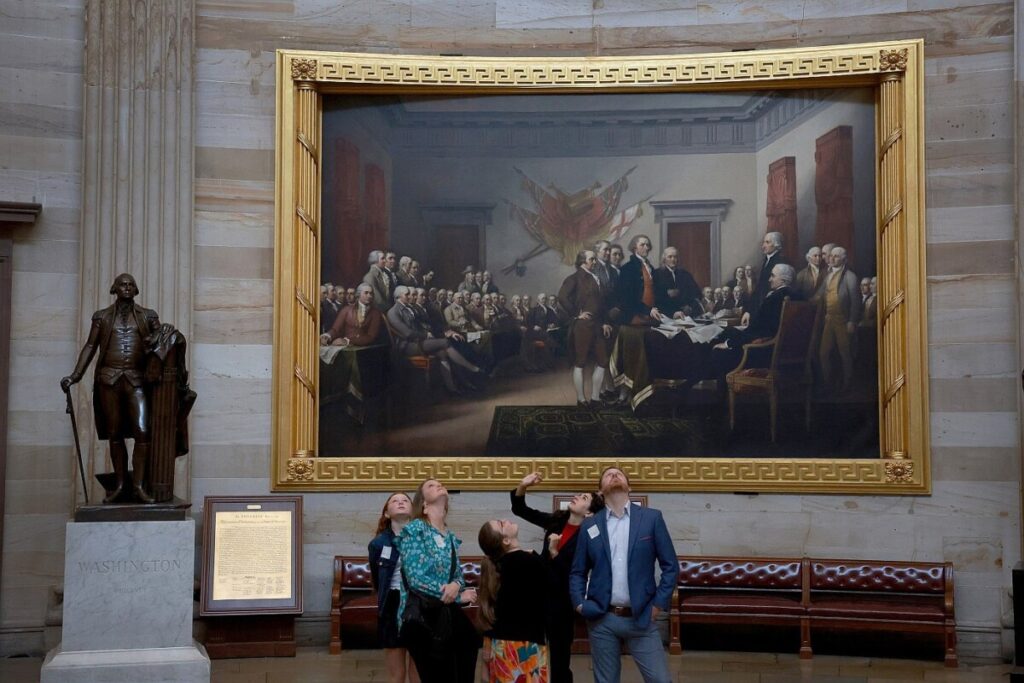
On July 2, 1776, a pivotal moment in American history unfolded in Philadelphia’s Second Continental Congress, where John Morton, a Finnish American and speaker of the Pennsylvania Assembly, cast a vote that would shape the future of the United States. As the swing vote in a closely divided Pennsylvania delegation, Morton faced immense pressure: a “no” vote could signal the colony’s opposition to independence, potentially derailing the revolutionary movement. Conversely, a “yes” vote would tip the scales to a 3-to-2 pro-independence majority, propelling the colonies toward a definitive break from British rule. With treason penalties hanging over the delegates—execution by hanging, disembowelment, and dismemberment for those captured—Morton’s decision was fraught with risk. Ultimately, he voted in favor of the independence resolution, enabling the unopposed passage of the declaration that birthed the United States.
Fast forward to today, and the legacy of Morton and his Finnish heritage is reflected not only in the United States but also in Finland’s remarkable achievements as a nation. With a population of just 5.6 million, Finland has become a global leader in various domains, ranking as the world’s freest and happiest nation, and excelling in education, health care, and social equality. The success of Finland is often attributed to its commitment to a capitalist economy that prioritizes free markets while maintaining a robust social safety net. Notably, while personal income taxes in Finland are higher on average than in the U.S., they fund comprehensive public services, including universal health care and free education, which significantly reduce the financial burdens commonly faced by American households. This societal structure fosters a sense of community and well-being, contrasting sharply with the polarization often seen in American politics.
As the United States approaches its 250th anniversary, the story of John Morton and the Finnish experience offers crucial lessons about unity and mutual respect in governance. In Finland, political debates, while present, are characterized by civility and cooperation, as exemplified by the recent presidential election where rivals publicly embraced each other, showcasing a stark contrast to the divisive rhetoric often found in American political discourse. William Doyle, the author, draws a powerful parallel between Morton’s courageous vote for independence and the contemporary need for Americans to transcend their differences and foster a more collaborative society. As the nation reflects on its past, embracing the spirit of unity and understanding could pave the way for a more harmonious future, echoing the ideals that Morton and his fellow delegates fought to establish over two centuries ago.
On July 2, 1776, a Finnish American man held the destiny of the United States in his hands.
The scene was the hall in Philadelphia that hosted the Second Continental Congress of the 13 American Colonies of British America. The man of destiny was John Morton, speaker of the Pennsylvania Assembly and the swing vote in his state delegation that could create the United States of America.
If Morton voted “no,” the influential Colony would be recorded as opposed to independence. This could deal a fatal blow to the infant nation by delaying or dashing hopes for a vote for independence from Great Britain that was unopposed by any of the Colonies. If he said “yes,” the Pennsylvania delegation would flip to a 3-to-2 pro-independence majority, creating unstoppable national momentum for a break with King George III’s government.
But it would place Morton and his fellow delegates at risk of condemnation by many constituents who were pro-crown loyalists or independence skeptics, and in real danger of being executed if captured by British forces. The maximum penalty for treason against the king at that time was to be hung by the neck until the edge of death, then disemboweled and torn into four pieces — while still alive.
Morton made his decision. He voted for the independence resolution, and Pennsylvania’s “yea” vote in the roll call of states enabled its unopposed passage. This was the moment that the United States of America came into existence. With the help of spirits from Finland — Morton’s father, grandfather, mother and wife were all of of Finnish descent.
The country that Morton and his colleagues created July 2, 1776, became the wealthiest, most powerful nation on earth. And the society that Morton’s distant relatives built in Finland also became one of the world’s most successful democracies.
For a nation of only 5.6 million people, brutal winter weather and few natural resources other than trees, Finland’s achievements are striking. Finland ranks as the No. 1 world’s freest nation in Freedom House’s 2025 report, the happiest nation for eight years in a row, the developed country with the most skilled adult population and the nation that leads the world in progress toward achieving the United Nations Sustainable Development Goals, including health and well-being, gender equality and ending poverty.
How has this happened? One reason is that Finland is, in the words of Helsinki-based journalists Anu Partanen and Trevor Corson in The New York Times, “a capitalist paradise,” a nation committed to free markets and capitalism. According to the Heritage Foundation’s 2025 Index of Economic Freedom, Finland has the best property rights in the world and scores higher than the United States in economic and investment freedom, judicial effectiveness, fiscal health and government integrity.
Taxes on personal income are significantly higher on average than in the United States, but they replace many large private expenses carried by U.S. households, and business and property taxes are lower. The national corporate tax rate in Finland will be lowered from the current 20% to 18% in 2027, which compares to about 25% in the United States when state taxes are included.
While Finns complain about their taxes, in the end, many people here consider them worth it, in exchange for a very strong social safety net, excellent universal public health care and free high-quality education through university. Medical bankruptcy, the No. 1 cause of bankruptcy in the U.S., is almost unheard of, as is the long-term stress associated with crushing student debt. Rates of violent crime, homelessness and hunger are extremely low.
Finland is, as Partanen puts it, a “well-being state.” Finns don’t have much to say publicly about religious values such as compassion, charity and humility; they just act on them.
There is some political polarization in Finland, and in the parliament, debates over immigration and an economy stuck in a cycle of low growth and relatively high unemployment are increasingly intense. But personal animosity in government plays out at a far lower intensity than in the United States, for example, and this may be one of the most powerful lessons Americans can learn from Finland.
When Finnish center-right politician Alexander Stubb won the presidential election last year, he headed for his Green Party opponent Pekka Haavisto’s election-night vigil for a surprise joint appearance. As the crowd cheered a standing ovation, the two men hugged, and Stubb told him, “You are one of the nicest people I have ever met.”
On the eve of America’s 250 th anniversary, Morton and Finland can remind us that now is a good time for Americans to declare independence from the tyranny of hating each other.
William Doyle is an American writer and TV producer based in Helsinki. In 2015, he was appointed as a Fulbright scholar to Finland/Tribune News Service


