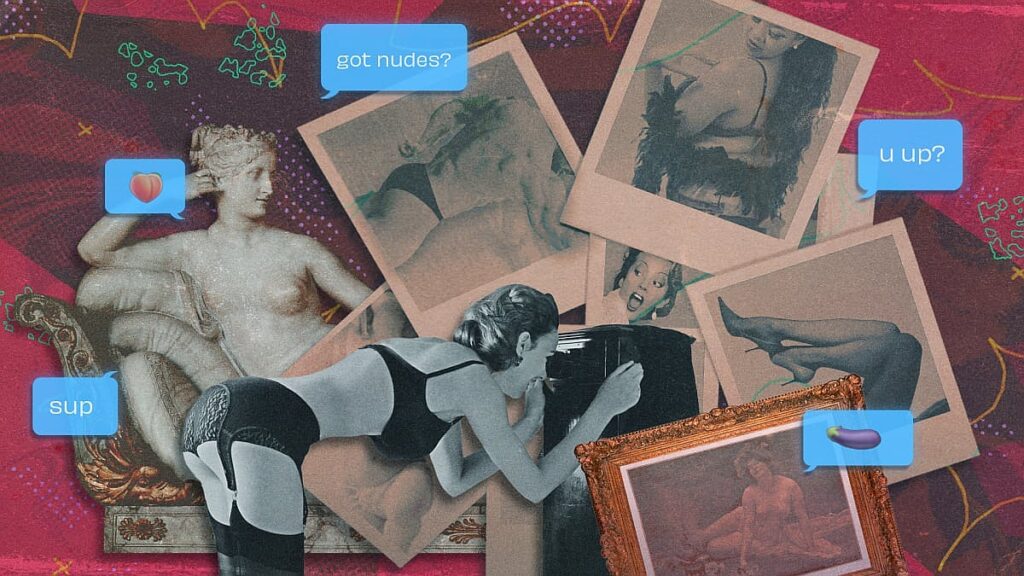
A history of nudes, from sculptures to Snapchat
The fascination with the nude form has been a cornerstone of human expression throughout history, evolving from ancient sculptures to modern digital exchanges. The earliest known representation of the naked body, the Venus of Willendorf, dates back to around 24,000 BCE, highlighting humanity’s long-standing interest in the human form. As art progressed, so did the interpretations of nudity, with significant works such as Michelangelo’s David and Manet’s Olympia challenging societal norms and perceptions of the nude. Fast forward to today, and the landscape has shifted dramatically with the advent of technology; research indicates that up to 80% of adults share intimate images, a stark contrast to the more formal exchanges of the past, like the romantic letters between married women and unmarried men in medieval times. Historian Dr. Eleanor Janega notes that while illicit exchanges have existed for centuries, the means of sharing such content have become vastly more accessible due to smartphones and social media platforms.
The modern era of nude sharing can trace its roots back to the 19th century with artists like Sarah Goodridge, who sent a miniature painting of her nude self to a romantic interest, marking a pivotal moment in the history of intimate visuals. This act of self-portraiture allowed women to reclaim their narratives around nudity, a theme echoed through various art forms over the years. The invention of photography further revolutionized how we perceive and share nudity, with early photographers like Hippolyte Bayard paving the way for a new medium that would democratize the representation of the human body. As technology advanced, so did the prevalence of nude sharing—by the early 2000s, the rise of camera phones and instant messaging transformed the way people engage with sexuality, leading to the phenomenon of sexting and the normalization of sharing nude images.
However, this digital intimacy comes with significant risks. Studies reveal that many individuals harbor fears of their intimate images being exposed or misused, especially in light of past scandals involving leaked celebrity nudes. Legal frameworks are also evolving, with recent laws in the UK addressing issues like cyberflashing and age verification for explicit content. The blurred lines between art and pornography raise questions about the societal perception of nudity, as seen in projects like Pornhub’s Classic Nude, which challenges the boundaries of what is considered acceptable in public spaces. As we navigate this complex landscape, it remains clear that the allure of the nude form—whether in art or digital communication—will continue to resonate across cultures and generations, reflecting our enduring connection to the human body and the intimate expressions of desire and vulnerability that accompany it.
The need to render the
nude form
has dominated human expression for centuries. In Western art history, one of the oldest known interpretations of a naked body is the
Venus of Willendorf,
possibly dating back to around 24,000 BCE. Later, we saw the mosaic art of
Narcissus, enamored by his own member
in a second-century latrine. Centuries down the line, in the early Renaissance, Italy’s obsession with nudes included
Michelangelo’s
David
and
Manet’s controversial
Olympia
, featuring a real woman and not a mythical figure.
As time moved onto Snapchatting genitals to a possible love interest you swiped right on, our fascination with the human body remains a constant drumbeat of society. It has also become more accessible, particularly over the last few decades, with the rise of smartphones and social media. As many as
eight out of 10 adults
share intimate content, including nudes, with each other, 2024 research shows.
SEE ALSO:
Taking nudes is an art. Here’s how to create a masterpiece.
We’ve collected the history of the nude, from sculpture to oil paintings, and from cam-chat to Snapchat. But more importantly, we’re diving into why, through history, we’re prepared to send nudes in whatever form we can.
The first nudes sent
Nudes are often not sent in isolation. Nowadays, at least, they’re accompanied by an explicit text or as a result of an exchange on our phones or in person.
People have been exchanging illicit letters for a long time, largely from married women writing to unmarried men in court, according to
Dr. Eleanor Janega
, historian, broadcaster, and author specialising in the medieval period. Few of these survive, as many were destroyed or censored from history, according to
The Lost Love Letters of Heloise and Abelard Perceptions of Dialogue in Twelfth-Century France
, which documents some remaining letters
.
These
exchanges were further limited by who was able to send these, thanks to the illiteracy rates of the Middle Ages;
few men and hardly any women could write
.
Portraits were exchanged before arranged marriages were agreed upon
, but these did not feature nudity and served to solely convey the appearance of the subject.
“People faced similar issues when sending nudes in the medieval period, because you would need someone to paint or draw you nude, which would be massively expensive,” says Janega.
“Moreover, at the time nudes are, in general, formulaic. People expect a nude to look a particular way, reflecting an idealised form, rather than to be a theoretical ‘realistic’ portrayal of a person.” This, likely being due to the nude form being interpreted as
the imperfect and mortal form of humanity
, a sentiment that has been felt through time, however not one equally felt across genders — with Ancient Greek sculptures and art more often than not
featuring a nude male form, but not female
— and if art did feature women, it was likely a depiction of a god and treated demurely, associated with shame rather than a heroic figure.
Nudes in the modern era
The “modern” sending of nudes, as in the conveying of a visual form of our own body,
can date back around 200 years
to American portrait artist Sarah Goodridge. As Goodridge worked on a commission for a new member of the United States House of Representatives, Daniel Webster, the two began exchanging romantic letters — some of which remain to this day.
In 1828, Goodridge painted her bare breasts surrounded by white cloth on a small canvas, only 2.6 by 3.1 inches. Intended for Webster’s eyes only, as many
miniature portraits were
, it remained in his family until the 1980s. Little fanfare was made of the discovery of this piece after Webster’s death, with
scholars noting
it was likely kept out of sight and off of inventories due to being deemed inappropriate for public viewing. Now, Goodridge’s seemingly untitled work, now known as
Beauty Revealed
, is now owned by the Metropolitan Museum of Art in New York City.
Goodridge’s private revolutionary act can now be seen as an innovative moment in human sexuality, experts note. By this point, society began to see, as Janega says, “a bunch of rich people with time on their hands who can paint, which means it is only a matter of time before they begin sending nudes as a form of flirtation. You cannot teach generations of people to paint artistic nudes and expect them to use these abilities solely for depicting the rape of Leda,” referencing the famed myth of a Spartan queen assaulted by Zeus, King of Gods, bearing his twins.
Beyond this, taking part in the arts institutionally was restricted to men. For instance, the Royal Academy admitted its first woman,
Laura Herford, in 1860
, and only because her initials were submitted.
Self-portraiture allowed Goodridge to take control of her presentation of nudity, as it has enabled women to control their presentation to the world, and the narrative placed onto women and femininity. Like Goodridge’s radical act, many artists have changed the way women are viewed through their artwork, which was celebrated by the
National Portrait Gallery in London
in a 2024 exhibition.
Goodridge’s romantic gesture lives on, though it required significantly more time and effort to create than a photograph taken on a phone. Still, the importance of this moment can’t be underestimated: a visual form of nude form was becoming more accessible than it had been before.
The photographed nude
With the innovation of photography in 1839, our approach to the nude form began to shift, with a pioneer of photography, Hippolyte Bayard,
taking a naked self-portrait in
1840. As photography boomed, so did nudes.
Other 19th-century nude photography remains famed, including those
taken by Nadar
between 1860 and 1861, often used as studies for paintings. One of his models, Marie-Christine Leroux, went on to pose for many famed artists.
Naked photography would also be included in
journals like
National Geographic
, with white explorers documenting indigenous people encountered around the world —
a past the publication is reckoning with.
. These images were often taken and printed without consent.
Later, after World War I, nude photography came into its own, with less imitation of paintings and sculptures and more stylized pieces, such as
Edward Weston’s
Nude
taken in 1936. Others used photography as a means of insight into hidden lives, such as in
Diane Arbus’
Retired man and his wife at home in a nudist camp one morning, N.J
or to recapture idealized moments of youth, like in Larry Clark’s
Teenage Lust
series, taken in the early 1970s.
With the arrival of the millennium, personal cameras became more ubiquitous, with sales of camera phones reaching
18 million in 2002
,
257 million in 2004
, and up to
1.24 billion shipments in 2024
. The rise of the smartphone spelled a crash for camera sales:
camera shipments worldwide
dropped by 94 percent between 2010 and 2023.
Smart devices and the ability to instant message revolutionised our approach to sexuality, beginning the
era of sexting
and cam chats. Sending nudes and explicit messages may have spelled the death of previous forms of interaction. Namely, this means of the love letter, a loss
Vogue
lamented
, along with phone calls, back in 2014, with many seeing the new digital frontier of sexuality as less romantic, and more explicit (not necessarily true, especially if we remember curse-laden
love letters written by James Joyce
), and intimidating.
When does art become pornography?
Galleries around the world host pieces showcasing the naked form — but at which point does this transform from being something considered worthy of value, of public importance, to something considered explicit?
“Boundaries between art and pornography have become increasingly blurred,” says
Freya Gowrley
, art historian at the University of Bristol. She points to Pornhub’s Classic Nude project, an interactive online experience, launched in 2021 when access to galleries was still limited. The exhibition offered a virtual tour of 30 famous nude artworks through history, from Paul Cézanne’s
Bathers
to Gustave Courbet’s
L’Origine du Monde
, with pornographic videos inspired by these pieces.
“Unsurprisingly, several of the big museums objected to their work being used in this context,” Gowrley says, with some,
like the Louvre
, threatening legal action for unauthorised usage of these artworks. However, others noted that
the use of various artworks
is often left unchallenged, including on sites such as Etsy, which similarly offers a commercial benefit to the redistributor, indicating that moral concerns may have been the root of the concern.
The project also raised interesting questions about the line between art and porn, Gowrley says. “Why is Sarah Goodridge’s ‘selfie’ painting any more artistic than something snapped on an iPhone, or produced in a studio?”
Gowrley compares these to artist
Jeff Koons’
Made in Heaven
series in the late ’80s, early ’90s, depicting his naked form engaging in sexual acts with his then-wife Ilona Staller, famed for her work in pornography.
“Moving these images into the gallery space transformed them into art, but does that mean that they are no longer illicit images?” she says.
Why is Sarah Goodridge’s “selfie” painting any more artistic than something snapped on an iPhone, or produced in a studio?
– Art historian Freya Gowrley
This question has also been the subject of online debate, following the establishment of
FOSTA/SESTA
in the U.S. in 2018. The laws, in theory, were meant to curb online sex trafficking, but in practice, large social media sites began deplatforming online sex workers. (Multiple studies show this
made sex workers
less safe
.) Beyond that, artists, including erotic and LGBTQ artists, sometimes find themselves
banned or shadowbanned
(unable to be discovered) from platforms like Instagram, even though their posts are artistic and not pornographic. Then again, that line is different depending on who you ask.
Advancements in technology rapidly increased our access to the nude form — and sharing our own.
Why do we love to send nudes?
With smartphones, pretty much everyone with an internet connection has the ability to take, send, and receive nude photographs across various apps and platforms. Many people take advantage. Sending nudes on the gay hookup app
Grindr
, for instance, has become commonplace for queer men. There are even features baked in to protect photographs now, and
blogs on Grindr’s site
referring to the app as a “digital dark room.”
Meanwhile, intimate photos make the rounds on Reddit in various ‘gone wild’ subreddits, leading to other explicit exchanges.
Research shows
that people who perceive their own attractiveness are more likely to post nudes on Reddit, although they are unlikely to feel high self-esteem at the same time.
Another study shows that
sending nude content
often takes place in the context of committed relationships, as a form of expressing and experiencing sexual desires.
But why do we want to?
We send nudes “because it’s basically a form of foreplay, that kind of is a sexual act in itself,” says
Gigi Engle
, author of
Kink Curious
and resident kink and sex expert for sex-positive community
JOYclub
.
SEE ALSO:
Dating app launches feature to ask whether users want to see nudes
“I think we play sex on this hierarchy [that] penetrative sex is the most legitimate form, and that’s just not really true. Sending sexy pictures is very titillating. It gets us excited.”
“I think that sending nudes can be like writing a modern love letter; intimate, exciting, and affirming. But it only works if it’s something you want to do, the other person wants to receive it, and both of you understand the risks,” says Impola.
“People like to see those kinds of sexy pictures, that’s why we’re sending them up. I think there’s also an element of people sending them in the heat of the moment without really thinking through some of the repercussions that could happen,” Engle suggests.
The risks of digital intimacy
A
2022 survey
shows that 80 percent of participants who have sent an intimate photo of themselves to another worry that it will be acquired by someone else, with 86 percent of men who have received an intimate photo saving it to their device, and 79 percent of women. The famed
2014 leak of celebrity nudes
left a lasting legacy; our phones aren’t as secure as we had been led to believe. (Mashable has a guide on
safely storing nude images
.)
Cyberflashing, a form of indecent exposure taking place digitally, became a
crime in the UK
in 2024. Despite this, many people have experienced receiving explicit images nonconsensually. YouGov research in the UK released last year revealed that 55 percent of women under-40 surveyed who can recall the first time they
received an unsolicited sexual image
say they were under 16 when this occurred.
Where are we now?
This year, the
UK’s age verification law
, requiring proof of age to visit websites containing explicit content (and in some cases, non-explicit sites like
YouTube
) came into effect. Reactions have been mixed, as requiring verification can be seen as infringing upon privacy, or simply dodged with a VPN (or
images from a video game
).
Political divides are opening up between
young men and women in the UK
and U.S., and it’s possible these changing attitudes could impact sexual behaviour in the digital landscape. It’s hard to know what’s to come next, but looking back over history? It’s clear that we all find ourselves longing to be with, see, or interact with another.
Our digital lives are only expanding, so we’ll likely be sending nudes for the foreseeable future, even if our attitudes toward it change.