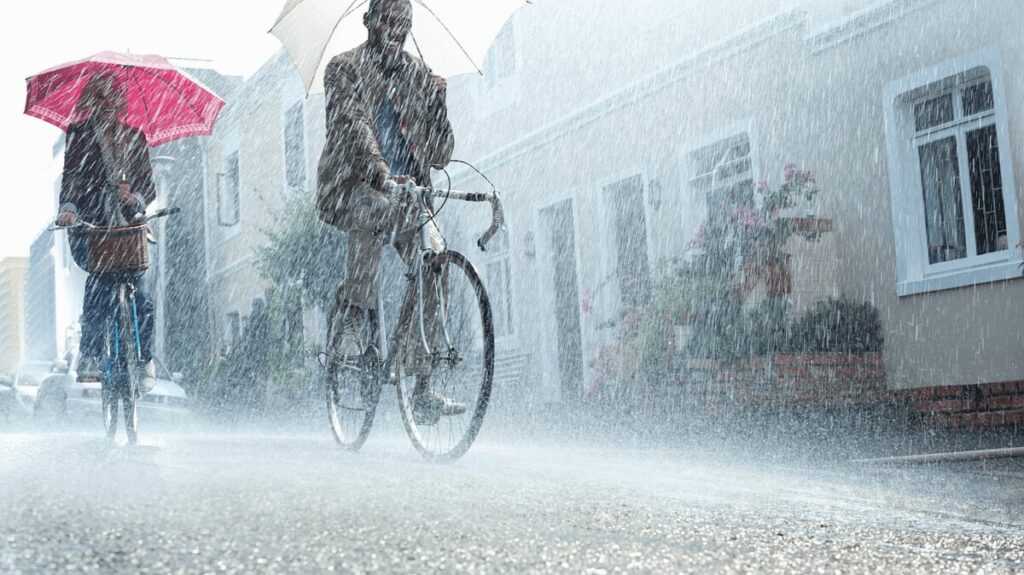
What does ‘chance of precipitation’ really mean? A meteorologist explains.
Understanding weather forecasts can often feel perplexing, especially when it comes to interpreting the “chance of precipitation.” As meteorologist Cyrena Arnold explains, this percentage does not simply indicate the likelihood of rain in a specific area or the intensity of the downpour. For instance, a forecast stating a 30% chance of rain means that if the same weather model were run ten times, rain would be expected in three of those scenarios. This statistic does not account for the duration or severity of the precipitation, which can vary widely. For example, a 100% chance of precipitation could result in a brief, intense thunderstorm or a steady drizzle throughout the day, showcasing the complexity of weather forecasting.
The intricacies of precipitation types further complicate forecasts. All precipitation begins as snow in the atmosphere, influenced by temperature variations at different altitudes. Arnold highlights that forecasting rain is generally more straightforward than predicting sleet or freezing rain, which occur under specific atmospheric conditions. Sleet forms when snowflakes partially melt and then refreeze before hitting the ground, while freezing rain starts as snow, melts in warmer air, and then freezes upon contact with colder surfaces, creating hazardous conditions. These nuanced interactions make forecasting freezing rain particularly challenging, as even slight temperature changes can drastically alter the expected outcome.
When considering the accuracy of weather forecasts, it’s essential to recognize that predictions are more reliable closer to the event. Arnold likens this to observing a distant swirl of dust on a dirt road; as it approaches, the details become clearer. While meteorologists can provide good forecasts for temperature trends weeks in advance, the specifics of precipitation are best understood in the short term. This complexity underscores the advanced mathematics and physics involved in meteorology, reminding us of the skill and expertise required to predict the weather accurately. So, the next time you check the forecast, remember that behind those percentages lies a world of intricate atmospheric dynamics.
Understanding the
weather
forecast can sometimes feel like reading tea leaves. Do I need a heavier coat? Should we move our plans inside because of
rain
? Will it be safe to drive?
With at least
nine types of precipitation
and constantly changing dynamics in the atmosphere, predicting the chance of precipitation can be a particular challenge for both civilians and meteorologists alike. But it’s not impossible.
What does ‘chance of precipitation’ really mean?
Precipitation is simply when
water falls down to Earth’s surface
as part of the natural water cycle. Precipitation can take several forms, including rain, snow, ice, and sleet and is forecast using satellite data and mathematical formulas.
When it comes to looking at the chance of precipitation in the forecast, it helps to first understand what chance of precipitation
isn’t
, says
meteorologist Cyrena Arnold
.
“If it says 30 percent, it doesn’t necessarily mean that it’s going to rain for 30 percent of the area,” Arnold tells
Popular Science
. “It also doesn’t have an indication of how heavy the rain will be. It’s not like 30 percent necessarily means light rain and 100 percent is heavy rain.”
There are several different types of forecasting models meteorologists use to predict weather, including the Global Forecast System (GFS), European Centre for Medium-Range Weather Forecasts (ECMWF), and more regional models including North American Mesoscale (NAM). They all use satellite data and mathematical formulas to track weather fronts and predict when and where precipitation might occur. Seeing a 30 percent chance of precipitation in your weather app means if meteorologists run the same
weather forecasting model
10 times with some slightly different variables, precipitation will show up in three out of the 10 model runs.
“You also do have to remember that if it says, there’s a 30 percent chance of rain, that means there’s a 70 percent chance that it won’t,” Arnold explains.
The chance of precipitation also doesn’t predict how long the rain will last, how much will fall, or how intense it will be. For example, the forecast could say that there is a 100 percent chance of precipitation, but that could mean it will be in a squall line thunderstorm where it
rains incredibly hard
for only 15 minutes in a given area, or a steady drizzle that lasts all day.
“A percentage has absolutely zero indication of how long that rain is going to last, how severe is that rain,” says Arnold.
Related Weather Stories
Why 60 degrees in fall feels different than in the spring
Lightning can kill you even if it’s sunny
What is a heat dome?
What is dew point? A meteorologist explains that sticky air.
Does the type of precipitation impact the forecast?
Generally speaking, all forms of precipitation start out as
snow
because our atmosphere is so much colder than the ground.
“It doesn’t matter if it’s summer in New York City [rain] is starting [as] snow,” says Arnold.
Regardless of how high or low a cloud is, clouds are always colder than the ground temperature. “If your cloud bases are at 10,000 feet, the temperature will drop 50 degrees. So, if it’s 80 [degrees Fahrenheit] down here, it’s 30 up there.”
Those variations in atmospheric temperature make forecasting rain easier than forecasting sleet, freezing rain, or, in some cases, snow.
“If it’s cold up there and it’s cold down here, we know that it’s going to be snow,” says Arnold. “Where things get really interesting is in this middle area when you look at sleet and freezing rain.”
Sleet occurs when snowflakes partially melt as they fall through a shallow layer of warm air
. Those slushy drops refreeze as they go through a deep layer of freezing air above the surface, and will eventually reach the ground as frozen rain drops that bounce.
Image: National Weather Service.
By comparison, freezing rain does not fall as an icy pellet, and freezes upon impact with a surface. It begins as snow, but when the water drop falls through a warmer and more shallow pocket of air, it
melts and changes it from a solid to a liquid
. The water drop will then expand and freeze if it hits a deeper and colder air pocket and if the ground’s temperature is below freezing. The result is an icy layer that is dangerous for drivers, pedestrians, and
snow shovelers
alike.
Forecasting these icy weather events “is incredibly difficult and incredibly nuanced, especially the freezing rain,” Arnold says.
With all of that interaction between warm air, cold air, deeper air pockets, and shallow air pockets, the freezing rain forecast can change on a dime.
“If you have one of these variables move slightly by a couple degrees, you have a completely different situation. It’s just a very volatile forecast,” says Arnold.
Trying to predict freezing rain is especially important since this kind of precipitation can be very dangerous, bringing down tree limbs, power lines, and increasing car accidents. Even a
0.01 inch of freezing rain and ice
is enough for walking and driving to be unsafe.
“Sleet isn’t so bad because it’s not as catastrophic, and you just need a deeper pool of cold air at the surface to allow that drop to to be snowflake, melt into a water drop, and then freeze again,” says Arnold. “If it’s a deep cold, it will freeze again and fall with a little ice pellet.”
When is the weather forecast most accurate?
While we all would love to know exactly what the weather is going to be during our beach vacation, those
10-day forecasts
are not always the best to follow. The closer you are to the timeframe, the better the information.
Arnold explains that one way to understand forecasting is to imagine that you are driving down a long dirt road that stretches for miles. You then notice a swirl of dust, so you know that there is something on the road, but don’t know if it’s a car, a truck, a horse, or something else entirely.
“As it gets closer, the picture gets clearer and clearer. You see that it’s blue, which you didn’t know before,” says Arnold. “As it gets closer, you can see if it’s a car or truck and eventually you can see the make and model of the vehicle.”
Unfortunately, there is no perfect threshold for knowing when the forecast will be the most accurate. The best guidance is that the closer we get, the better we know what the weather will look like.
What meteorologists do know farther in advance are temperature patterns. “There are very good forecasts one to two weeks out that help us understand if temperatures are going to be above or below normal,” says Arnold. “We’re very good at that.”
And remember,
meteorology is very difficult
. It combines extremely high-level math and physics that most of us can’t even compute with constantly shifting variables. So please be nice to your local meteorologist.
In
Ask Us Anything
, Popular Science answers your most outlandish, mind-burning questions, from the everyday things you’ve always wondered to the bizarre things you never thought to ask. Have something you’ve always wanted to know?
Ask us
.
The post
What does ‘chance of precipitation’ really mean? A meteorologist explains.
appeared first on
Popular Science
.


