The Slow Death of the Prestige Thriller
**Exploring the Duality of Parenting in “All Her Fault”**
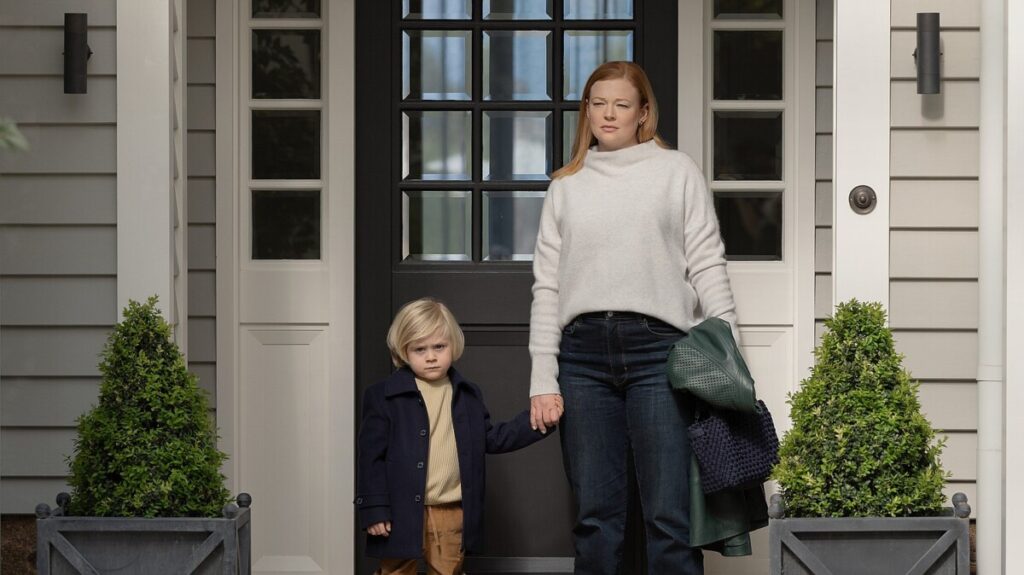
The new series “All Her Fault,” featuring Sarah Snook from HBO’s “Succession,” presents a gripping dual narrative that intertwines the melodrama of a thriller with the sobering realities of modern parenting. The show kicks off with a chilling premise: Marissa, played by Snook, arrives to pick up her son Milo from a playdate, only to discover that the house is empty and no one knows who he is. This sets the stage for a suspenseful exploration of community dynamics and emotional turmoil, as parents grapple with the implications of a child’s disappearance in their affluent Chicago suburb. The series, based on a novel by Irish author Andrea Mara, initially captivates viewers with its intense storyline, diving headfirst into an environment rife with suspicion and fear.
However, the brilliance of “All Her Fault” lies not just in its thrilling narrative but also in its nuanced portrayal of parenting. As Marissa navigates the chaos of her son’s disappearance, the show delves into the everyday struggles of working mothers. It highlights the societal pressures they face, such as the judgment from stay-at-home moms when a nanny becomes a suspect, and the guilt that accompanies balancing career and family life. The character of Jenny, played by Dakota Fanning, further exemplifies this struggle, as she juggles her professional aspirations with the demands of motherhood. This duality is enriched by the inclusion of Jim Alcaras, the lead investigator portrayed by Michael Peña, who also grapples with the challenges of parenting a nonverbal son. His character’s insights into parental love provide a broader context to the unfolding drama, elevating the narrative beyond mere thriller tropes.
Despite its strong start, “All Her Fault” struggles to maintain its momentum as the series progresses. Critics note that while the show begins with a fresh perspective on the complexities of motherhood, it eventually succumbs to the predictable conventions of the thriller genre. The reliance on red herrings and melodramatic twists detracts from the emotional depth established in the earlier episodes. Additionally, the heavy-handed musical score during pivotal moments feels out of sync with the show’s initial realism, leaving viewers yearning for the authenticity that characterized its opening. This inconsistency raises questions about the current state of television, particularly regarding the industry’s tendency to lean on formulaic adaptations rather than original storytelling. While “All Her Fault” offers glimpses of brilliance and insightful commentary on women’s lives, it ultimately reflects a broader trend in television that prioritizes marketability over innovation.
All Her Fault
contains two dramas. One—melodramatic, Hitchcockian at its best, Lifetime-hacky at its worst—follows all the most generic beats of the airport thriller, starting when Marissa (played by
Succession
’s Sarah Snook
) arrives to pick up her son, Milo, from a playdate at a house where, somehow, no children live and no one has ever heard of him. The other—sensitive, almost documentary-realist about the dynamics of modern parenting—deals with the fallout, as a community struggles to confront how such a nightmarish failure of safeguarding could have happened. The two modes of the show intersect only briefly, in the show’s terrific opening scene, as Snook’s eyes begin to dart with mounting panic that she’s trying frantically to rationalize in the presence of a stranger. But for the rest of the series they diverge, leaving us stuck inside a mostly hokey story that has flashes of brilliance, or at least of sharp insight into the tensions and fault lines of working motherhood.
I’ve rarely felt more frustrated with television than I have this year, watching hour after hour of
humdrum wealth porn
, self-indulgent maximalism, and turgid aimlessness.
All Her Fault
, initially, seemed to fall into the first category—it’s based on a crime novel by the Irish writer Andrea Mara, it’s set in an affluent suburb of Chicago (the series was filmed in Australia), and its trailer teases lies, dead bodies, and a minefield of familial conflict. So the first few episodes were a pleasant surprise: Without preamble, Milo is suddenly missing, which throws us headfirst into a charged environment of suspicion and terror. But, around the edges of the story, Megan Gallagher (who created the show and wrote five of its eight episodes) fleshes out other nuances. Marissa’s husband, Peter (Jake Lacy), relies on his wife to answer basic questions about their son during a police interview; Jenny (Dakota Fanning), the mother of a boy in Milo’s class, has to leave an important work meeting when her husband can’t manage bedtime on his own. The second episode flashes back to the weeks after Marissa and Peter bring a newborn Milo home; Marissa frantically Googles sleep routines and swaddling techniques while Peter serenely assures her that he’ll do anything she asks him to do to help. (The look she gives him in return is so murderous, it almost burned a hole in my screen.)
[
Read: Money is ruining television
]
Pausing the episode to fill in a Google doc with an assigned code word for someone to use if they have to pick up my kids from school without prior authorization, I felt uncannily immersed in the plot—the WhatsApp groups, the ever tenser requests from PTA reps for volunteers (somehow delivered in a sonic register only women can hear), the guilt, the extreme frustration. One of the suspects in Milo’s disappearance is, immediately, a nanny, leading the stay-at-home moms to judge the working moms for leaving their kids with strangers; meanwhile, to be a working father in the world’s imagination, the show slyly points out, is to glide like a swan away from blame and self-reproach. Still,
All Her Fault
goes beyond the novel in thoughtful ways by considering the lead investigator on Milo’s case, Jim Alcaras (Michael Peña), who
does
struggle to balance his work with the needs of his nonverbal 13-year-old son, and whose insight into what people would do out of profound love for their children enhances his understanding of the case. Without Alcaras,
All her Fault
would be yet another televisual excavation of wealthy white pain, but the shared resonances between his character and Marissa help broaden the show’s vision.
Snook is fantastic as Marissa, delivering complicated anguish in a series of chunky knits. Fanning’s Jenny, trying to secure a new whale of a client for her publishing company while her feckless husband perpetually clocks out of activities with their son, is also compelling to watch, particularly when Jenny and Marissa find ways to bolster each other. Nevertheless,
All Her Fault
starts floundering midway through and never quite finds its footing again. The problem, it seems clear, is the source material, and the mandates it sets out. The show can color outside the lines of the thriller format, but it can’t transcend them altogether—the red herrings have to be carelessly dropped, the mind-boggling twists revealed. Nor does it really lean away from stylistic convention: Whether by directorial choice or by imposition, the most pivotal scenes in the series are accompanied by a score so sonorous and heavy-handed that it evokes a
Murder She Wrote
rerun, not a glossy mystery for one of the most ambitious actors currently working. None of these choices is outright awful, but they are jarring when juxtaposed with the verisimilitude and emotional realism of the early episodes.
Maybe
All Her Fault
is a sign of an industry in retrenchment, relying on formulaic adaptations rather than original concepts because they’re demonstrably easy and popular. Maybe this is the best we can hope for at the moment—an expanse of blah, studded with a few exceptions. Top-tier television used to entice movie stars with the promise of meaty roles and superlative writing; 2025 television enlists battalions of Oscar winners by waving around a script based on a mid-tier best seller and the prospect of a couple of months on location in Nantucket. I’m grateful for the producers—Reese Witherspoon and Nicole Kidman among them—who’ve seen untapped potential in books that would allow them to tell
textured stories about women’s lives
. But TV has become overly reliant on adapting lurid, pulpy paperbacks, the resulting shows associated with prestige only because their stories were once printed out. (Netflix is particularly implicated here—consider, if you can bear it, the body-switching infidelity thriller
Behind Her Eyes
, or anything in its Harlan Coben collection.) Viewers, meanwhile, get artless plots with familiar faces in glamorous locations that offered decent tax incentives. It could be better; it could be worse—but it’ll keep you watching, which is apparently all that really counts.


