Speaker Johnson’s choice to lead by following the president goes against 200 years of House speakers building up the office’s power
In recent times, the role of the Speaker of the House has evolved significantly from its original intent, with current Speaker Mike Johnson exemplifying this shift. The framers of the U.S. Constitution envisioned the House of Representatives as a powerful legislative body, with the speaker acting as a nonpartisan moderator. However, over the years, this ideal has transformed into a position heavily influenced by party politics. Johnson, a Republican from Louisiana, has aligned himself closely with former President Donald Trump, prioritizing party loyalty over the foundational responsibilities of Congress. This shift raises questions about the balance of power within the government and the effectiveness of Congress in fulfilling its constitutional duties.
Historically, the speaker’s role has seen a centralization of power, particularly since the early 20th century. Figures such as Joseph Cannon and Newt Gingrich expanded the speaker’s influence, allowing them to control legislative processes and party dynamics. This centralization was partly a response to the complexities of governing a growing nation. While strong speakers like Sam Rayburn and Nancy Pelosi have successfully passed significant legislation, the current political climate presents unique challenges. Johnson’s recent decision to keep Congress out of session for eight weeks during a government shutdown illustrates the tension between party allegiance and the responsibilities of Congress, limiting the chamber’s ability to perform essential functions such as oversight and policy debate.
As Johnson navigates his role, he faces the dual challenge of addressing pressing national issues while managing a party that remains deeply tied to Trump’s influence. The implications of his leadership style are profound; by prioritizing party over the legislative process, the House risks diminishing its own power and effectiveness. The future of Congress may depend on whether Johnson can reconcile these competing demands, ensuring that the institution remains a robust representative of the people’s interests rather than a mere extension of partisan politics. As the political landscape continues to evolve, the role of the speaker will undoubtedly remain a focal point in the ongoing dialogue about governance and accountability in the United States.
https://www.youtube.com/watch?v=GwDpY6g5h-Y
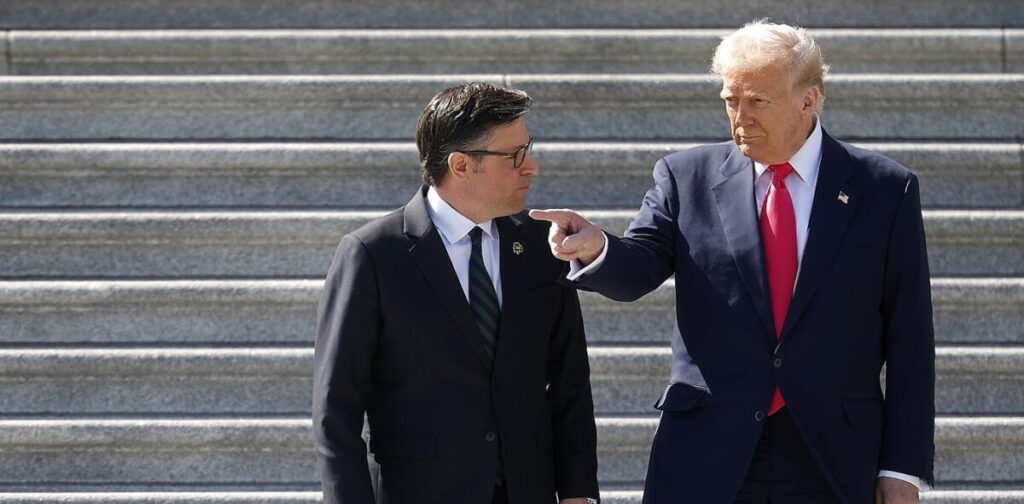
House Speaker Mike Johnson has given a lot of effort to pushing the agenda of President Donald Trump.
Kevin Dietsch/Getty Images
When the
framers of what became the U.S. Constitution
set out to draft the rules of our government on a hot, humid day in the summer of 1787, debates over details raged on.
But one thing the men agreed on was the power of a new, representative legislative branch. Article I – the first one, after all –
details the awesome responsibilities of the House of Representatives and the Senate
: power to levy taxes, fund the government, declare war, impeach justices and presidents, and approve treaties, among many, many others.
In comparison,
Article II
, detailing the responsibilities of the president, and
Article III
, detailing the Supreme Court, are rather brief – further deferring to the preferred branch, Congress, for actual policymaking.
At the helm of this new legislative centerpiece, there was only one leadership requirement: The House of Representatives
must select
a speaker of the House.
The position, modeled after parliamentary leaders in the British House of Commons, was
meant to act
as a nonpartisan moderator and referee.
The framers famously disliked political parties
, and they knew the importance of building coalitions to solve the young nation’s vast policy problems.
But this idealistic vision for leadership quickly dissolved.
The current
speaker of the House, Mike Johnson
, a Republican from Louisiana, holds a position that has strayed dramatically from this nonpartisan vision. Today, the leadership role is far more than legislative manager – it is a powerful, party-centric position that controls nearly every aspect of House activity.
And while most speakers have used their tenure to strengthen the position and the power of Congress as a whole, Johnson’s choice to
lead by following President Donald Trump
drifts the position even further from the framers’ vision of congressional primacy.
The opening of the second session of the 59th Congress in 1906, with Speaker Joseph Cannon presiding.
Artist Frances Benjamin Johnston, Photo by Heritage Art/Heritage Images via Getty Images
Centralizing power
By the early 1800s, Speaker of the House Henry Clay, first elected speaker in 1810 as a member of the Whig Party, used the position to
pursue personal policy goals
, most notably entry into the War of 1812 against Great Britain.
Speaker Thomas Reed continued this trend by
enacting powerful procedures
in 1890 that allowed his Republican majority party to steamroll opposition in the legislative process.
In 1899, Speaker David Henderson
created a Republican “cabinet”
of new chamber positions that directly answered to – and owed their newly elevated positions to – him.
In the 20th century, in an attempt to further control the legislation Congress considered, reformers solidified the speaker’s power over procedure and party.
Speaker Joseph Cannon
, a Republican who ascended to the position in 1903,
commandeered the powerful Rules Committee
, which allowed speakers to control not only which legislation received a vote but even the amending and voting process.
At the other end of the 20th century was an effort to retool the position into a fully partisan role. After being elected speaker in 1995, Republican Newt Gingrich expanded the responsibilities of the office beyond handling legislation by
centralizing resources in the office of the speaker
. Gingrich grew the size of leadership staff – and prevented policy caucuses from hiring their own. He controlled the flow of information from committee chairs to rank-and-file members, and
even directed
access to congressional activity by C-SPAN, the public service broadcaster that provides coverage of Congress.
As a result, the modern speaker of the House now plays a powerful role in the development and passage of legislation – a dynamic that scholars refer to as the
“centralization” of Congress
.
Part of this is out of necessity:
The House in particular, with 435 members
, requires someone to, well, lead. And as America has grown in population, economic power and the size of government, the policy problems Congress tackles have become more complex, making this job all the more important.
But the position that began as coalition-building has evolved into controlling the floor schedule and
flow of information
and coordinating and commandeering committee work.
My work on Congress
has also documented how leaders invoke their power to dictate
constituent communication
for members of their party and use
campaign finance donations
to bolster party loyalty.
This centralization has cemented the responsibilities of the speaker within the chamber. More importantly, it has elevated the speaker to a national party figure.
Major legislation passed
Some successful leaders have been able to translate these advantages to pass major party priorities: Speaker Sam Rayburn, a Democrat from Texas, began his tenure in 1940 and was the
longest-serving speaker of the House
, ultimately working with eight different presidents.
Under Rayburn’s leadership, Congress passed incredible projects, including the
Marshall Plan
to fund recovery and reconstruction in postwar Western Europe, and legislation to develop and construct the
Interstate Highway System
.
In the modern era, Speaker Nancy Pelosi, a Democrat and the
first and only female speaker
, began her tenure in 2007 and held together a diverse Democratic coalition to
pass the Affordable Care Act into law
.
But as the role of speaker has become one of proactive party leader, rather than passive chamber manager, not all speakers have been able to keep their party happy.
Republican Minority Leader Joseph William Martin Jr., left, and Democratic Speaker of the House Sam Rayburn confer on the House rostrum in January 1956.
PhotoQuest/Getty Images
Protecting Congress’ power
John Boehner, a Republican who became speaker in 2011
, was known for his procedural expertise and diplomatic skills. But he ultimately resigned after he relied on a bipartisan coalition to end a government shutdown in 2014 and
avert financial crises
, causing his support among his party to plummet.
Speaker Kevin McCarthy was ousted in 2023
from the position by his own Republican Party after working with Democratic members to
fund the government
and maintain Congress’ power of the purse.
Although these decisions angered the party, they symbolized the enduring nature of the position’s intention: the protector of Article I powers. Speakers have used their growing array of policy acumen, procedural advantages and congressional resources to navigate the chamber through immense policy challenges, reinforcing Article I responsibilities – from levying taxes to reforming major programs that affect every American – that other branches simply could not ignore.
In short, a strengthened party leader has often strengthened Congress as a whole.
Although Johnson, the current speaker, inherited one of the most well-resourced speaker offices in U.S. history, he faces a dilemma in his position: solving enormous national policy challenges while managing an unruly party bound by loyalty to a leader outside of the chamber.
Johnson’s recent decision to keep Congress
out of session
for eight weeks during the entirety of the government shutdown indicates a balance of deference tilted toward party over the responsibilities of a powerful Congress.
This eight-week absence severely weakened the chamber. Not being in session meant no committee meetings, and thus, no oversight; no appropriations bills passed, and thus, more deference to executive-branch funding decisions; and no policy debates or formal declarations of war, and thus, domestic and foreign policy alike being determined by unelected bureaucrats and appointed judges.
Unfortunately for frustrated House members and their constituents, beyond new leadership, there is little recourse.
While the gradual, powerful concentration of authority has made the speaker’s office more responsive to party and national demands alike, it has also left the chamber dependent on the speaker to safeguard the power of the People’s House.
SoRelle Wyckoff Gaynor does not work for, consult, own shares in or receive funding from any company or organization that would benefit from this article, and has disclosed no relevant affiliations beyond their academic appointment.


