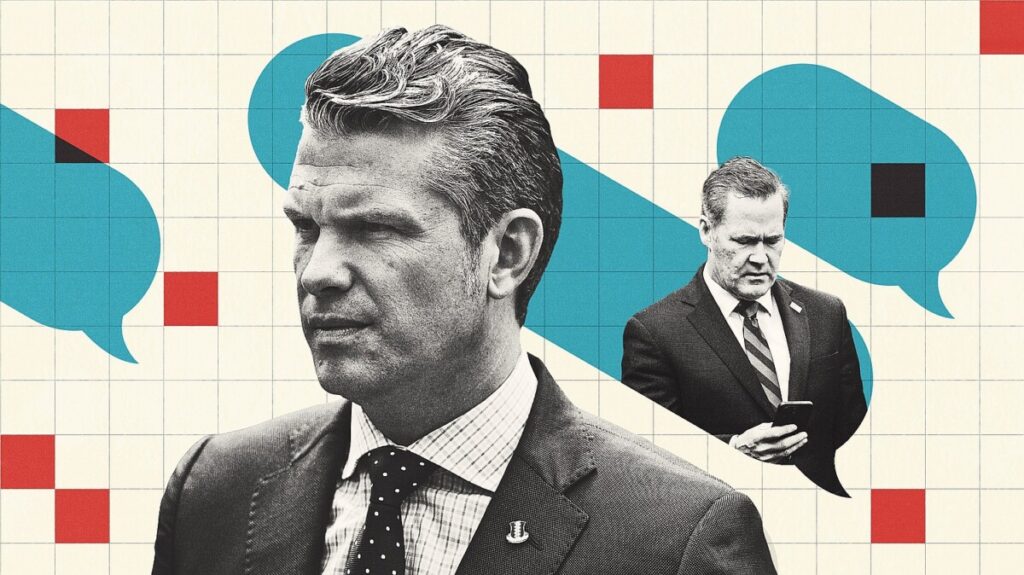
Pentagon Report: Hegseth Risked Endangering Troops With Signal Messages
In a significant security breach involving the Trump administration, a report by the Pentagon’s inspector general has revealed that Defense Secretary Pete Hegseth shared sensitive military information in a Signal chat, potentially compromising U.S. operations in Yemen. This chat, which inadvertently included The Atlantic’s editor in chief, Jeffrey Goldberg, contained details about U.S. airstrike timings that are typically reserved for secure communication channels. The inspector general’s findings confirm that while the mission was not ultimately jeopardized, Hegseth’s actions violated Pentagon policies prohibiting the use of unapproved platforms for classified information. The report, set to be published soon, underscores the risks posed by such breaches, especially if adversaries like Houthi militants had intercepted the information, which could have led to disastrous consequences for U.S. personnel.
Senator Mark Kelly, a member of the Armed Services Committee, emphasized that the report clearly stated Hegseth should not have used a cellphone to transmit classified information via an unclassified system. Despite the administration’s initial claims that the information shared was not classified, the report indicates otherwise, revealing that U.S. Central Command had classified the airstrike details as secret. Hegseth, who had the authority to declassify information, has not publicly clarified why he deemed it necessary to share such sensitive operational details in a casual chat that included emojis and informal language. The incident has raised concerns among military personnel about a perceived double standard in accountability, where senior officials may evade repercussions for actions that would lead to severe consequences for lower-ranking members of the military.
This breach, dubbed “Signalgate,” has not only drawn ire from critics but has also highlighted ongoing management issues within the Trump administration, particularly under Hegseth’s leadership. His tenure has been marked by internal conflicts and a focus on personnel matters over strategic military operations. Furthermore, recent reports have emerged suggesting Hegseth may have issued controversial orders during military operations that some legal experts argue could amount to war crimes. Amidst this backdrop, the Signal chat incident has become a focal point for discussions about operational security and the handling of classified information within the highest echelons of government, prompting calls for accountability and further investigations into Hegseth’s conduct. The fallout from this episode illustrates the broader implications of casual communication practices among top officials and the potential risks they pose to national security.
https://www.youtube.com/watch?v=pGoplk-9nAE
This article was featured in the One Story to Read Today newsletter.
Sign up for it here.
For nearly nine months, Trump-administration officials have defended top national-security leaders who shared information in a Signal chat about U.S. strikes in Yemen, first
reported
by
The Atlantic
’s editor in chief, Jeffrey Goldberg, who was inadvertently included in the group. Officials played down the severity of the breach and insisted that the information wasn’t classified.
Now the Pentagon’s top watchdog has concluded that
the information Defense Secretary Pete Hegseth shared in the chat
could have put the mission, U.S. personnel, and national security at risk had it fallen into the wrong hands. The information Hegseth shared
included the precise times
that fighter pilots would attack their targets, the sort of information ordinarily shared only on secure platforms. If Houthi militants had learned those details in advance, they might have been able to shoot down American planes or better defend their positions.
The Defense Department inspector general found that while the mission ultimately was not jeopardized, Hegseth violated his department’s own policies when he used Signal, a commercial messaging app that is not approved for sharing classified information. The IG’s report, scheduled to be published on Thursday, was described to us by numerous U.S. officials familiar with its findings.
Senator Mark Kelly, an Arizona Democrat who sits on the Armed Services Committee, said that the report found Hegseth was in violation of Pentagon regulations. “They very clearly stated he should not be using his cellphone and putting this kind of information on an unclassified system,” he told reporters on Capitol Hill.
The report also found that the information Hegseth shared was classified at the time he received it. (Trump administration officials had tried publicly to argue otherwise.) Battlefield information like what Hegseth shared is routinely classified because of the risk it would pose to U.S. forces were it exposed. U.S. Central Command, which is responsible for military operations in the Middle East, had classified the information about the air strike as secret, according to defense officials who spoke with us on the condition of anonymity.
But the report also found that Hegseth, as the secretary, had the authority to declassify information, Kelly noted. Less clear is why Hegseth thought it was appropriate or necessary to do so. The secretary did not give an interview to the inspector general, according to people familiar with the matter.
“This review affirms what the Administration has said from the beginning — no classified information was leaked, and operational security was not compromised,” said Karoline Leavitt, White House press secretary, in a statement. “President Trump stands by Secretary Hegseth.”
In a post on X late Wednesday, Hegseth declared “total exoneration” and “case closed,” in an apparent reference to the report. He also adopted a common Trump signature of thanking readers for “your attention to this IG report.” He did not address any of the report’s findings.
An attorney for Hegseth did not respond to a request for comment.
The inspector general’s office, led by acting director Steven Stebbins, also noted that Hegseth is hardly the only official to have used the encrypted messaging app.
What is known is that Hegseth’s communications included the precise times that U.S. fighter planes would attack their targets, the sort of information ordinarily shared only on secure platforms. Signal, an open-source encrypted messaging service, is popular with journalists and others who seek more privacy than other text-messaging services are capable of delivering. Current and former government officials have told us that if lower-level employees shared such sensitive information on a commercial platform, they would certainly be fired and possibly be prosecuted.
The inspector general’s conclusions seem likely to create an impression among the military rank and file that there are
two sets of rules
: one for the Defense Department’s presidentially appointed leadership, and one for everyone else.
The inspector general’s findings may also compound the criticism that Hegseth has been facing since he assumed office. Critics—including people within the Trump administration—have complained about his chaotic management, which has been marred by infighting among senior aides, and they say that Hegseth has spent more time focused on personnel issues and
physical-fitness standards
than running the world’s most advanced military. A number of Democrats and at least one Republican have called for him to resign. And now two congressional committees led by Republicans have said that they will investigate a
report
in
The
Washington Post
that Hegseth gave a verbal order to leave no survivors in a September military strike on an alleged drug boat, leading the United States to conduct a follow-up strike that killed two people who survived the initial attack. Some legal experts have said that such an order could be a war crime. During a Cabinet meeting on Tuesday, Hegseth said that he “did not personally see survivors” clinging to the boat after a first strike, and he has denied knowing that a second strike could have hit them.
Signalgate
became a shorthand for ineptitude at the highest reaches of the administration. Foreign allies told us that they felt justified in their earlier
reluctance to share their secrets
with the United States, given President Donald Trump’s long history of mishandling classified information. Interspersed in the chat—along with questions about the wisdom of conducting the Yemen strike and details about weapons packages, targets, and timing—were emoji, exclamation points, acronyms, and several words in all caps. “PATHETIC,” Hegseth wrote to describe Europe’s response to threats to a key shipping lane.
Signal is not approved by the government for sharing classified information, which is normally transmitted over approved, secure government systems. Indeed, inside much of the Pentagon, personnel are not even allowed to bring their cellphones into their office; instead, they have to keep them outside their door in storage lockers.
When officials want to discuss military activity, they customarily go into a specially designed space known as a sensitive compartmented information facility, or SCIF—most Cabinet-level national-security officials have one installed in their home—or they communicate only on approved government equipment.
[
Read: The Trump administration accidentally texted me its war plans
]
The Signal group chat concerning Yemen turned out to be just one of at least a dozen such groups that administration officials had used to conduct government business, former and current officials told us.
The inspector general’s report examined only Hegseth, not other senior officials in the Signal chat whose actions aren’t under the Pentagon’s jurisdiction, including CIA Director John Ratcliffe, Vice President J. D. Vance, and then–National Security Adviser Mike Waltz, now the ambassador to the United Nations. Waltz set up the “Houthi PC small group” chat in the first place and inadvertently added Goldberg. There are no comparable reviews planned for these officials or other members of the chat.
The unprecedented security breach revealed the Trump administration’s casual approach to handling some of the country’s most sensitive information. “We are currently clean on OPSEC,” or operations security, Hegseth wrote in the chat, unaware the group clearly wasn’t.
The story became comedy gold for
late-night
hosts. (
Saturday Night Live
reimagined it as the show’s
cold open
.) Perhaps the fiasco resonated so widely because it was simultaneously so relatable and so reckless. Who hasn’t felt the chagrin of accidentally posting in the wrong group chat or hitting “Reply All” to an office email? And also: The senior-most government leaders in the United States
did
what
with their secret attack plans
?
Hegseth, a former National Guard soldier and Fox News host, has faced other questions about his professional and personal judgment since his nomination last fall. During his confirmation process, he defended himself against allegations of heavy drinking and sexual assault, which he denied. Since taking office, scrutiny has intensified as he has summarily fired scores of senior military officers without cause, focused on personnel issues such as service members’ weight and hair, and departed from precedent by launching sharp partisan attacks.
The Signal chat also revealed disagreement at the highest levels of the administration about the wisdom of the strikes and—more broadly—how the Trump administration should employ the military and when it should leave the world’s problems to others. Trump and members of his administration have emphasized that the attack itself was a success despite the security breach.
In May, the president decided to
stop bombing Houthi targets and declared victory
, even though the group retained significant fighting power and had vowed to keep attacking Israel, which the strikes were originally intended to prevent.
Signalgate generated a rare acknowledgment from Trump
that his administration may have made a mistake
. In a Truth Social post criticizing Goldberg’s prior reporting about him, Trump acknowledged that he was “somewhat more ‘successful’” with the Signal story.
“I think we learned: Maybe don’t use Signal, okay?” Trump said in an interview with
The Atlantic
. “If you want to know the truth. I would frankly tell these people not to use Signal, although it’s been used by a lot of people. But, whatever it is, whoever has it, whoever owns it, I wouldn’t want to use it.”
[
Read: ‘I run the country and the world
]
’
After the strike on the Houthis,
The Atlantic
reported on the existence of the Signal group and broadly described the kind of information that top national-security officials had shared, but at first chose to leave out some of the most sensitive information, including Hegseth’s text about the strike’s timing. Journalists frequently choose to withhold these kinds of details, as well as information about intelligence sources, to strike a balance between legitimate national-security concerns and the public’s need to know about government misconduct.
But after the initial story was published, Trump-administration officials, and the president himself, claimed that the information in the text chain wasn’t classified, stunning national-security experts and defying common sense. Operational information of the sort that Hegseth shared is routinely classified because its exposure could jeopardize a mission and risk the lives of U.S. forces.
Administration officials also accused
The Atlantic
of misrepresenting the information in the Signal chat and exaggerating the severity of the security breach. The magazine then shared the full text of the chat.


