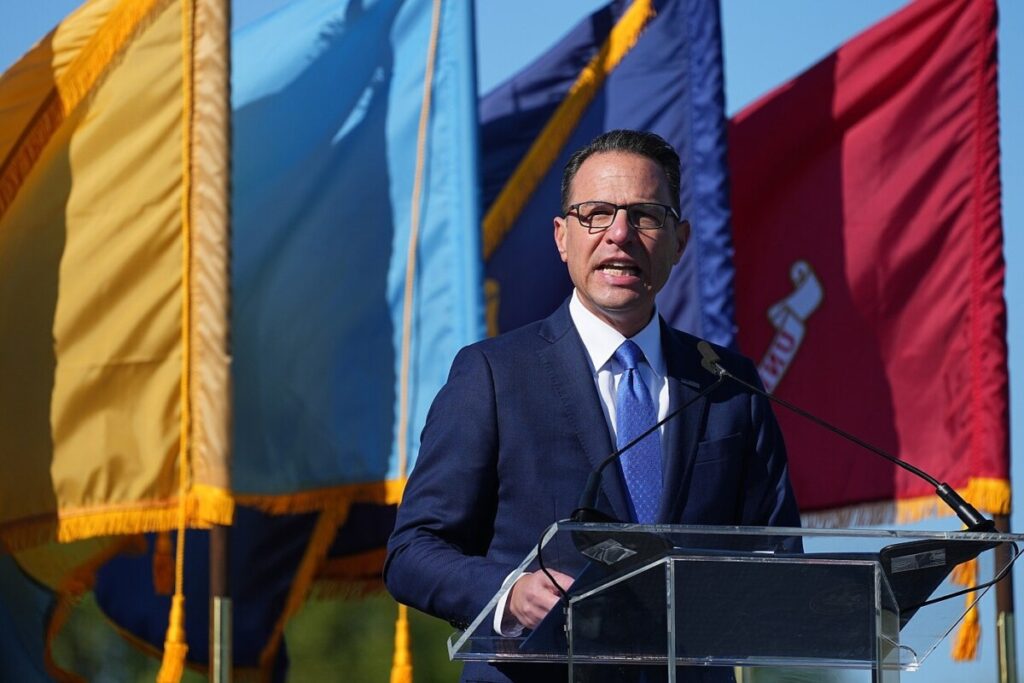
Schoen and Mangel: Could Dems look to Shapiro for 2028?
As California Governor Gavin Newsom solidifies his position as the front-runner for the Democratic presidential nomination in 2028, another contender is emerging: Pennsylvania Governor Josh Shapiro. Following a significant victory on Proposition 50, Newsom boasts a 6-point lead over Vice President Kamala Harris in the latest polling, positioning him as a strong candidate with considerable national recognition. However, Shapiro, despite his lower national profile, presents a compelling case as a potential challenger, particularly due to his success in a pivotal swing state. Having won Pennsylvania three times—as attorney general and governor—Shapiro has demonstrated an ability to appeal to a broad spectrum of voters, including independents and even some Trump supporters, making him a candidate that Democrats cannot afford to overlook.
Shapiro’s political strategy is characterized by a pragmatic centrism that contrasts sharply with the increasingly polarized Democratic primary electorate. His centrist stance, especially regarding Israel, could alienate some progressive voters, yet it also positions him favorably for a general election where moderate swing voters are crucial. Notably, Shapiro’s governance has been marked by tangible achievements, such as securing a $20 billion investment from Amazon and delivering significant funding for education and public safety—all accomplished within a divided government. This record of bipartisan cooperation and effective governance has earned him a 60% approval rating among Pennsylvania voters, suggesting that he could be a formidable candidate against any Republican contender, including a potential matchup against Vice President J.D. Vance, where he leads by 10 points in hypothetical polling.
However, Shapiro faces significant hurdles on his path to the nomination. His centrist approach may not resonate with the far-left factions of the Democratic Party, which have gained substantial influence in recent years. Additionally, his Jewish identity and support for Israel could become contentious issues in a primary where progressive voters prioritize candidates with strong anti-Trump credentials. As the political landscape evolves, Shapiro’s ability to balance his pragmatic governance with the demands of a more ideologically driven electorate will be crucial. Ultimately, while Newsom may currently lead in national polls, Shapiro’s unique strengths and appeal to swing voters could make him a serious contender in the 2028 race, provided he can navigate the complexities of the Democratic primary process.
By virtually every metric, California Gov. Gavin Newsom is the front-runner for Democrats’ 2028 presidential nomination.
Fresh off a high-profile win on Proposition 50, Newsom leads almost all individual polls, giving him a 6-point lead (26% to 20%) over 2
nd
place Kamala Harris in the RealClearPolitics polling
aggregator
.
Nevertheless, there is another governor who could be a formidable challenger atop Democrats’ ticket in 2028: Pennsylvania Gov. Josh Shapiro.
To be sure, Shapiro does not have the national profile that Newsom does. So far, the most national attention he’s received came in the summer of 2024, when Harris was considering him for her running mate.
And yet, lacking a strong national “brand” early on is not fatal in and of itself, as former President Barack Obama knows
In November 2005 – analogous to this point in the 2008 cycle –
polling
showed Hillary Clinton (41%) leading John Edwards (14%) and Al Gore (12%), with Obama not even included.
Still, while a lack of name recognition can be overcome, Shapiro faces a number of hurdles should he decide to run.
He’s doggedly centrist at a time of increasing partisanship.
In that same vein, his support for Israel – to say nothing of his Judaism – is increasingly anathema to the far-left, which makes up a large part of Democrats’ primary electorate.
However, Shapiro does have a number of strengths that others – particularly Newsom – do not, which could make him a strong candidate who Democrats should not overlook.
Foremost is his proven ability to carry Pennsylvania, the most important swing state.
Aptly named, the Keystone State – which Shapiro has won three times as attorney general then governor – holds the keys to the White House for any Democrat, given today’s electoral math.
Moreover, polling among Pennsylvania voters suggests Shapiro would likely win again.
In a hypothetical 2028 matchup, Shapiro beat VP J.D. Vance by 10-points (53% to 43%) – including a 58% to 33% lead with independents – per Quinnipiac
polling
.
President Trump won the state by less than one-half of a percentage point in 2024.
To that end, while Newsom’s advantage in national Democratic polling is clear, Democrats should be clear eyed about the fact that in order to win, they need someone who appeals to moderate swing voters, not solely coastal elites and progressives.
Put another way, as Binyamin Applebaum
posited
in the New York Times, “A cardboard cutout of a presidential candidate could win California…and another 15 deep blue states. The question Democrats need to answer…is what kind of Democrat can win Pennsylvania.”
In his 2020 run for attorney general, Shapiro won
more
votes than both Joe Biden and Donald Trump did that year.
Likewise, in 2022, running for governor, Shapiro not only held onto all of Biden’s 2020 voters, but also brought in Trump voters in key suburban areas,
per
a Pennsylvania political analyst.
Moreover, according to the aforementioned Quinnipiac poll, six-in-10 (60%) Pennsylvania voters – including 66% of Independents – approve of the job Shapiro is doing. Just 28% disapprove.
It’s easy to see why.
Since being elected governor, he’s
secured
a $20 billion investment from Amazon, delivered over $1 billion for farmers along with $500 million for business development, won funding for hiring more than 1,500 police officers, historic funding for K-12 education, and unprecedented permitting reform – all while cutting taxes.
Notably, Shapiro has done all of this and more with a divided government, an impediment Newsom has never had to navigate in the deep-blue confines of Sacramento.
For their part, Republicans understand the threat Shapiro poses.
GOP strategist David Urban
said
over the summer that, “Republicans will try to bang (Shapiro) up.” But, Urban continued, “whoever’s going to run against Josh is going to be pushing a big rock up the hill.”
Behind Shapiro’s enduring popularity is his prioritization of delivering tangible wins for constituents, rather than endlessly appealing to “vibes” or spending considerable time waging partisan warfare.
Describing his time in office, the Pittsburgh Post-Gazette
said
, “Mr. Shapiro, who has built a reputation of working across party lines, has remained popular while emphasizing a mantra of ‘Get (expletive) done.’” No wonder his official
motto
is “G-S-D.”
Politically, Shapiro’s pragmatic centrism is both a benefit and an obstacle.
It would certainly help in a general election.
Conversely, it would be an obstacle with a primary electorate increasingly dominated by the far-left.
Further complicating matters is that while Shapiro often sparred with Trump during his first term – as attorney general – he has taken a much softer approach as governor.
Similarly, during the height of the redistricting fight over the summer, Shapiro made no effort to redraw Pennsylvania’s maps.
Most of this was due to political realities – the state legislature is GOP-controlled – but with Democratic voters prioritizing candidates with strong anti-Trump bona fides, Shapiro’s head-down approach may hurt him in the primaries.
Finally, Shapiro’s biggest vulnerability in a Democratic primary is the elephant in the room that many, including the
New York Times
,
Van Jones
,
USA Today
,
NBC
, and
others
, attribute to the reason he was passed over for Harris’ VP slot – his Judaism and support for Israel.
This has had a real world impact on Shapiro.
When, last April, someone threw Molotov cocktails into the governor’s residence – where Shapiro and his family had just finished their Passover dinner – the attacker
stated
that he targeted Shapiro due to his support for Israel.
Ultimately, assuming Democrats’ goal is to win the 2028 election and not merely placate their progressive base, Shapiro is the sort of candidate who could pose a genuine and formidable threat to Vance or any other Republican.
That being said, he would have to make it to a general election first.
As long as the far-left remains the most potent force in Democratic primaries, his support for Israel and centrist beliefs present considerable obstacles, despite his credentials or ability to win critical swing voters.
Douglas Schoen is a longtime Democratic political consultant. Saul Mangel is a vice president with Schoen Cooperman Research.


